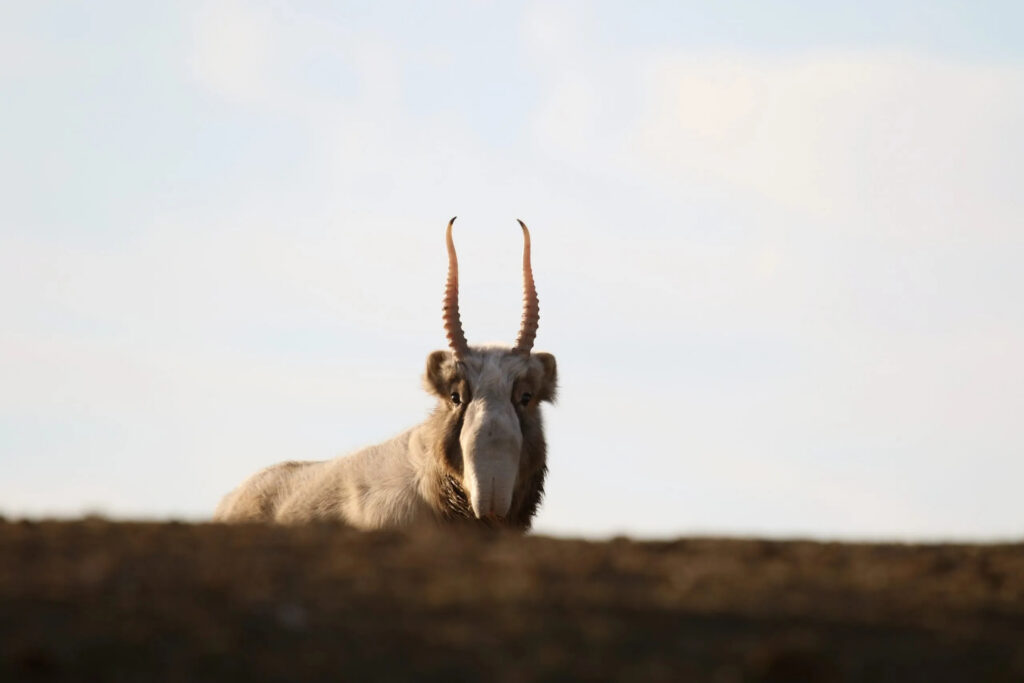
The rugged expanses of the western Kazakhstani steppe present a landscape where boundaries blur and ancient rhythms persist. Skidding off primary tarmac and onto a web of tire-track paths, conservation teams navigate a terrain that has seen millennia of change. Flanking these dirt trails are parallel animal tracks, crisscrossing a stark horizon where howling Siberian winds push ghost-like formations across the plains. Through binoculars, observers witness a prehistoric tableau: hundreds of nomadic saiga antelope piercing the frigid air with ringed horns, their distinctive, bulbous snouts filtering the harsh winter winds as they sprint across the treeless expanse.
Described by field researchers as inherently freedom-loving, the saiga antelope is a survivor of a bygone geological epoch. These migratory ungulates once shared a landscape dominated by woolly mammoths, saber-toothed cats, and giant deer sporting twelve-foot antlers, ultimately outliving them all. When early human caravans first navigated this unforgiving geography, migrating saiga herds frequently served as natural guides, charting viable paths across the vast Central Asian interior. Today, organizations such as the Association for the Conservation of Biodiversity of Kazakhstan (ACBK) monitor these resilient mammals to ensure their survival against modern fragmentation.
Field Audits and the Critical Rutting Season
Timing is crucial for wildlife monitoring on the steppe. Field audits by ACBK researchers—such as conservationists Alexandr and Albert, who boast a combined quarter-century of tracking experience—are deliberately scheduled to coincide with the saiga rutting season. This critical annual period involves massive gatherings where antelope form single-file lines before engaging in competitive displays and mating rituals.
For males, the rut is a period of intense physical exertion. Dominance is established through headbutting and aggressive strutting, often demanding so much energy that many males forego feeding entirely, occasionally succumbing to exhaustion. Females, meanwhile, assess potential mates based on physical fitness and a prominent, highly specialized trait: the saiga’s elongated, floppy nose. This nasal structure is essential for warming sub-zero winter air before it reaches the lungs and filtering out dust during arid summer months. Consequently, a larger snout serves as a primary indicator of male virility, prompting competing bucks to accentuate their physical features during annual congregations.
The open, treeless nature of the steppe historically made saigas prime subjects for wildlife tracking. While early conservationists spent weeks searching the boundless landscape for herds, modern GPS telemetry has transformed monitoring efforts. Today, satellite collars provide a reliable, uninterrupted stream of movement data, allowing researchers to accurately map migration corridors and designate protected wildlife sanctuaries based on empirical evidence.
Historical Context and the Nomadic Legacy
The human history of this region is inextricably linked to the movement of animals. Since the Early Iron Age, a powerful tradition of nomadism has defined the Eurasian steppe. The etymology of the word "Kazakh" is widely believed to originate from the Turkic term qaz, meaning "wanderer" or "vagabond." For millennia, pastoral communities migrated seasonally to higher altitudes during hot summer months for water and grazing, returning to sheltered valleys before the onset of winter gales.
These historical transit corridors formed the scaffolding for portions of the legendary Silk Road. Rather than a single fixed route, the Silk Road functioned as an evolving network of pathways connecting reliable stopovers, water sources, and pastures. The fertile banks of the Ural River in western Kazakhstan became a vital transcontinental crossroads, a geographic demarcation line where Europe meets Asia. Strategic settlements along the Caspian basin provided weary voyagers with rest stops, public baths, and trading hubs.
Throughout successive eras—from Turkic tribal confederations and the conquests of Genghis Khan to incorporation within the Russian Empire—traditional nomadic practices endured. However, the twentieth century brought profound systemic disruption. Under the Soviet Union, mandatory sedentarization policies forced mobile populations into permanent agricultural settlements, effectively halting migrations that had persisted for millennia.
This transformation was officially framed as modernization, yet it clashed fundamentally with ecological realities. Much of the steppe soil proved entirely unsuitable for intensive crop cultivation, which was the primary reason human and animal populations had remained nomadic. Ecologically and historically, sedentarization severed human communities from a lifestyle attuned to natural cycles, a vulnerability that now threatens remaining migratory wildlife populations.
Infrastructure Expansion and Migratory Fragmentation
While human nomadism was largely curtailed, saiga migrations continued, placing the animals on a collision course with twentieth and twenty-first-century infrastructure. The rapid expansion of railways, paved highways, and industrial development has systematically fragmented the Eurasian steppe, dividing once-contiguous saiga populations into isolated herds.
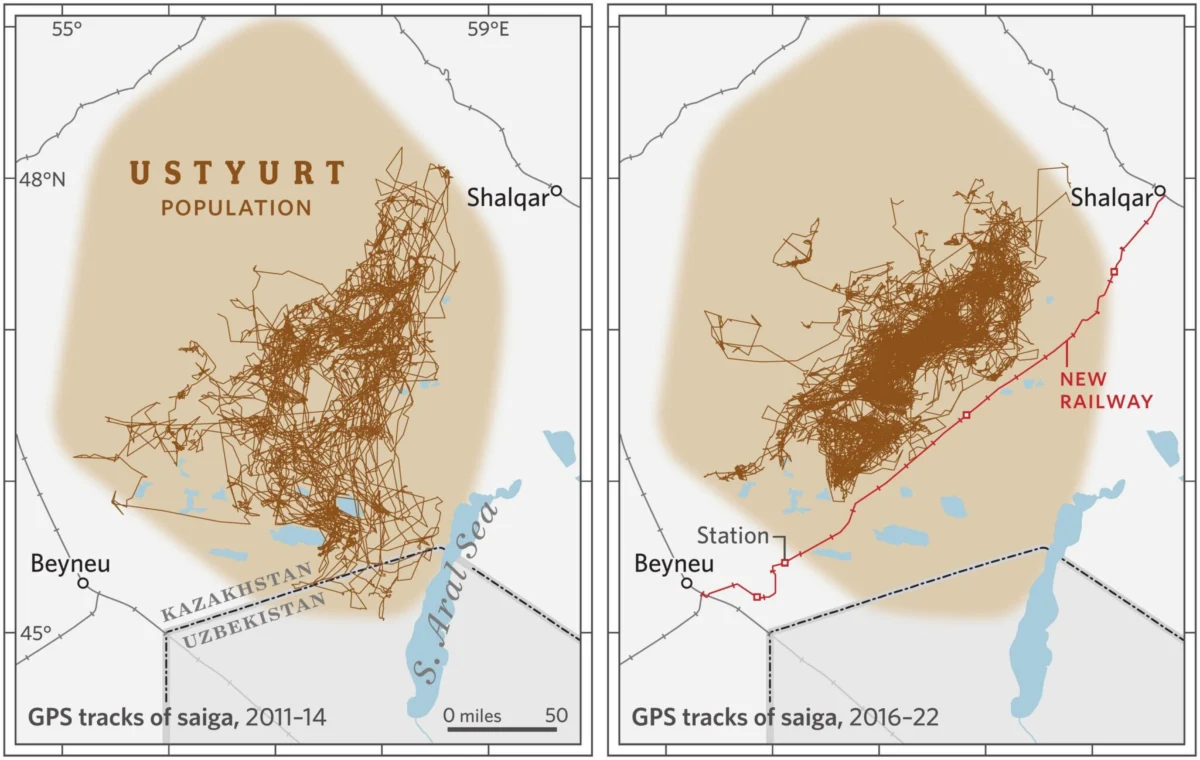
Tracking data reveals the devastating impact of linear infrastructure on wildlife behavior. Historical maps compiled by ACBK researchers illustrate how GPS-collared saigas routinely migrated deep into Uzbekistan until the construction of a major railway line in 2014 abruptly severed their traditional route. Pre-construction data shows dense clusters of movement data crossing the border freely; post-construction data depicts the same animals turning back despondently at the tracks while vital seasonal grazing grounds and water sources wither on the opposite side.
This disruption triggers a collapse in spatial knowledge. Much like human nomads forced into permanent settlements lost the generational geography of their ancestors, young saigas learn migration routes, water sources, and hazard avoidance through active social participation and observation. When migration corridors are physically blocked, entire stretches of ecological knowledge fade from memory, threatening the long-term viability of the species.
Conservation Strategies and Cross-Border Collaboration
To mitigate infrastructural damage, conservation groups and government agencies are implementing targeted engineering solutions. ACBK has partnered with Kazakh authorities to construct dozens of saiga-friendly crossings. These structures feature gently sloping earthen ramps designed to match the height of railway lines, creating the visual illusion of a natural gap in the barrier. Additionally, strategic placement of cattle-guard fencing far from the tracks prevents direct collisions between locomotives and animals, preserving the safety of the corridor.
International cooperation is also expanding. In neighboring Uzbekistan, conservationists have collaborated to redesign border barriers, replacing solid barbed-wire walls with X-shaped barricades. These structures successfully block vehicular traffic while leaving sufficient clearance for saigas to traverse international borders. Conservation biologists remain optimistic that these cumulative interventions will gradually restore ecological connectivity across the plateau.
Broader Implications for Steppe Ecosystems
The plight of the saiga antelope underscores broader challenges facing migratory species globally. As industrial development and climate pressures accelerate, the preservation of transboundary ecological corridors becomes increasingly urgent. The ongoing efforts in Kazakhstan and Uzbekistan serve as an operational model for balancing infrastructure requirements with the preservation of ancient migratory pathways.
Ultimately, the survival of the saiga represents more than the preservation of a single charismatic species; it maintains the ecological integrity of the Eurasian steppe itself. By safeguarding the pathways of these resilient ungulates, conservationists preserve a living link to a prehistoric landscape, ensuring that the ancient rhythms of the steppe continue into an uncertain future.