The automotive landscape is witnessing a significant escalation in the midsize electric vehicle (EV) segment with Lucid Group’s recent unveiling of its highly anticipated Cosmos SUV. This reveal, made during Lucid’s 2026 investor day, immediately positions the Cosmos as a direct competitor to BMW’s upcoming iX3, another technologically advanced EV poised to enter the market. The emergence of these two contenders signifies a pivotal moment, promising consumers a richer selection of premium, midsize electric options that blend performance, innovation, and practicality.
The 2026 Lucid investor day provided an exclusive first look at two of Lucid’s three planned midsize EVs, with the Cosmos taking center stage. Attendees were given an up-close encounter with the vehicle, which quickly revealed its strategic market positioning. Its design, features, and intended price point strongly suggest a head-to-head confrontation with BMW’s iX3, a vehicle that, until now, was largely considered a frontrunner in the value proposition for technologically advanced midsize EVs. The iX3, slated for a summer 2026 release, represents BMW’s ambitious foray into this burgeoning market segment with its "Neue Klasse" platform.
BMW iX3: A New Era of Electrification for a Legacy Brand
The BMW iX3 marks a significant milestone as the inaugural production vehicle from BMW’s groundbreaking "Neue Klasse" (New Class) platform. This initiative is designed to redefine BMW’s electric offerings, targeting the mass market while steadfastly adhering to the brand’s core principles of driving dynamics and luxury. The platform signifies a fundamental shift in BMW’s EV strategy, moving beyond adaptations of existing internal combustion engine (ICE) architectures to purpose-built electric vehicles.
Production of the iX3 commenced in Europe in early 2026, with initial customer deliveries beginning shortly thereafter. North American consumers can anticipate its arrival by mid-2026. While the initial launch will focus on the iX3 50 xDrive, representing the mid-tier offering, BMW has confirmed plans for an even more accessible "entry-level" variant and a performance-oriented "M package" version to follow. Early projections place the starting price of the iX3 around the $60,000 mark, with subsequent models expected to occupy price points both above and below this figure, offering a tiered approach to attract a wider customer base.
Technological advancements are a cornerstone of the iX3’s appeal. It will feature an 800-watt charging architecture, a first for a BMW EV, enabling ultra-fast charging capabilities. This sophisticated system is rapidly becoming the industry standard for premium EVs, significantly reducing downtime and enhancing the ownership experience. Powering the vehicle are advanced cylindrical lithium-ion NMC (Nickel Manganese Cobalt) cells. This cutting-edge battery technology translates to enhanced energy density, a crucial factor in achieving competitive range. BMW estimates the iX3 will deliver an impressive range of up to 405 miles on a single charge, a figure that places it firmly in contention with established long-range EVs.
Despite its powerful 463-horsepower output and a sub-5-second 0-60 mph acceleration time, BMW representatives emphasize that the iX3 is engineered to provide a driving experience that closely emulates a conventional ICE vehicle. This approach aims to assuage any potential anxieties for drivers transitioning from traditional powertrains, offering familiar handling and responsiveness. Practicality is also a key consideration, with the iX3 boasting an estimated 65 cubic feet of interior cargo space. Furthermore, it includes a 2-cubic-foot frunk (front trunk), a welcome addition despite the vehicle’s classification as a midsize SUV.

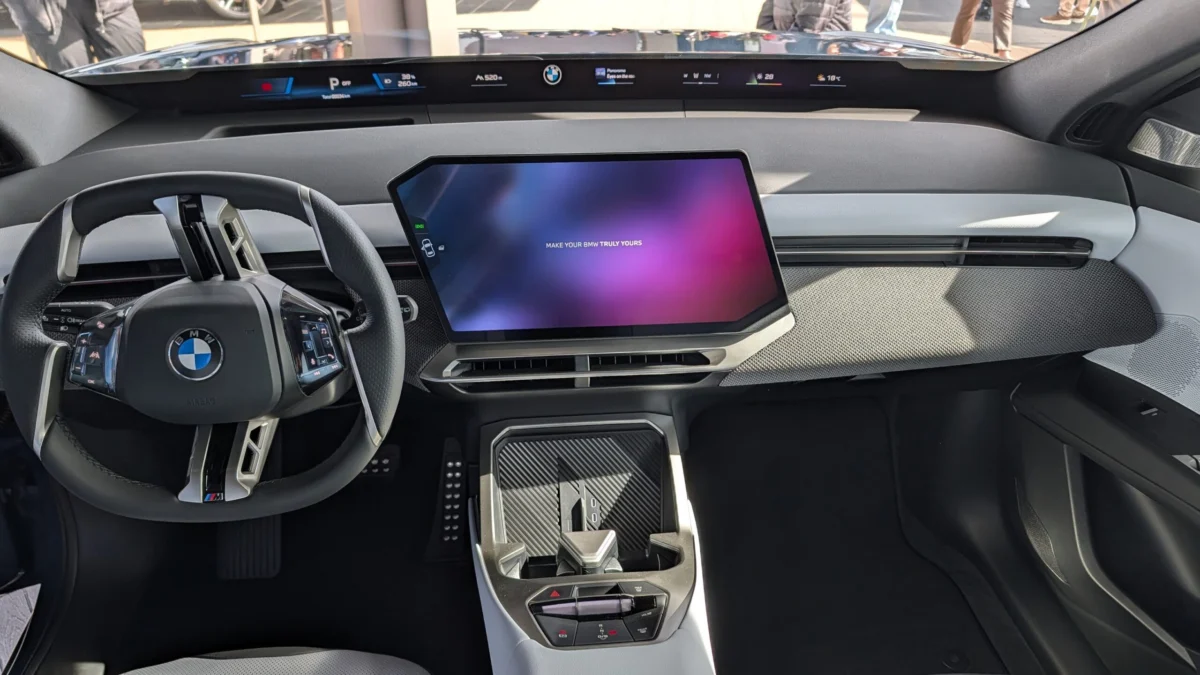
The iX3’s infotainment system is another area where BMW is pushing boundaries. The new panoramic display spans the length of the dashboard, offering a visually striking and highly customizable interface. This advanced system is complemented by BMW’s newly developed AI assistant, created in collaboration with Amazon. Early impressions of this AI system suggest it is among the most intuitive and capable currently available, promising seamless integration of vehicle functions and driver assistance.
Lucid Cosmos: A Lightweight Contender Aiming for Efficiency and Performance
Lucid’s response to the growing midsize EV market comes in the form of the Cosmos, a five-seat electric SUV designed to directly challenge the segment dominated by vehicles like the BMW iX3. The Cosmos represents Lucid’s strategy to penetrate the "midsize" segment, a market characterized by high demand and significant growth potential.
A key differentiator on paper is the Cosmos’s projected pricing. While the entry-level iX3 is still some months away from a definitive price announcement, Lucid is making a bold statement by targeting an initial price point of $50,000 for the Cosmos. However, this competitive entry price is tempered by a later market entry for the Cosmos, expected in early 2027. This staggered launch means Lucid’s entry-level trim will likely contend with BMW’s more budget-conscious iX3 variants, the pricing of which remains to be fully disclosed. The ultimate price strategy employed by BMW for its lower-tier iX3 models will be a critical factor in this competitive equation.
The Cosmos is projected to offer a range of approximately 300 miles, which is less than the iX3’s 405-mile estimate. This difference is largely attributable to a smaller battery pack. While BMW is equipping the iX3 with a substantial 108.7 kWh battery, Lucid has opted for a more compact 69 kWh unit. Instead of solely relying on increased battery size to achieve range, Lucid has prioritized weight reduction and aerodynamic enhancements to maximize efficiency. This focus has resulted in an impressive efficiency rating of 4.5 miles per kWh. Mirroring BMW, Lucid has also adopted the 800-volt architecture for its charging system, ensuring compatibility with high-speed charging infrastructure.
Lucid’s emphasis on lightweight construction extends to its powertrain. The company’s new "Atlas" motor is reported to be 23% lighter than its already compact predecessor. This reduction in weight, stemming from a smaller motor and battery, contributes to the Cosmos’s remarkable performance figures. Lucid claims a sub-3.5-second 0-60 mph acceleration time, significantly outpacing the BMW iX3’s projected performance. Furthermore, Lucid is promising "best-in-class" cargo space, with unofficial reports suggesting it will surpass the capacity of a Toyota RAV4, especially when including the frunk.
While the iX3 may hold an advantage in terms of infotainment sophistication, the Cosmos is not without its strengths in this area. Lucid’s 36-inch-wide display is certainly impressive, but BMW’s panoramic display is described as being on a "different level." However, Lucid is making a strategic choice to incorporate a significant number of physical buttons within the Cosmos cabin. This includes dedicated controls for the sound system and HVAC, a feature likely to be welcomed by a substantial portion of consumers who prefer tactile feedback for essential functions.
The AI Arms Race: A Crucial Battleground

Perhaps the most striking and strategically significant similarity between the iX3 and the Cosmos lies in their advanced AI assistant capabilities. Both manufacturers are investing heavily in this technology, recognizing its potential to revolutionize the in-car experience and extend the vehicle’s functionality beyond simple transportation.
BMW’s AI assistant, experienced firsthand by the author during testing, proved to be highly impressive, demonstrating advanced natural language processing and contextual understanding. Lucid’s AI assistant, subjected to similar tests in New York City, yielded comparable results, indicating a high level of sophistication. Both companies share ambitious long-term visions for their AI systems, aiming to enable users to conduct online shopping, manage personal schedules, and even control smart home devices directly through their vehicles’ interfaces. While BMW’s partnership with Amazon provides a strong foundation and potential short-term advantages in AI development, Lucid’s independent progress suggests a robust competitive landscape in this critical domain.
Implications for the Midsize EV Market
The arrival of the Lucid Cosmos as a direct competitor to the BMW iX3 is poised to significantly reshape the midsize electric SUV segment. For consumers, this intensified competition translates into more choices, potentially leading to more competitive pricing, accelerated technological innovation, and a greater variety of feature sets to cater to diverse preferences.
BMW’s "Neue Klasse" platform represents a long-term commitment to electrification, aiming to solidify its position as a leader in the premium EV market. The iX3, as the vanguard of this initiative, is designed to appeal to a broad audience, blending traditional BMW driving pleasure with cutting-edge EV technology. Its emphasis on a familiar driving experience, coupled with impressive range and a sophisticated AI system powered by Amazon, positions it as a formidable contender for established BMW loyalists and new EV adopters alike.
Lucid, on the other hand, is leveraging its expertise in high-performance EV powertrains and advanced battery technology to carve out its niche. The Cosmos’s focus on lightweight construction, aerodynamic efficiency, and rapid acceleration, combined with a more accessible starting price point, suggests a strategy aimed at attracting performance-oriented buyers and those seeking greater value for their investment. The inclusion of physical buttons, a departure from the all-touchscreen trend, could prove to be a strategic advantage for Lucid, appealing to a segment of the market that prioritizes tactile controls.
The battleground between these two titans will likely extend beyond raw specifications and price. The seamless integration of AI assistants, the intuitiveness of infotainment systems, the practicality of interior space, and the overall user experience will be crucial determinants of success. As the automotive industry continues its rapid transition to electrification, the midsize SUV segment is emerging as a critical battlefront, and the rivalry between the BMW iX3 and the Lucid Cosmos promises to be one of the most compelling narratives in the coming years. The anticipation for a head-to-head comparison of these two groundbreaking vehicles is high, and the outcome will undoubtedly influence the direction of the midsize EV market.