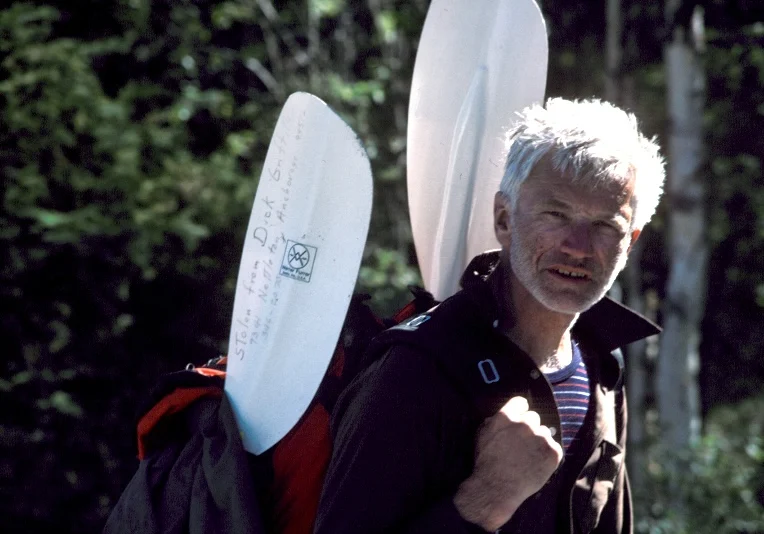
Dick Griffith, a titan of Alaskan exploration and a foundational figure in the state’s outdoor adventure ethos, passed away peacefully in his sleep last week at the age of 98. Griffith, whose life was a testament to enduring human spirit and an unwavering commitment to the wild, leaves behind a legacy that profoundly shaped the landscape of Alaskan wilderness pursuits and inspired generations of adventurers. His passing marks the end of an era for those who knew him and for the broader community he so significantly influenced.
A Life Defined by the Uncharted
Born into humble beginnings during the Great Depression, Griffith’s life journey was a remarkable arc from scarcity to unparalleled achievement in the pursuit of personal exploration and a deep connection with the natural world. His early life, marked by the challenges of a dirt farm, instilled in him a resilience and a profound appreciation for resourcefulness that would become hallmarks of his adventurous spirit. This upbringing, as he once wryly noted, fueled a desire to "die with a silver spoon in my mouth," a sentiment he realized not through material wealth alone, but through a life rich in experience, purpose, and generosity.
Griffith’s formative years were a crucible for the man he would become. By his mid-50s, he was already a recognizable figure in the Alaskan adventure scene, his shock of white hair and quiet determination drawing comparisons to cinematic icons. Yet, those who encountered him recognized something far more profound than a mere image of ruggedness. He embodied a rare blend of grit and grace, a living embodiment of the “Clint Eastwood in tennis shoes and a backpack” ideal, but with an intrinsic humility that set him apart. Many aspiring adventurers of the author’s generation, then in their twenties, looked to Griffith as an aspirational figure, hoping to emulate his adventurous spirit. As they aged, however, the depth of his accomplishments and the unique essence of his character became increasingly apparent, solidifying his status as a once-in-a-lifetime mentor and inspiration.
The Genesis of an Explorer: Early Expeditions and a Lifelong Partnership
Griffith’s adventurous spirit first truly bloomed in his early twenties. In 1949, at the age of 22, while retracing John Wesley Powell’s epic 1,200-mile journey from Green River, Wyoming, to the end of the Grand Canyon, he met Isabelle. Their encounter was serendipitous; Isabelle offered to finance the remainder of his expedition if she could join him. While the full trip that year was not completed, their shared experience ignited a powerful connection. They married a year later, in 1950, and in 1951, embarked on a groundbreaking expedition together. They achieved the first complete inflatable rubber raft descent of the Grand Canyon, a feat that showcased their pioneering spirit and their burgeoning expertise in navigating challenging waterways.
This partnership continued to push boundaries. In 1952, Dick and Isabelle undertook another significant expedition, navigating the vast and rugged depths of Mexico’s Copper Canyon in a small Air Force survival raft. Their journey resulted in the first documented descent of the Rio Urique. When questioned about the origin of his remarkably adaptable raft, Griffith characteristically downplayed its significance, remarking that such rafts were readily available and inexpensive following the war, often costing as little as a dollar. This anecdote underscores Griffith’s knack for resourcefulness and his ability to leverage available means for extraordinary undertakings.
Embracing the Alaskan Frontier: A Pioneer’s Move and Arctic Immersion
The Griffiths relocated to Alaska in 1954, a move that would indelibly link Dick’s name with the state’s untamed wilderness. Their two children, Barney and Kimmer, were born in this new frontier. It was in Alaska that Griffith’s adventurous endeavors truly escalated, characterized by a profound desire for personal reflection and a deep engagement with the land, rather than a pursuit of external accolades.
In 1959, at the age of 32, Griffith embarked on an ambitious 500-mile solo trek across the North Slope and through the Brooks Range, from Kaktovik on the Arctic Ocean to Anaktuvuk Pass. This expedition was a stark demonstration of his self-reliance and his commitment to living off the land. He documented this epic journey with his characteristic understated wit, recounting how his initial team of three dogs and a partner dwindled due to injury, death, and desertion, leaving him to complete the journey with his own ingenuity. Despite the immense hardships, including hunger, relentless mosquitoes, and challenging river crossings, Griffith reached Anaktuvuk Pass, forging enduring friendships with the Nunamiut people. These relationships, symbolized by the intricately carved masks that adorned his Anchorage home, represented a bridge between Alaska’s pre-statehood era and the modern age, a testament to the respect and understanding he cultivated.
The Brooks Range Traverse and Resilience in the Face of Adversity
Griffith’s connection to the Brooks Range remained a central theme in his life. While his engineering career and family life occupied him during the 1960s and 70s, his adventurous spirit never waned. In 1977, at the age of 50, he returned to the Arctic with his friend Bruce Stafford to complete a traverse of the Brooks Range from Kaktovik to Kotzebue. This expedition marked the first fully documented traverse of this formidable Arctic mountain range, cementing his reputation as a preeminent explorer.
Tragically, his dedication to the Arctic came at a significant personal cost. In 1979, during a solo ski trip, Griffith suffered severe frostbite, resulting in the amputation of parts of his legs and buttocks. He recounted this harrowing experience with his typical humility, stating, "They amputated my butt." This debilitating injury, however, did not deter him from his passion for the wild. His resilience became legendary, demonstrating an indomitable will to continue exploring despite profound physical challenges.
A Decade of Dedication: The Unalakleet to Hudson Bay Expedition
Undeterred by his injuries, Griffith embarked on what would become one of his most ambitious and longest-running expeditions at the age of 61. In 1982, he began a monumental 4,000-mile journey from Unalakleet, Alaska, to Hudson Bay, traversing northern Alaska and the Northwest Passage. For nearly a decade, he dedicated his springs to this singular pursuit, undertaking solo ski trips for one to two months each year.
This extended expedition presented numerous challenges, including a memorable encounter with a polar bear. During one of his solo trips, a curious polar bear approached his tent while he slept. Lacking a firearm, Griffith devised an ingenious, albeit unconventional, solution. He wrapped numerous pain relief tablets, including Tylenol and Advil, in smoked salmon and left them on the snow. He never saw the bear again, a testament to his resourcefulness and quick thinking in extreme situations. After eight annual expeditions, Griffith finally reached Hudson Bay in 1990, at the age of 73, completing a journey that spanned over a decade and covered thousands of miles.
The "Prime of Life" Philosophy: Continued Exploration into Later Years
Griffith’s perspective on aging and adventure was encapsulated in his own actions and his memorable pronouncements. When the author, at 64, expressed his admiration for Griffith’s continued expeditions, Griffith inquired about his age and, upon learning it, declared, "Sixty-four? You’re only 64? Well, you’re in the prime of your life!" This sentiment reflected his belief that age was merely a number and that a life lived with purpose and movement was a life well-lived. He famously compared life to a bicycle: "If you stop moving, you fall over."
This philosophy propelled him to continue his active pursuits well into his later years. At 64, he completed a demanding 450-mile solo ski trip from Point Barrow to Barter Island, a month-long journey where he self-sufficiently hauled all his gear. Even as he observed younger adventurers, Griffith continued to set an unparalleled example, demonstrating that the spirit of exploration knows no age limit.
The Alaska Mountain and Wilderness Classic: A Legacy of Stewardship
Griffith was not only an accomplished adventurer but also a devoted steward of the Alaskan outdoor community. He was a consistent participant and a guiding force behind the Alaska Mountain and Wilderness Classic, a challenging weeklong race that required participants to carry all their own food and gear without roads or outside assistance. He completed his last Classic race at the remarkable age of 81.
His involvement with the Classic extended far beyond mere participation. For the last 43 years, he was instrumental in keeping the event alive, often hosting pre-race dinners at his home, serving a renowned salad from a giant wooden bowl. For over 30 years, he provided logistical support, driving racers to and from the event. Perhaps most importantly, Griffith served as the "tail gunner," bringing up the rear and ensuring that no participant was left behind. Stragglers often found that their most valuable lessons in backcountry travel were learned during their week with Griffith, who imparted his wisdom and experience with a gentle but firm hand.
Wit, Wisdom, and Generosity: A Multifaceted Character
Beyond his physical feats, Dick Griffith was celebrated for his sharp wit and profound generosity. During the inaugural Alaska Mountain and Wilderness Classic in 1982, at age 55, he arrived at a river crossing with an inflatable raft, a novel approach at the time. Donning a Viking hat, he playfully chided the younger competitors, asserting that "old age and treachery beat youth and skill every time." His humor was always balanced with a deep sense of responsibility; he waited to ensure everyone else had safely crossed the challenging glacial river before proceeding.
Griffith’s generosity extended far beyond the wilderness. He was a dedicated philanthropist, contributing significantly to the community, particularly the Eagle River Visitor Center and individuals in need. He nurtured a circle of friends, whom he affectionately called his "orphans," inviting them for holiday and Sunday dinners, and offering support and companionship. His commitment to community also manifested in his decades-long volunteer work maintaining trails in Chugach State Park, often alongside other volunteers and Boy Scouts earning merit badges.
An Enduring Impact on Alaskan Adventure
Dick Griffith’s life was a masterclass in pushing boundaries, fostering resilience, and living with purpose. His extensive expeditions, his pioneering spirit in raft travel, and his unparalleled commitment to the Alaskan wilderness have left an indelible mark. He was a man who lived by his own principles, embracing challenges with courage and humility, and sharing his experiences and resources generously.
His passing is mourned by a community that he helped to build and inspire. While he never sought recognition for his contributions to the shaping of Alaskan outdoor sports, his actions and his spirit have undoubtedly made him a legend. Dick Griffith’s legacy is not just in the miles he traversed or the rivers he navigated, but in the countless lives he touched and the enduring inspiration he provided to all who seek adventure and a deeper connection with the wild. He will be profoundly missed on his next great adventure.