








In the late 1970s and early 1980s, the landscape of motorcycle racing was fundamentally transformed by the rise of production-based competition. This era was defined by the legendary Freddie Spencer, whose precise, fluid riding style became synonymous with the dominance of the Honda CB750 and CB900 platforms. These machines, while modified for the track, retained the unmistakable silhouette of their street-legal counterparts: lack of windscreens, upright handlebars, and the distinct, muscular aesthetic of a raw, unfaired roadster. Today, Honda is revisiting that golden age with the introduction of the 2026 CB1000F, a motorcycle that attempts to harmonize the raw, retro-inspired aesthetic of the Spencer era with the sophisticated mechanical and electronic architecture of the modern Fireblade.
A Chronology of the Superbike Identity
To understand the significance of the 2026 CB1000F, one must look back at the developmental timeline of Honda’s inline-four legacy. In 1979, the AMA Superbike championship became a testing ground for manufacturers to prove the viability of their production motorcycles. The CB750 and subsequent CB900F were not purpose-built prototypes; they were commercial products pushed to their absolute limits.
The timeline of this lineage is critical to the brand’s identity:
- 1969: The original CB750 Four debuts, changing the motorcycle industry forever by offering mass-produced multi-cylinder performance.
- 1982: Freddie Spencer secures a monumental victory at the Daytona Superbike race aboard a modified CB900F, cementing the "muscle bike" archetype in the American consciousness.
- 2017: Honda releases the CBR1000RR Fireblade, which featured a high-output, race-derived engine that would eventually serve as the technical heart of the 2026 CB1000F.
- 2026: The official launch of the CB1000F, designed specifically to capture the "Best Balanced Roadster" concept, combining 1980s aesthetic cues with 21st-century rider aids.
Engineering the "Best Balanced Roadster"
The core philosophy behind the 2026 CB1000F is an intentional departure from the hyper-aggressive ergonomics of modern sportbikes. While the current market is saturated with aerodynamically complex, fairing-heavy machines, Honda’s design team opted for a "naked" architecture.
The centerpiece of the machine is the 1,000 cc DOHC inline-four engine. By utilizing the 2017 Fireblade motor as a base, engineers had a high-performance foundation that was already proven in extreme conditions. However, placing a race-tuned engine into a street-focused frame required significant recalibration. According to technical specifications released by Honda, the engine underwent a comprehensive overhaul of its camshaft profiles and intake/exhaust timing.
The goal of this tuning was to shift the torque curve. Where the 2017 Fireblade prioritized high-RPM power for circuit racing, the 2026 CB1000F provides a "midrange-focused" delivery. This transition from a top-end screamer to a torque-heavy roadster offers practical benefits for street riders, providing immediate power for overtaking without requiring constant gear changes. The acoustic output—a deep, raspy note—is a direct result of this internal tuning, designed to evoke the spirit of the vintage racing machines of the early 80s.
Aesthetic Continuity and Design Language
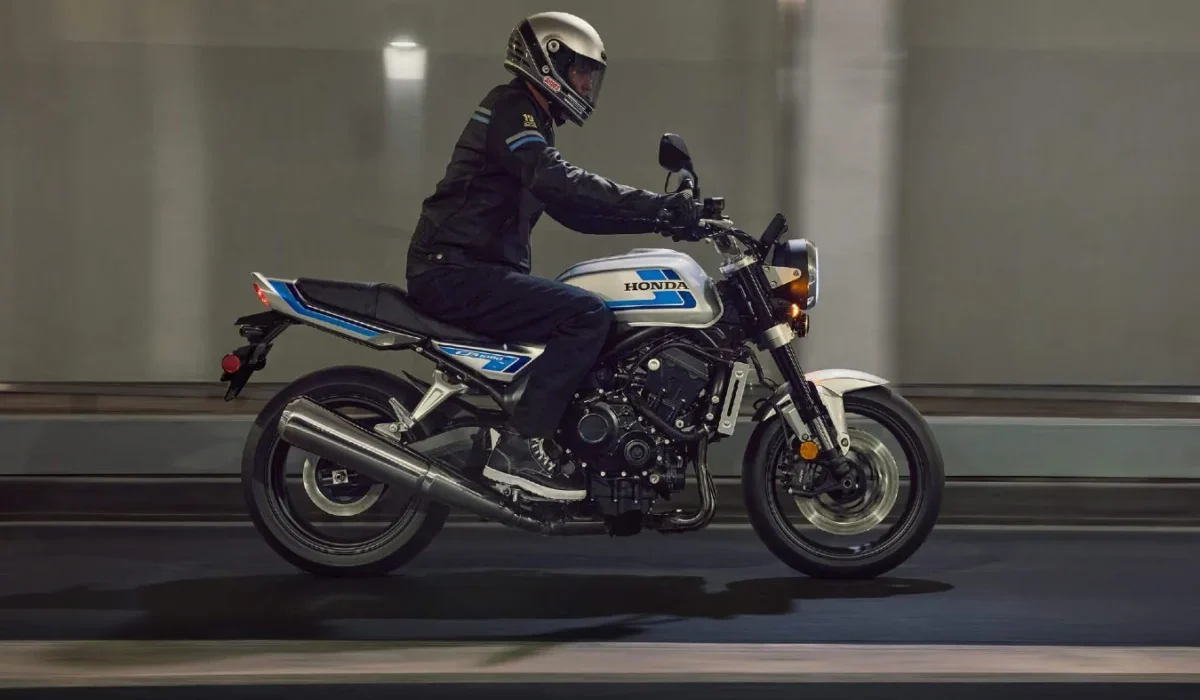
The visual language of the 2026 CB1000F is not merely nostalgic; it is a calculated homage. The paint scheme—Wolf Silver accented by distinct blue racing stripes—is a nearly exact replica of the livery worn by Spencer’s 1982 Daytona-winning machine.
The motorcycle’s proportions are designed to emphasize the engine. The fuel tank is sculpted to appear wider and more muscular, tapering into the side and rear bodywork to create a streamlined, athletic stance. Despite the retro look, the lighting is entirely modern. A large, circular LED headlight serves as the focal point of the front fascia, providing a high-intensity light pattern that contrasts with the vintage styling. The chassis—a blacked-out frame and swingarm—serves to ground the design, ensuring that the silver-and-blue bodywork remains the primary visual attraction.

Integration of Modern Electronic Suites
While the exterior aesthetic suggests a simpler time, the internal electronics of the 2026 CB1000F position it firmly in the contemporary market. Honda has implemented a comprehensive technological suite to ensure the bike remains competitive with modern European and Japanese naked bikes.
Key technical features include:
- Inertial Measurement Unit (IMU): A six-axis IMU monitors yaw, pitch, and roll, allowing for more precise control of the traction control and ABS systems.
- Throttle-by-Wire (TBW): This system facilitates multiple riding modes, allowing the user to adjust power delivery and engine braking to suit varying road conditions.
- Connectivity: The five-inch TFT display integrates with the HondaSync app, enabling navigation, telephony, and music control through an iOS or Android smartphone interface.
- Security: The Honda Smart Key system adds a layer of convenience and theft deterrence, allowing the rider to start the bike without removing the key from their pocket.
Broader Market Implications
The introduction of the CB1000F represents a shift in the motorcycle industry’s approach to the "heritage" segment. Rather than producing a basic, underpowered "retro-styled" bike, manufacturers are increasingly building high-performance machines that look like classics but handle like modern sportbikes.
Industry analysts suggest that this strategy is a response to the aging demographic of motorcycle enthusiasts who grew up watching the AMA Superbike golden era. By combining the emotional appeal of the 1980s with the safety and usability of 2026 technology, Honda is attempting to capture a broad cross-section of the market. The CB1000F targets the rider who values the performance of a liter-class bike but finds the aggressive, cramped riding position of track-focused supercars to be impractical for daily use.
Official Positioning and Industry Reaction
Honda has explicitly positioned the CB1000F as the "Best Balanced Roadster." This terminology suggests a move away from the "horsepower wars" that characterized the last decade of sportbike development, in favor of usability and rider-centric ergonomics.
Industry experts have noted that the use of the Fireblade engine provides a level of legitimacy that is often missing from "lifestyle" motorcycles. Because the engine is not a detuned, low-cost alternative but a precision-engineered version of a championship-winning motor, the bike maintains a high performance ceiling. This technical foundation is expected to make the CB1000F a significant contender in the naked-bike segment, challenging rivals that have traditionally dominated the space through a mix of raw power and electronic sophistication.
Conclusion: A Synthesis of Eras
The 2026 Honda CB1000F stands as a testament to the enduring legacy of the early 1980s racing scene. It is a motorcycle that acknowledges the history of the sport through its visual cues—the iconic blue stripes, the upright handlebars, and the muscular tank—while utilizing modern materials and electronics to solve the inherent flaws of the original machines.
By moving the power band to the midrange and incorporating advanced IMU-based safety systems, Honda has created a motorcycle that is as comfortable on a winding mountain pass as it is in urban environments. As the motorcycle industry continues to navigate the balance between nostalgia and innovation, the CB1000F serves as a template for how heritage can be leveraged to create a product that is not just a reminder of the past, but a functional, high-performance tool for the present. For the discerning enthusiast, it represents the rare confluence of heritage, technology, and approachable power, marking a return to the "production-based" ethos that made Honda a household name in the annals of Superbike history.