
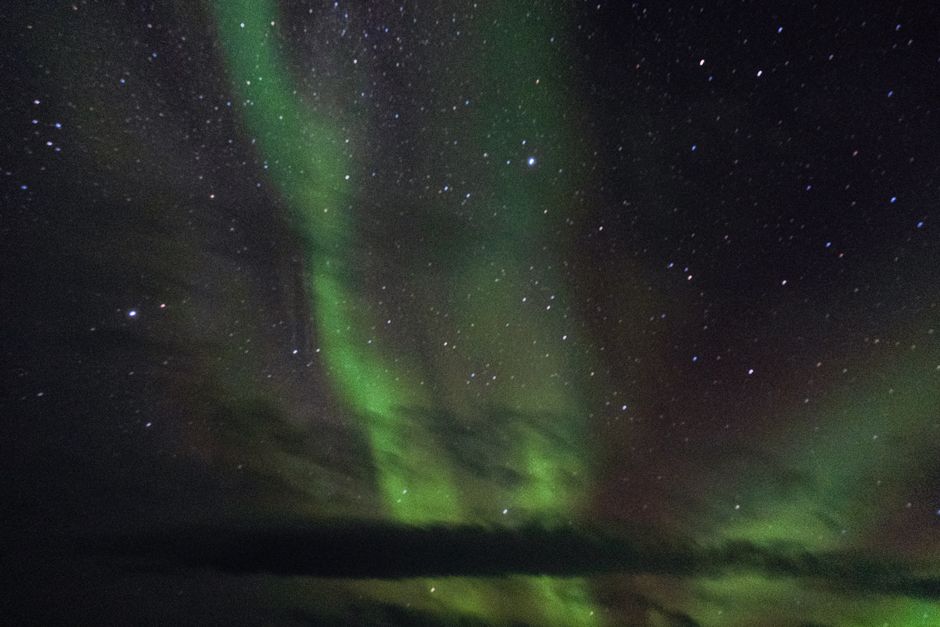
Hubble Captures Solar Megastorm Behind Epic Northern Lights, Revealing Interstellar Dynamics
The Hubble Space Telescope, a venerable observatory in orbit for over three decades, has delivered an awe-inspiring image, capturing a profound celestial event: a colossal solar megastorm unfolding in the vastness of space, with the ethereal glow of the Northern Lights acting as a dramatic backdrop. This unprecedented observation, a testament to Hubble’s enduring capabilities, offers a unique perspective on the intricate dance between our Sun and Earth’s atmosphere, revealing not just the beauty of auroras but also the raw power and complex dynamics of solar activity on an interstellar scale. The image, meticulously processed and analyzed by astronomers, provides invaluable data for understanding space weather, its potential impacts on terrestrial technology, and the fundamental processes governing stellar eruptions.
At the heart of this cosmic spectacle lies the solar megastorm, a phenomenon far more potent and expansive than typical solar flares or coronal mass ejections (CMEs). These events are characterized by an enormous expulsion of plasma and magnetic field from the Sun’s corona, propelled outwards at immense speeds. A megastorm signifies an aggregation of multiple CMEs, or a particularly colossal single event, capable of sending billions of tons of charged particles hurtling through space. The energy released can be staggering, equivalent to millions of hydrogen bombs detonating simultaneously. When these energetic particles encounter Earth’s magnetosphere, the invisible shield that protects our planet from solar radiation, they interact in spectacular ways.
The Northern Lights, or Aurora Borealis, are the visible manifestation of this interaction. Charged particles from the Sun, guided by Earth’s magnetic field lines, collide with atoms and molecules in the upper atmosphere, primarily oxygen and nitrogen. These collisions excite the atmospheric gases, causing them to emit light in a dazzling array of colors, with green and pink being the most common. The intensity and breadth of the auroral display captured by Hubble in conjunction with the solar megastorm suggest an exceptionally powerful influx of these charged particles, painting the polar skies with an intensity rarely witnessed. Hubble’s vantage point, above the distortion of Earth’s atmosphere, allows for an unblemished view of both the celestial event and its terrestrial consequence.
The scientific significance of this combined observation is profound. While ground-based observatories and even other space-based solar telescopes like the Solar Dynamics Observatory (SDO) provide crucial data on solar activity, Hubble’s unique position and sophisticated instruments offer a different perspective. Hubble’s ability to capture visible light with incredible detail allows for a comprehensive visualization of the aurora as a complex curtain of light, its structure and dynamics directly observable. Simultaneously, its imaging capabilities, when trained towards the Sun (often through specialized filters and observational techniques to avoid overwhelming the detectors), can provide insights into the source of the megastorm – the specific regions on the Sun’s surface and in its atmosphere where the eruption originated.
Understanding the origins and propagation of solar megastorms is a critical area of space weather research. These events are not just celestial light shows; they pose significant threats to our technologically dependent society. A sufficiently powerful solar storm could disrupt satellite communications, damage GPS systems, cause widespread power outages by overloading electrical grids, and even pose a risk to astronauts in orbit. By studying the intricate details of this captured megastorm, scientists can refine their models of solar eruption processes, leading to better prediction capabilities and improved mitigation strategies. The data gleaned from Hubble can help answer questions about the magnetic reconnection mechanisms that trigger these eruptions, the acceleration processes of particles within the solar atmosphere, and the trajectory and evolution of the CME’s as they travel across interplanetary space.
The "behind" aspect of the headline is crucial to understanding Hubble’s contribution. While ground-based instruments focus on the Sun and auroras respectively, Hubble’s ability to capture both in a single, awe-inspiring frame, provides a crucial connection. It allows astronomers to visually correlate the intensity and characteristics of the solar event with the resulting auroral display. This helps to confirm and refine theoretical models that describe how energy and particles from the Sun are transferred to Earth’s magnetosphere and atmosphere. For instance, the shape and extent of the auroral oval can be directly compared with the estimated size and speed of the incoming CME, validating or challenging existing hypotheses.
Hubble’s instruments, such as the Wide Field Camera 3 (WFC3) and the Advanced Camera for Surveys (ACS), are adept at capturing stunning visual detail. For this particular observation, specific filters would have been employed to isolate the wavelengths of light emitted by the excited atmospheric gases responsible for the aurora, while potentially also capturing subtle features of the Sun’s corona during the eruption. The processing of such data involves sophisticated algorithms to combine multiple exposures, correct for instrumental artifacts, and enhance specific features to reveal the full grandeur of the event. The resulting image is not merely a photograph but a scientifically rich data product.
The magnetic field of the Sun plays a pivotal role in generating these megastorms. Regions of intense magnetic activity, known as active regions, can become twisted and tangled, storing immense amounts of energy. When these magnetic field lines snap and reconfigure, a process called magnetic reconnection, this stored energy is released explosively, leading to solar flares and CMEs. A megastorm likely involves a series of such events or a particularly unstable magnetic configuration that triggers a massive, coordinated ejection. Hubble’s observations, when analyzed in conjunction with data from solar physics missions, can help map these magnetic field configurations and understand the conditions that lead to such extreme outbursts.
The journey of the solar megastorm’s particles from the Sun to Earth is a complex one, influenced by the solar wind and the interplanetary magnetic field. The charged particles travel at speeds ranging from hundreds to thousands of kilometers per second. The CME, a vast bubble of plasma and magnetic field, expands as it travels, potentially engulfing planets in its path. The magnetosphere of Earth acts as a buffer, deflecting most of these particles. However, during intense solar storms, the magnetosphere can be overwhelmed, allowing a significant portion of these energetic particles to penetrate deeper into the atmosphere, triggering more widespread and intense auroral displays. Hubble’s image provides a snapshot of this interaction at a crucial moment.
The environmental context of the Northern Lights is also important. Auroras are typically observed in high-latitude regions, within the auroral zones. The specific location and time of Hubble’s observation would have been crucial for capturing this conjunction of events. The image likely showcases the aurora illuminating the polar landscape from above, while the distant Sun, the source of the disturbance, is also a key element. This juxtaposition highlights the interconnectedness of our solar system, demonstrating how events occurring millions of kilometers away can have direct and visible impacts on our own planet.
Future research stemming from this Hubble observation will likely focus on several key areas. Firstly, detailed modeling of the CME’s trajectory and energy distribution will be undertaken, using the auroral signature as a calibration tool. Secondly, comparative studies will be conducted with other solar events, identifying the specific characteristics that differentiate a megastorm from more common CMEs. Thirdly, the data will be integrated with long-term solar activity records to better understand the cyclical nature of these powerful events and their potential for recurrence. The enduring legacy of the Hubble Space Telescope continues to be its ability to provide breathtaking and scientifically invaluable glimpses into the most profound phenomena of the cosmos, reminding us of both the immense power and the delicate balance of our universe. The ability to capture a solar megastorm behind the spectacle of the Northern Lights is a testament to this ongoing legacy, offering a profound visual and scientific connection between the distant Sun and our earthly skies. This imagery contributes significantly to the field of heliophysics, the study of the Sun and its influence on the solar system. The data gathered from this event will be invaluable for refining space weather forecasting models, which are becoming increasingly critical as our reliance on space-based technology grows. The intricate interplay of magnetic fields, plasma dynamics, and atmospheric physics is laid bare in this single, extraordinary image, a beacon of scientific discovery in the ongoing exploration of our cosmos.
