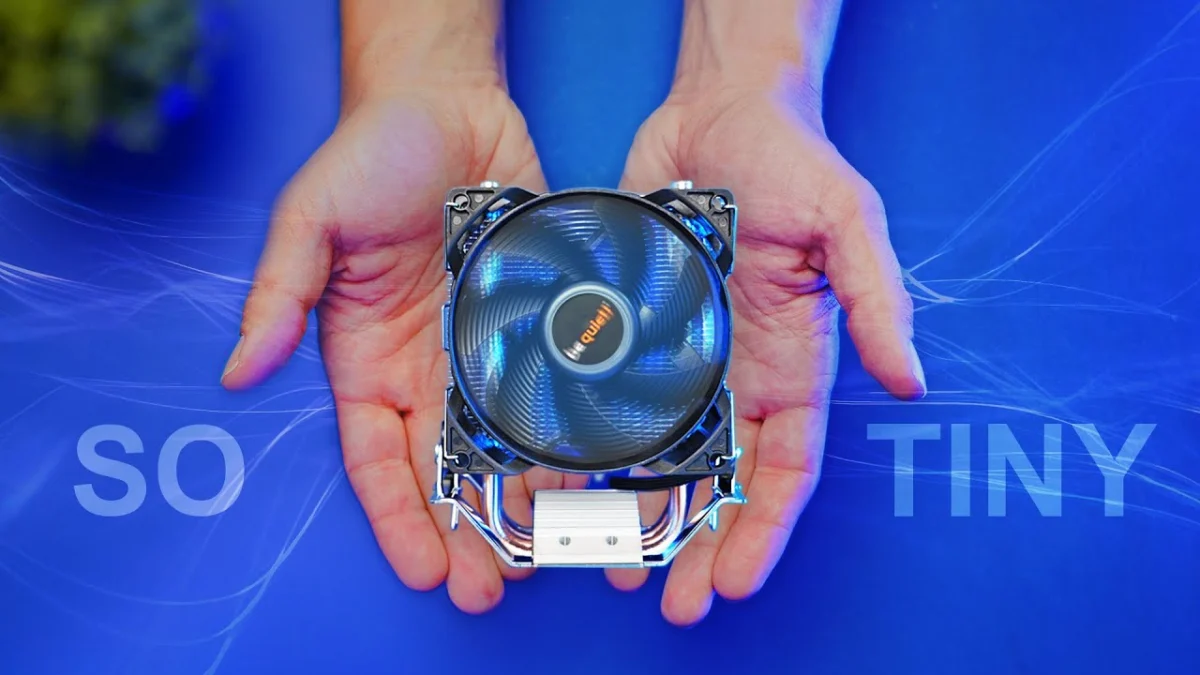
The modern personal computer hardware market is frequently dominated by conversations surrounding high-end components, liquid cooling loops, and massive dual-tower heatsinks designed to tame power-hungry processors. However, the vast majority of mainstream consumers and system builders operate under different constraints: budget limitations, compact chassis footprints, and standard thermal loads that do not require excessive cooling apparatuses. Addressing this substantial market segment, German hardware cooling manufacturer Be Quiet! has released the Pure Rock Slim 2, an entry-level, single-tower CPU cooler priced at an aggressive $25. Despite its diminutive physical dimensions and budget-oriented pricing strategy, comprehensive performance evaluations indicate that this 92mm cooling solution delivers thermal and acoustic metrics capable of challenging significantly larger and more expensive alternatives.
Market Context and Pricing Dynamics
The launch of the Pure Rock Slim 2 arrives during a period of shifting consumer demand within the PC component industry. With AMD’s Ryzen processors gaining substantial market share due to their competitive multi-core performance and power efficiency, demand for versatile, widely compatible coolers has surged. Historically, entry-level cooling has been anchored by foundational products such as the Cooler Master Hyper 212 Evo, a 120mm cooler that has served as a benchmark for budget builds for over a decade. However, these traditional 120mm tower coolers frequently present compatibility challenges in modern small-form-factor (SFF) chassis, where vertical clearance is at a strict premium.
Priced officially at $25, the Pure Rock Slim 2 occupies a highly competitive tier in the hardware ecosystem. Industry analysts note that while the MSRP is firmly established at this accessible price point, global supply chain fluctuations and third-party reseller markups on platforms such as Amazon and Newegg have occasionally complicated consumer purchasing. Prospective buyers are advised to source the component directly from authorized retailers to secure the intended $25 price point. Within this bracket, 92mm coolers are not an entirely novel concept; however, few options exist from tier-one manufacturers that successfully integrate advanced thermal technologies into such a compact and cost-effective package.
Physical Dimensions and Form Factor Advantages
One of the defining characteristics of the Pure Rock Slim 2 is its remarkably compact physical footprint. Standing at a height of 135mm, with a depth of 82mm and a width of 97mm, the heatsink is substantially smaller than standard 120mm tower coolers like the Noctua NH-U12S or the aforementioned Cooler Master Hyper 212 Evo.
This reduced vertical profile makes the Pure Rock Slim 2 exceptionally well-suited for space-constrained environments. A prime example is its compatibility with popular compact chassis designs such as the Cooler Master MasterBox NR200, which imposes a strict maximum cooler height limitation of 155mm. While this threshold accommodates many standard coolers, the narrower width and shorter height of the Pure Rock Slim 2 ensure seamless integration, allowing the heatsink to work cooperatively with standard chassis airflow dynamics rather than conflicting with them. Furthermore, the slim profile entirely eliminates memory clearance issues. Even on motherboards where all four DIMM slots are fully populated with tall, heat-spreader-equipped RAM modules, the cooler maintains unobstructed access, a frequent pain point for users utilizing larger dual-tower or wide single-tower alternatives.
Engineering Design and Iterative Improvements
As an evolutionary successor to the original Pure Rock Slim, the second-generation model introduces several structural and functional refinements while retaining the core architectural philosophy of its predecessor. The heatsink utilizes a dense aluminum fin array traversed by three 6mm copper heatpipes that employ a Heatpipe Direct Touch (HDT) baseplate design, ensuring direct contact with the integrated spreader of the processor.
Comparing the Pure Rock Slim 2 to the original iteration reveals minor dimensional adjustments, specifically an extended fin array at the rear to optimize thermal dissipation, alongside a revised baseplate configuration. However, the most significant updates lie in the included cooling fan and the mechanical installation apparatus.
The cooler is equipped with a 92mm Be Quiet! Pure Wings 2 PWM fan, engineered to operate at speeds up to 2,300 RPM. While a rotational speed of 2,300 RPM might imply elevated noise levels compared to slower-spinning 120mm fans, the Pure Wings 2 series is specifically optimized for acoustic efficiency. The fan utilizes rifle-bearing technology and optimized fan blade geometry to minimize turbulence, resulting in exceptional acoustic performance under varying loads.
Installation Process and Hardware Compatibility
Installation simplicity has historically been a critical factor for entry-level components, as these parts are frequently purchased by novice builders. Be Quiet! has completely revamped the mounting mechanism for the Pure Rock Slim 2, yielding divergent experiences depending on the CPU platform.
For systems utilizing AMD hardware (specifically AM4 sockets), the installation process is exceptionally streamlined. Be Quiet! pre-installs the AMD mounting brackets at the factory—a deliberate design choice acknowledging AMD’s dominant market presence among consumer builders. The installation relies on the standard, stock motherboard backplate supplied with every AMD AM4 motherboard. To mount the cooler, users simply align the provided spring clips over the standard retention hooks, rotate the heatsink into position, and secure the clips. This tool-free approach requires minimal effort and utilizes the motherboard’s existing retention infrastructure.
Conversely, the Intel installation process utilizes traditional push-pin mechanisms. While push-pin systems require no tools and are straightforward to execute, industry reviews frequently note that they fall short in delivering optimal, uniform mounting pressure compared to dedicated backplate and screw-down systems. Nevertheless, the physical stability of the mounted cooler is robust, with engineered tolerances minimizing lateral movement despite the absence of threaded fasteners.
Thermal Performance and Acoustic Analysis
To evaluate the real-world capabilities of the Pure Rock Slim 2, thermal and acoustic testing was conducted across varying power dissipation (Thermal Design Power, or TDP) workloads.
At baseline noise testing, the Pure Wings 2 fan demonstrated remarkable acoustic control. When operating at 70% fan speed, the noise output dropped to the testing environment’s minimum noise floor, an impressive achievement for a 92mm fan operating at elevated RPMs. Even at maximum rotational velocity (100% duty cycle), the cooler plateaued at approximately 40 decibels, allowing it to maintain a significantly quieter operational profile than many competing entry-level cooling solutions.
In thermal stress evaluations utilizing a standard 95W TDP workload, the Pure Rock Slim 2 proved highly competitive, trading blows with larger, more expensive cooling towers. When subjected to a more demanding 125W workload—pushing close to the manufacturer’s stated maximum TDP threshold of 130W—the cooler maintained structural thermal integrity. Remarkably, test results demonstrated that the compact $25 cooler matched the thermal performance of the premium Noctua NH-U12S up to a 37-decibel noise threshold and consistently outperformed the Cooler Master Hyper 212 Evo across equivalent testing intervals.
However, the physical limitations of a 92mm single-tower heatsink become apparent when workloads exceed its thermal capacity. Tests conducted at a 150W TDP threshold indicated that the cooler rapidly reaches saturation, confirming that users operating high-wattage, enthusiast-tier processors under sustained heavy loads will still require larger air coolers or closed-loop liquid cooling (AIO) solutions.
Broader Industry Implications and Conclusions
The introduction and performance verification of the Be Quiet! Pure Rock Slim 2 underscore a significant shift in the entry-level PC hardware segment. By bridging the gap between ultra-budget pricing and refined acoustic engineering, the product challenges the necessity of purchasing larger, more cumbersome heatsinks for mainstream computing tasks.
For the average consumer utilizing a standard 65W to 95W processor—whether for gaming, office productivity, or general home use—the Pure Rock Slim 2 presents a compelling value proposition. Its combination of a modest $25 price point, high memory compatibility, compact form factor suitable for small-form-factor builds, and quiet acoustic profile establishes a new benchmark for budget cooling solutions. While high-end overclockers and workstation users running sustained heavy multi-threaded loads will continue to require heavy-duty thermal solutions, the Pure Rock Slim 2 effectively demonstrates that effective, whisper-quiet CPU cooling no longer requires a substantial financial investment or a massive physical footprint.