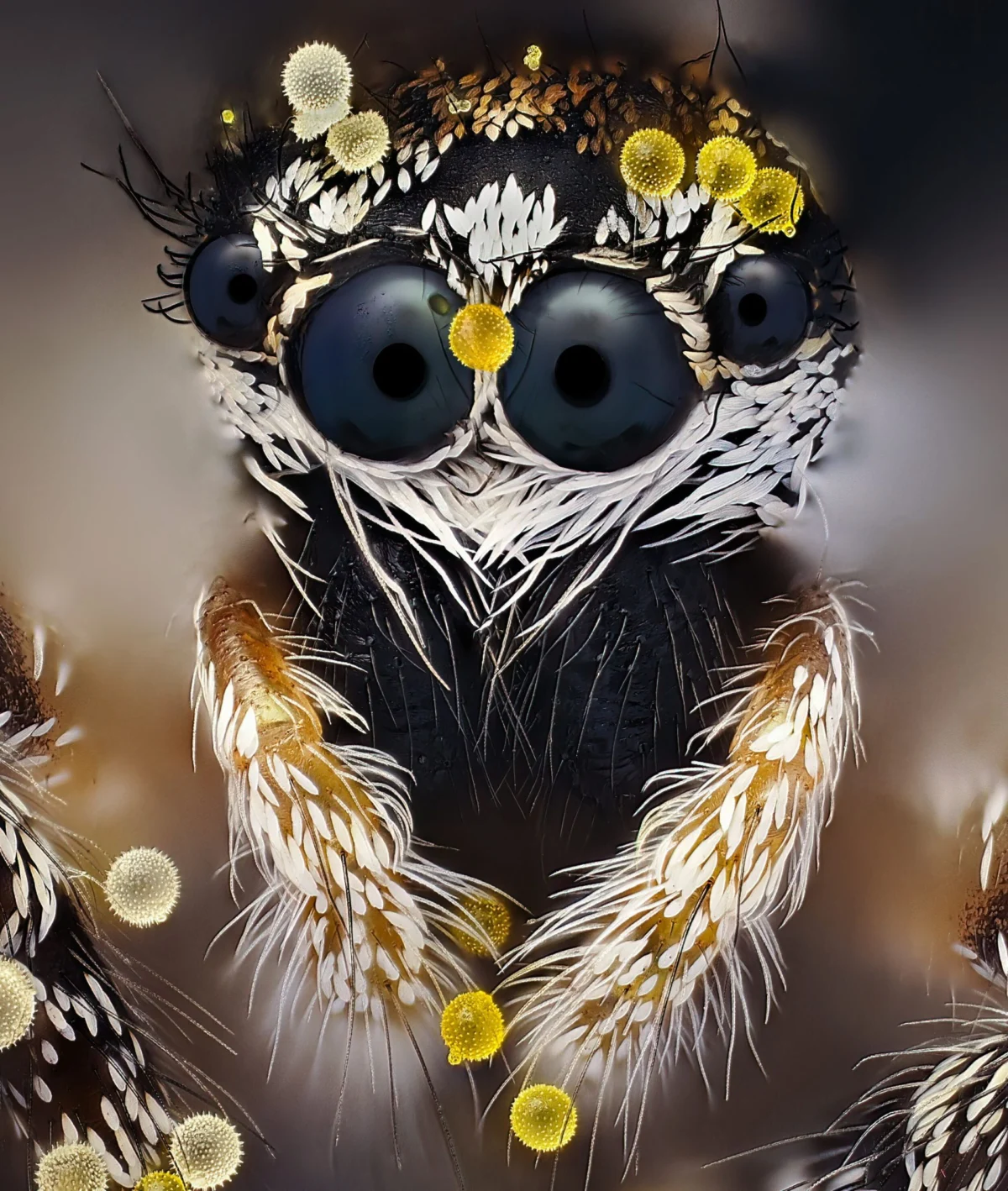
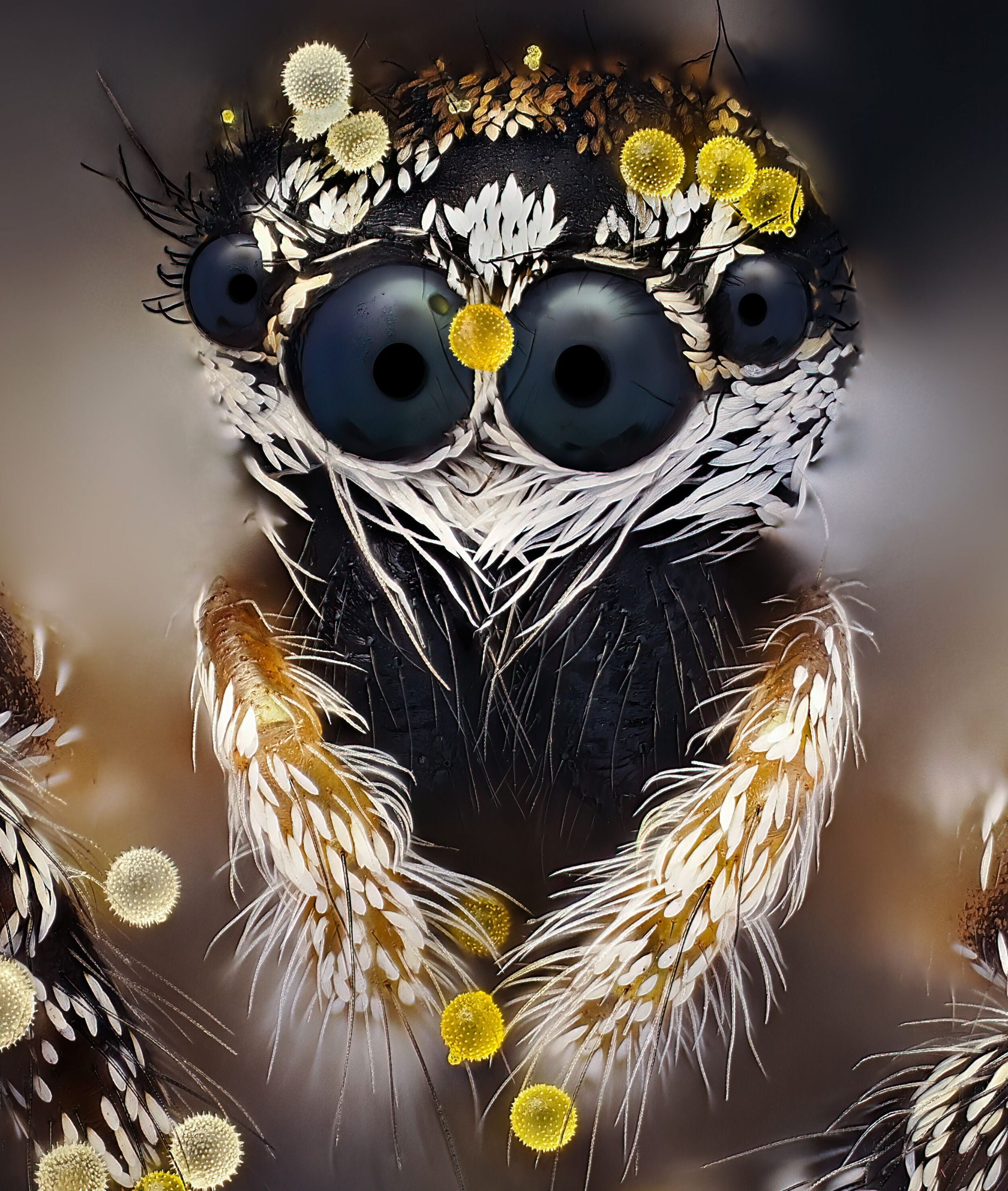
German macro-photographer John-Oliver Dum has secured second place in the prestigious Nikon Small World 2026 Photomicrography Competition with a mesmerizing, highly detailed portrait of a common jumping spider (Salticus scenicus). Magnified 20 times under specialized laboratory and camera equipment, the image reveals a startlingly intricate view of nature, showcasing the delicate facial structures of the arachnid alongside microscopic grains of pollen that resemble precious jewels scattered across its body.
The achievement highlights the remarkable intersection of scientific documentation and fine art photography, shedding light on a hidden world that remains entirely invisible to the naked eye. As advanced photomicrography techniques continue to evolve, images like Dum’s are redefining how the public perceives microscopic ecosystems and the creatures that inhabit them.
Main Facts and Subject Profile
The award-winning photograph features Salticus scenicus, a species of jumping spider widely distributed across Europe and North America. Typically measuring between 5 millimeters and 9 millimeters in length—smaller than an average human fingernail—the creature is known for its acute vision and dynamic hunting style rather than spinning webs to catch prey.
In Dum’s composition, the spider is captured staring directly into the camera lens. Its anatomy, usually perceived as threatening or unsettling by the general public, is rendered with striking intimacy. Two massive, dark central eyes dominate its face, flanked by smaller secondary eyes. Delicate white and cream-colored scales frame its head and furry front legs, creating a texture reminiscent of soft velvet.
Adding to the visual poetry of the shot, vibrant yellow and cream pollen grains are scattered across the spider’s head and limbs. Positioned atop its crown and resting neatly between its primary eyes, the pollen grains create a regal, jewel-encrusted effect that challenges traditional, fear-based perceptions of arachnids.
The Technical Mastery of Photomicrography
Capturing a subject at 20x magnification presents monumental technical hurdles, chief among them being an extremely shallow depth of field. At such close ranges, only a microscopic fraction of the subject remains in sharp focus at any given time, rendering traditional single-shot photography inadequate for scientific or high-detail artistic documentation.
To overcome this limitation, John-Oliver Dum utilized a painstaking technique known as focus stacking. This method involves capturing dozens—and occasionally over a hundred—individual frames of the same subject, each taken at micro-incremented focus distances along the Z-axis. Specialized software is then utilized to algorithmically merge the sharpest slices of each individual photograph, producing a final composite image with extraordinary depth, clarity, and edge-to-edge sharpness.
Based in Bendorf, Germany, Dum operates within a magnification range of 1x to 100x. His specialized professional rig comprises a high-resolution Sony Alpha 1 camera body, an MJKZZ automated macro rail system designed for ultra-precise focal steps, and professional-grade microscope optics sourced from industry leaders such as Mitutoyo, Nikon, Olympus, and Carl Zeiss Jena. This rigorous technical setup allows him to bridge the gap between scientific microscopy and fine art. Dum’s work has previously earned international recognition, with exhibitions hosted at prominent institutions including the Tokyo Photographic Art Museum and ARTIS-Micropia in Amsterdam.
Background and Context of the Nikon Small World Competition
The Nikon Small World Photomicrography Competition, established in 1974, is widely regarded as the leading global platform celebrating the beauty, complexity, and scientific importance of life as viewed through the light microscope. Open to scientists, researchers, and hobbyist photographers alike, the annual contest receives thousands of entries from across the globe, submitted by participants representing diverse scientific and artistic disciplines.
Over its more than five-decade history, the competition has served as an essential bridge between scientific research and public engagement. By highlighting imagery that combines technical precision with aesthetic value, Nikon Small World routinely surfaces microscopic phenomena that would otherwise remain confined to academic journals or laboratory archives.
The 2026 edition of the competition featured a remarkably diverse array of winning entries, pushing the boundaries of what modern optical equipment can capture. The overall first-place prize was awarded to experimental macro-photographer Ole Bielfeldt, who captured a never-before-seen view of an inkjet printer operating at a microscopic level. Dum’s second-place finish with Salticus scenicus complements the competition’s broader mission to reveal the hidden mechanical, biological, and ecological structures that govern everyday environments.
Implications for Science Communication and Art
The success of Dum’s jumping spider portrait underscores a growing appreciation for the role of art in scientific education. Insects and arachnids frequently suffer from negative public perception, often driven by fear or misunderstanding. By magnifying these organisms and presenting their anatomical features with unprecedented clarity and artistic intention, photographers like Dum can foster empathy and curiosity toward species that play vital roles in ecological balance.
Furthermore, the integration of advanced focus-stacking technologies and high-end digital sensors has democratized high-magnification photography. Techniques that were once restricted to well-funded university laboratories and institutional research centers are now increasingly accessible to independent artists and dedicated naturalists. This technological shift has accelerated the volume of public-facing scientific imagery, inspiring a new generation of hobbyists to explore backyard ecosystems with scientific rigor.
As environmental pressures continue to threaten global biodiversity, detailed macro-documentation serves a dual purpose. Beyond its undeniable aesthetic appeal, high-magnification photography provides researchers with invaluable visual records of micro-morphology, contributing to entomological studies, taxonomic classification, and public conservation initiatives.
The complete gallery of winning images, honorable mentions, and video entries from the Nikon Small World 2026 competition is currently available for public viewing on the official Nikon Small World website, offering audiences worldwide a rare glimpse into the universe that exists just beyond the limits of human vision.