For decades, the market for outdoor eyewear has been dominated by increasingly futuristic, aerodynamic, and aggressive designs. Sleek, wrap-around sport sunglasses utilizing high-contrast mirrored lenses and minimalist plastic frames have become the default uniform for trail runners, cyclists, and mountaineers alike. Yet, a distinct counter-movement exists in high-altitude environments, anchored by a piece of gear that refuses to conform to modern aesthetic norms. The Julbo Vermont Classic Glacier Sunglasses sit at a fascinating intersection of mountaineering heritage, polarizing fashion, and uncompromising functional design. Currently featured in outdoor retail promotions at a notable 30 percent discount bringing the price to $115 at retailers like REI, these iconic shades continue to provoke strong reactions from outdoor enthusiasts, neatly dividing the community into camps of staunch admirers and skeptical critics.
The Anatomy of Alpine Protection: Form Meets Function
At first glance, the Julbo Vermont Classic is striking precisely because it looks entirely out of place in the twenty-first century. Rather than attempting to blend in with contemporary athletic aesthetics, the sunglasses proudly display their mid-century roots. However, every distinct visual element on the frame serves a critical, calculated purpose for above-treeline expeditions where environmental hazards multiply rapidly.
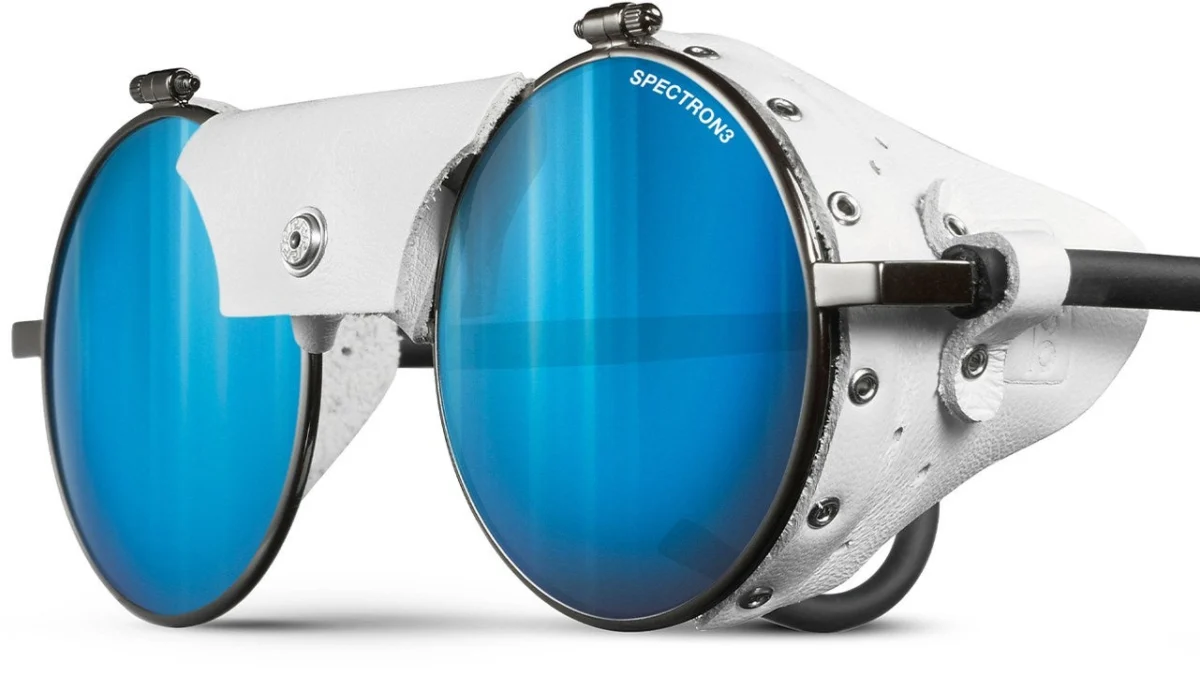
The most defining characteristic of the Vermont Classic is its utilization of supple leather side shields, complemented by a matching leather piece affixed to the bridge of the nose. In high-altitude mountaineering environments, harsh sunlight is only part of the equation. Snow blindness—photokeratitis caused by ultraviolet radiation bouncing off pristine snowfields—presents a severe, painful risk to climbers. Traditional sport sunglasses often allow stray light to leak in through the periphery, bouncing off glaciers and rock faces directly into the wearer’s eyes. The leather side shields of the Vermont block lateral glare entirely, creating a micro-environment of deep shade around the eyes. Furthermore, they act as a physical barrier against scouring alpine winds, blowing ice crystals, and particulate matter at high elevations.
Equally unique is the retention system. Eschewing straight arms that rely entirely on side-of-head clamping pressure or a rubberized grip, the Vermont features flexible arm ends bent into the shape of a shepherd’s crook. These metal temples loop securely around the back of the wearer’s ears. For mountaineers navigating steep, technical terrain, scrambling over exposed rock, or enduring heavy winds, this physical hook ensures that the glasses remain anchored to the face even if the wearer trips, looks straight down, or experiences a sudden gust.
Bridging Decades: The Modernization of a Classic
While the silhouette and tactile materials of the Vermont evoke a 1950s aesthetic, the interior technology has undergone quiet, necessary revisions to meet contemporary safety and performance standards. Historically, authentic glacier glasses of the mid-twentieth century relied heavily on mineral glass lenses. While glass offers exceptional optical clarity and scratch resistance, it carries significant drawbacks for high-risk outdoor pursuits: it is heavy, prone to shattering upon violent impact, and can create dangerous shards near the eyes in the event of a fall.
Julbo addressed this vulnerability by integrating modern polycarbonate lenses into the classic frame structure. Polycarbonate offers a remarkable strength-to-weight ratio, providing high impact resistance while drastically reducing the overall weight resting on the bridge of the nose and ears. Crucially, these modern lenses provide 100 percent protection against UVA, UVB, and UVC radiation. This blending of vintage craftsmanship with high-tech material science allows modern adventurers to enjoy the aesthetic and environmental shielding of a traditional mountaineering tool without sacrificing modern ocular protection standards.
Historical Chronology and the Evolution of Julbo
To understand the cultural and functional weight of the Vermont Classic, one must look back at the origins of Julbo as a brand and the broader evolution of glacier eyewear. Founded in the Jura region of France in the late 19th century by Jules Baud, the company initially manufactured optical glasses for crystal hunters in the Chamonix valley who needed protection against blinding mountain light. As mountaineering transitioned from an elite aristocratic pursuit into an organized global sport in the early-to-mid 20th century, the demand for specialized ocular protection surged.
By the 1950s, Julbo had established itself as a pioneer in technical eyewear, developing early iterations of sun-protection glasses equipped with side shields. The design language crystallized during this era, responding directly to the needs of legendary French mountaineers conquering the high peaks of the Alps, the Andes, and the Himalayas. These glasses became standard-issue equipment for expeditions tackling extreme altitudes where thin air filters less ultraviolet radiation and snow cover reflects up to 80 percent of UV rays.
Over the decades, as synthetic plastics took over the consumer market in the 1980s and 1990s, the vast majority of eyewear manufacturers abandoned metal frames and leather components in favor of injection-molded, lightweight synthetics. Yet, Julbo kept the Vermont design alive in its catalog as a heritage piece. Rather than fading into obscurity, the model experienced periodic resurgences, adopted not just by traditional alpinists, but by fashion-forward urbanites, winter sports enthusiasts, and outdoor gear historians who prized its unmistakable retro-industrial look.
The Great Divide: Cultural Perception and Aesthetic Polarization
Inside outdoor editorial teams and around alpine basecamps, the Julbo Vermont Classic occupies a uniquely contradictory space. Observers generally fall into two distinct ideological camps: those who view the glasses as unacceptably archaic, and those who consider them the pinnacle of timeless cool.
Critics of the design often point to its lack of versatility in lower-altitude, everyday environments. Wearing leather-shielded glacier glasses while walking through a suburban park or driving on a sunny afternoon can easily draw bewildered stares. The physical profile is undeniably bulky compared to frameless or minimalist sunglasses, and the specialized ventilation required to prevent fogging behind the leather shields can sometimes feel excessive for casual hiking.
Conversely, proponents argue that the Vermont offers a bold, authentic statement in a sea of homogenized outdoor gear. In an era where outdoor apparel has become increasingly uniform, corporate, and performance-obsessed, donning a pair of metal-and-leather glacier glasses signals an appreciation for mountaineering history and functional purism. For these enthusiasts, the polarized opinions surrounding the glasses are a feature, not a bug; the Vermont does not try to please everyone, nor does it blend into the background.
Broader Implications for the Outdoor Gear Market
The enduring popularity and periodic discounting of the Julbo Vermont Classic highlight a broader trend within the outdoor recreation industry: the commodification of nostalgia and heritage. As consumers experience fatigue from rapid product lifecycles and hyper-modern, disposable gear, heritage brands that possess genuine historical archives are finding commercial success by reintroducing legacy designs.
However, the Vermont survives not merely as a fashion novelty, but because its core engineering solves a genuine environmental problem. As climate change alters alpine landscapes, increasing the prevalence of exposed rock, melting glaciers, and intense solar reflection at high altitudes, the demand for robust, high-coverage eye protection remains as relevant today as it was in the 1950s.
Ultimately, the Julbo Vermont Classic Glacier Glasses represent a rare synthesis of form and function that has successfully bridged nearly a century of outdoor recreation. Whether viewed as an eccentric fashion statement or an essential piece of high-alpine survival gear, these sunglasses continue to challenge contemporary notions of what outdoor equipment should look like, proving that true utility never truly goes out of style.