The rugged expanses of the Eurasian steppe have long served as a testament to biological resilience, a landscape where few species endure the extremes of blistering summers and freezing winters. Among the most remarkable survivors of this unforgiving environment is the saiga antelope (Saiga tatarica), an ancient migratory ungulate whose lineage stretches back to the Pleistocene epoch. Once sharing a continent with woolly mammoths and saber-toothed cats, the saiga has outlived many of its prehistoric contemporaries through continuous, large-scale nomadic movements. Today, however, these resilient mammals face a modern existential crisis. As rapid industrialization, border fencing, and linear infrastructure carve up the Central Asian plains, conservationists are locked in a high-stakes race to preserve the ancient migratory pathways of one of the world’s most unique herbivores.
Chronology of a Crisis: From Prehistoric Survivors to Modern Fragmentation
For hundreds of thousands of years, saiga herds moved freely across an uninterrupted expanse stretching from the foothills of the Caucasus Mountains to the semi-arid plains of Mongolia. Historical records and archaeological findings, including cave paintings dating back to the seventh century BCE, illustrate a deep coexistence between the saiga and human nomadic cultures. In many ways, the migration of early human populations across Central Asia—paving the way for what would eventually become the legendary Silk Road—was guided by the intuitive movements of these animals, which instinctively tracked seasonal availability of water and pasture.
The twentieth century, however, introduced profound disruptions to this ancient equilibrium. Under the Soviet Union, mandatory sedentarization policies forced traditionally mobile human populations into permanent agricultural settlements, effectively halting centuries-old nomadic traditions. While human settlement patterns shifted toward urbanization, the saiga continued its annual migrations, albeit across an increasingly partitioned landscape.
The turning point for contemporary saiga conservation arrived in the post-Soviet era, marked by a surge in poaching during the 1990s and 2000s—primarily driven by the demand for male horns in traditional Asian medicine—followed more recently by catastrophic epizootic events, such as the 2015 die-off that wiped out more than 200,000 animals in a matter of weeks. Compounding these biological pressures, the rapid expansion of linear infrastructure over the past two decades has erected physical barriers that cut right through historical migration corridors.
Field Audits and Behavioral Insights: The Rutting Season
Gaining insight into the current status of these animals requires rigorous fieldwork in some of the most remote regions of western Kazakhstan. Conservation efforts are spearheaded by organizations such as the Association for the Conservation of Biodiversity of Kazakhstan (ACBK). Field audits conducted during critical seasonal milestones, such as the late-autumn rutting, provide vital data on population health, spatial distribution, and behavioral adaptations.
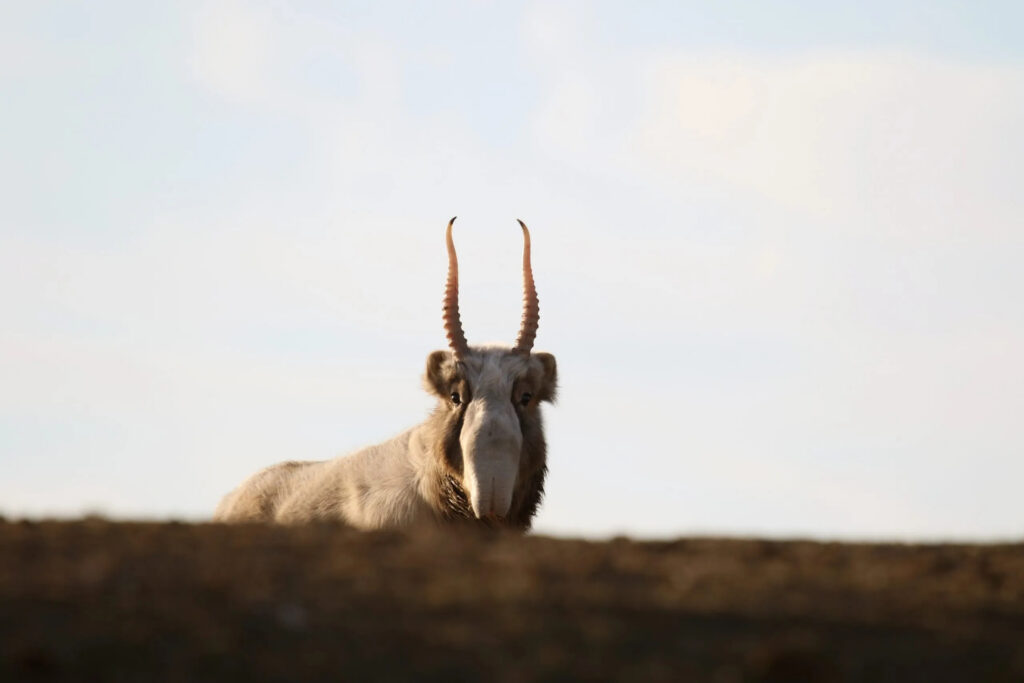
The saiga rut is a biological spectacle defined by intense physical exertion. Males engage in aggressive headbutting and territorial displays to vie for female attention, driven by the biological imperative to pass on their genetic traits. Females, meanwhile, exhibit selective mating preferences, notably prioritizing males with large, pendulous snouts. These distinctive, elongated noses are evolutionary masterpieces: they filter out abrasive dust during the dry summer months and warm frigid winter air before it reaches the lungs. During the height of the rut, males expend so much energy on territorial defense and courtship that many succumb to extreme physical exhaustion.
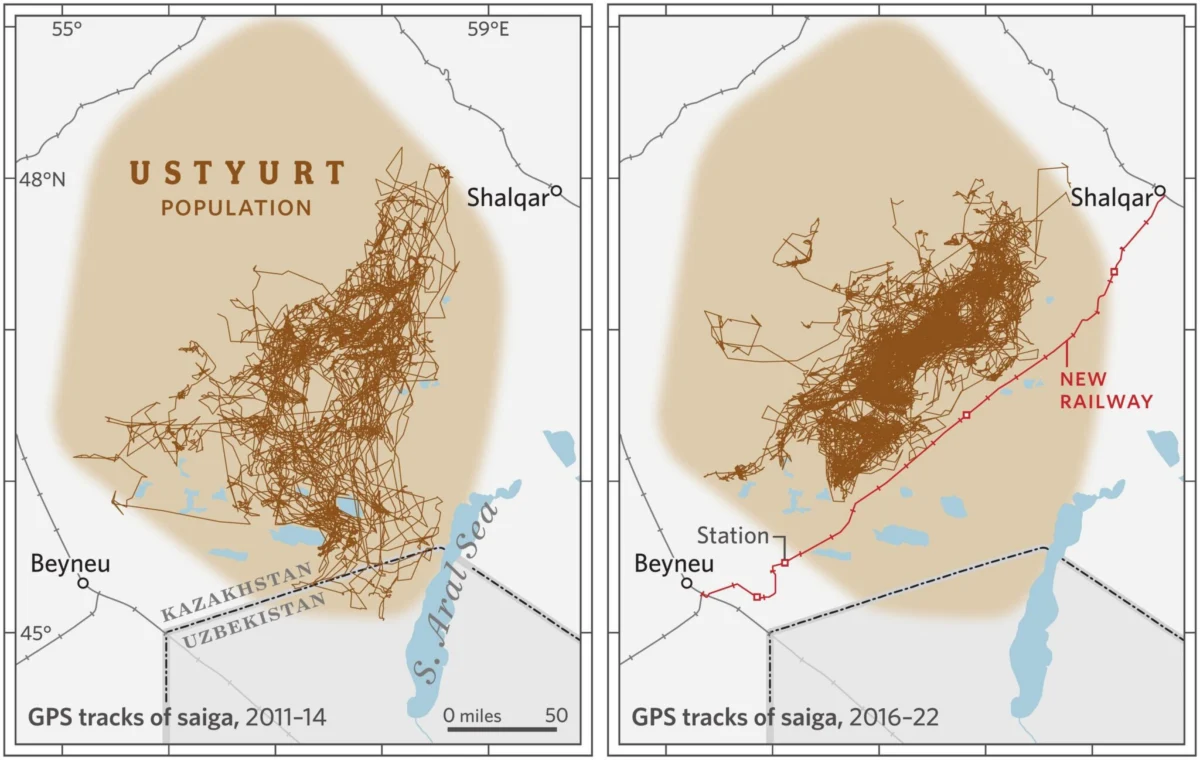
Monitoring these massive, fast-moving herds across a treeless landscape was historically a matter of guesswork, often requiring conservationists to spend weeks traversing boundless tracts of land. Today, the deployment of advanced GPS satellite telemetry has revolutionized monitoring capabilities, allowing researchers to track real-time movements and identify critical bottlenecks where human development intersects with wildlife routes.
Infrastructure and the Erosion of Spatial Knowledge
Data collected by ACBK and partner agencies reveal a disturbing trend: linear infrastructure—particularly railways, highways, and high-tensile wire fences—acts as an absolute barrier to migration. A poignant example documented by conservationists involves a population of GPS-collared saigas that historically migrated deep into Uzbekistan each winter. The construction of a new railway line in 2014 effectively severed this route. Post-construction tracking data shows individual animals milling about despondently on the northern side of the tracks, unable to cross while essential grazing lands and water sources wither on the southern side.
This artificial fragmentation triggers what scientists describe as a collapse in spatial knowledge. Much like human nomadic societies that lost their ancestral navigation skills when forced into sedentary farming, young saigas learn migration routes through active participation and social transmission from older generations. When physical barriers block these routes, entire segments of traditional migratory culture fade from collective memory. The severance of these paths threatens to turn once-vast nomadic populations into isolated, genetically vulnerable remnants.
Official Responses and Mitigation Strategies
Recognizing the severity of the threat, the Kazakh and Uzbek governments, in close collaboration with non-governmental conservation organizations, have initiated targeted infrastructural interventions designed to restore connectivity across the steppe.
In Kazakhstan, recent conservation legislation has established dedicated wildlife sanctuaries informed directly by GPS tracking data. Furthermore, ACBK has partnered with regional authorities to construct specialized, saiga-friendly crossing points along railway lines. These structures feature gently sloping dirt ramps that match the elevation of the tracks, creating a visual illusion of a natural break in the rail barrier. Strategic placement of distant cattle-guard fencing prevents direct collisions between fast-moving locomotives and the skittish ungulates, ensuring safety for both wildlife and rail transport.
Similarly, international cooperation has yielded pragmatic adjustments to border security infrastructure. Along the Kazakhstan-Uzbekistan border, traditional solid barbed-wire barriers—which historically proved lethal or impassable to migrating herds—have been systematically redesigned into X-shaped barricades. These modifications successfully deter unauthorized vehicular traffic while leaving precise ground-level clearances that allow saigas to step through safely.
Broader Impact and Implications for Conservation
The plight of the saiga antelope serves as a bellwether for large-scale migratory species worldwide. As global demand for transportation corridors and resource extraction increases, ecosystems are increasingly carved into fragmented ecological islands. The ongoing efforts in Central Asia demonstrate that modern development does not inherently require the permanent destruction of migratory pathways, provided that infrastructure planning incorporates robust biological data and cross-border cooperation.
Experts emphasize that the long-term survival of the saiga relies not only on halting illegal trade and mitigating disease risks, but on restoring the functional integrity of the Eurasian steppe. By bridging the gaps created by asphalt and steel, conservationists hope to ensure that the iconic trumpet of the saiga continues to echo across the frost-bitten plains for generations to come, preserving a living link to a prehistoric world.