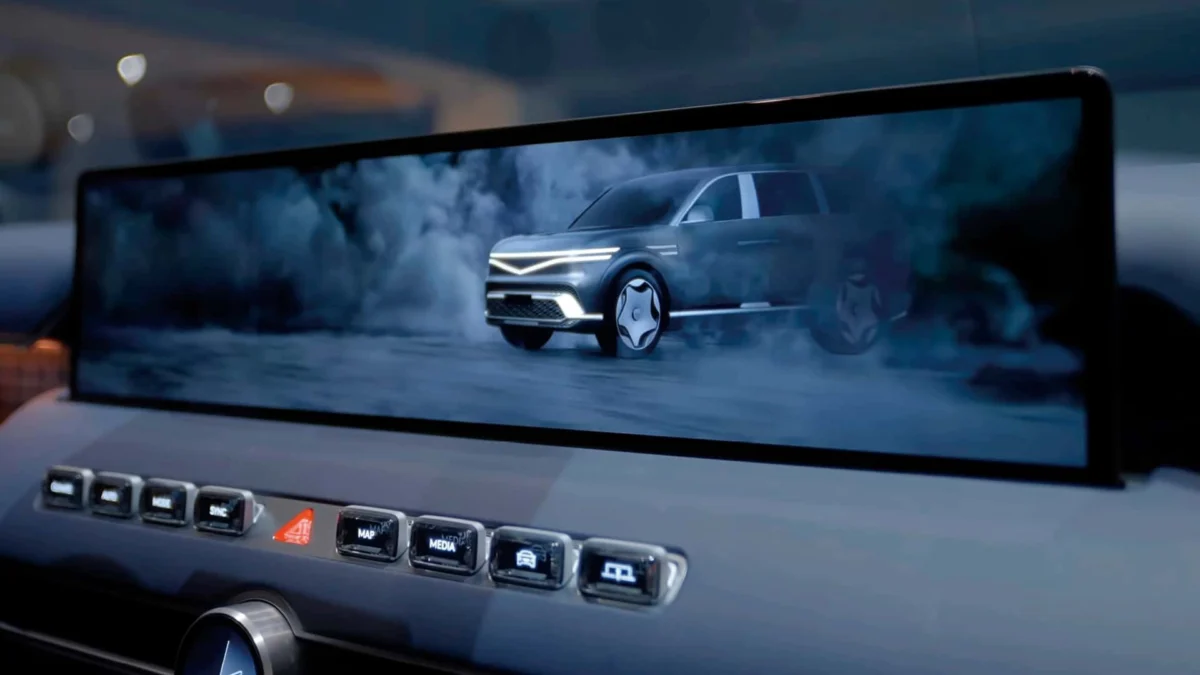
Modern automotive design has reached a point of digital saturation, where the dashboard is no longer a collection of gauges and tactile switches, but an expansive canvas for high-definition glass. As manufacturers compete to claim the largest display area, the industry has shifted from static screens toward dynamic, motorized interfaces. The upcoming Genesis GV90 represents the zenith of this trend, introducing a proprietary retractable OLED display system that transforms from a functional driving interface into a theater-like cinematic experience.
The Evolution of the Digital Cockpit
The trajectory of in-car infotainment over the last decade has moved from small, recessed center consoles to the "hyperscreen" era. Companies like Mercedes-Benz, BMW, and Lucid have pushed the boundaries of width, often stretching displays from door to door. Genesis, the luxury arm of the Hyundai Motor Group, has opted for a more sophisticated approach with the GV90. Rather than simply adding more surface area, the brand has focused on the duality of the cabin environment.
The GV90’s interior design philosophy centers on the "luxury lounge" concept, an attempt to bridge the gap between a traditional vehicle cabin and a private living space. The centerpiece of this effort is a motorized OLED display that physically alters its dimensions based on the vehicle’s operational status. When the driver is in control, the system maintains a 23.6-inch diagonal display to ensure critical driving information remains prioritized and within the peripheral field of vision. Once the vehicle enters a parked state—facilitated by the advanced autonomous or stationary systems integrated into the GV90 platform—the unit undergoes a mechanical shift, rising 3.5 inches (90 millimeters) to reveal a 24.6-inch panel.
Engineering Complexity and Structural Rigidity
The transition from a static display to a motorized one introduces significant mechanical hurdles. Engineers at Genesis were tasked with maintaining a weight-efficient structure while ensuring the display remains stable during high-speed driving and vibration-heavy road conditions. The addition of a motor, gear assembly, and vertical guides creates a potential vulnerability: screen flutter.
To mitigate this, the engineering team bypassed traditional dashboard mounting methods. Instead, the entire display assembly is anchored directly to the structural crossbar behind the dashboard. This steel backbone provides the necessary rigidity to prevent harmonic vibrations from affecting the visual output.
The testing phase for this mechanism was extensive. According to internal documentation, the display underwent more than 100,000 deployment cycles. To ensure global viability, the system was subjected to extreme thermal testing. A specific environmental stress test involved operating the mechanism at -22°F (-30°C) to ensure the lubrication and electronic actuators maintained consistent performance. Furthermore, the acoustic profile of the movement was capped at 40 decibels, ensuring that the deployment is silent enough to avoid disrupting the quiet luxury aesthetic of the cabin.
Safety Protocols and Airbag Integration
One of the most complex challenges in moving dashboard components is maintaining compliance with Federal Motor Vehicle Safety Standards (FMVSS), particularly concerning Supplemental Restraint Systems (SRS). Any motorized component in the path of an airbag deployment zone poses a significant liability.
The Genesis GV90 system is designed with a "failsafe" retraction protocol. In the event of an impact detected by the vehicle’s sensor array, the screen is programmed to retract into its stored position instantly. This ensures that the display does not become a projectile or a barrier during passenger airbag deployment. The system’s placement was calculated to provide a clear clearance path, satisfying rigorous safety audits that remain the primary hurdle for any interior feature that occupies the top section of the dashboard.
Cultural Context and Global Market Adoption
The shift toward "in-car entertainment" as a primary product feature is largely driven by shifting demographics in the Asian market, particularly China. In these regions, the chauffeur-driven experience or the "third space" concept—where the car acts as a retreat between the office and the home—is a dominant consumer expectation. For these buyers, high-quality audio-visual capabilities are as important as powertrain performance.
In the North American and European markets, the adoption rate of in-car streaming is historically lower, often limited to charging intervals for electric vehicles. However, as the GV90 positions itself as a technological flagship, Genesis is betting that the novelty and functional utility of a larger screen will appeal to a broader demographic. By offering a media interface that supports streaming services and live television, the GV90 transforms the vehicle into a mobile cinema, theoretically increasing the vehicle’s utility for families and commuters who spend significant time waiting in parked vehicles.
Comparative Analysis of Display Trends
When compared to the industry standard, the GV90’s approach is unique. Most competitors, such as the BMW i7 with its "Theater Screen" that descends from the roof, focus on rear-passenger entertainment. Genesis, by contrast, focuses on the front-row experience. This design choice implies a belief that the driver, too, should be entitled to an immersive entertainment experience when the vehicle is stationary.
The 70% increase in viewable area provided by the 3.5-inch elevation might seem marginal on paper, but in the context of high-resolution OLED technology, it represents a significant shift in aspect ratio and usability. By optimizing the screen for media playback when parked, Genesis is prioritizing the "user experience" over the "driver experience," a subtle but profound pivot in how the luxury SUV segment is defined.
Implications for Future Automotive Design
The development of the GV90’s display is a microcosm of the current automotive arms race. Manufacturers are moving away from purely performance-based specifications—such as 0-60 times or horsepower—toward "lifestyle-based" specifications. If the GV90 proves successful, it is likely that competitors will look toward similar motorized solutions that allow for a clean, minimalist aesthetic while driving, coupled with high-tech, maximalist displays for leisure.
However, the cost of this complexity is non-trivial. Every motorized component is a potential point of failure. As vehicles age, the reliability of these mechanical screen guides will be tested. Furthermore, the integration of such a large, complex display requires sophisticated software management to ensure that the transition between "driving mode" and "lounge mode" is seamless and lag-free.
Looking Ahead
The Genesis GV90 is slated to be a flagship that sets the tone for the brand’s future portfolio. Beyond the screen, the vehicle is expected to feature high-capacity battery architectures and advanced driver-assistance systems (ADAS) that will eventually enable more autonomous capabilities.
As the industry moves toward Level 3 and Level 4 autonomy, the interior will become the primary battleground for brand differentiation. The ability of the GV90 to pivot from a functional cockpit to a high-fidelity lounge indicates that Genesis is preparing for a future where the act of driving is secondary to the experience of occupying the space.
While critics may argue that the complexity of a rising screen is an unnecessary luxury, the commitment shown by the engineering team—evidenced by the 100,000-cycle testing regime and the rigorous cold-weather trials—demonstrates that this is not a mere afterthought. It is a calculated, engineered feature intended to cement the GV90’s status as a premium, forward-thinking vessel. Whether this will be the standard for all future luxury vehicles remains to be seen, but for now, it stands as a testament to the lengths to which manufacturers will go to capture the attention of an increasingly digital-native consumer base.
The GV90 does not just provide a screen; it provides a theatrical event. By choosing to prioritize the cabin’s atmosphere, Genesis has signaled that the next generation of luxury SUVs will be judged as much by their internal theater as by their performance on the open road. As the automotive sector moves deeper into the era of electrification and connectivity, such features will likely move from the "optional" category to the "expected" standard for the luxury segment.