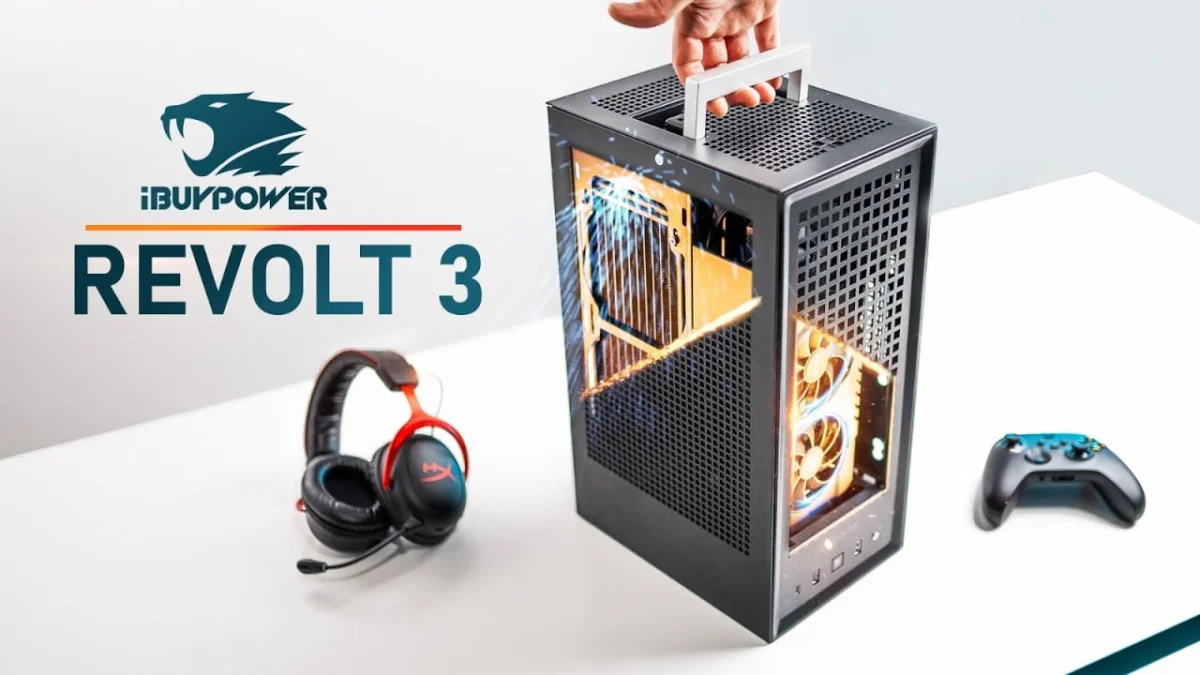
The hardware landscape is witnessing a notable shift as traditional system integrators expand their product portfolios to include standalone component manufacturing. iBUYPOWER, globally recognized for engineering high-performance pre-built gaming desktops and production workstations, is officially making its debut in the independent PC enclosure market. The centerpiece of this strategic expansion is the Revolt 3, an innovative vertical ITX chassis initially unveiled to the public at the Consumer Electronics Show (CES). Originally designated under the working title Revolt 3 MK3, the moniker has since been streamlined for commercial release. Expected to launch globally around July 2021, the Revolt 3 will be distributed both as a standalone hardware product under a dedicated sub-brand and integrated directly into iBUYPOWER’s proprietary high-end desktop configurations.
Product Architecture, Pricing Strategies, and Consumer Feedback Integration
As iBUYPOWER prepares for the commercial manufacturing phase, the company has adopted an open-feedback methodology to finalize critical product specifications, pricing models, and aesthetic variations. Market analysts note that hardware manufacturers increasingly rely on direct community engagement during the prototype phase to optimize supply chain efficiency and consumer satisfaction.
The primary marketing decision centers on product bundling. iBUYPOWER is evaluating two distinct purchasing tiers for the Revolt 3. The first option proposes a standalone chassis priced at approximately $90 USD, catering to enthusiasts who prefer utilizing existing components, such as standard SFX or SFX-L power supplies. The second option introduces an all-inclusive bundle priced at roughly $200 USD, which incorporates an 80Plus Gold-certified SFX-L power supply rated at 700 watts. This bundled tier features custom-length, pre-routed cabling designed specifically for the chassis dimensions, aiming to streamline the initial assembly process and eliminate common cable management hurdles associated with small form factor (SFF) builds.
Simultaneously, iBUYPOWER is seeking public consensus regarding the aesthetic presentation of the front mesh panel situated adjacent to the graphics card chamber. Current prototype iterations feature interchangeable colored mesh options, including black, silver, off-white, and gold. While metallic silver harmonizes cleanly with the broader industrial design of the chassis enclosure, and gold offers a distinct, cozy visual identity, design critics emphasize the necessity of balancing aesthetic novelty with holistic spatial integration.
Form Factor, Exterior Design, and Physical Ergonomics
Measuring approximately 18.4 liters in total volume, the Revolt 3 occupies a unique dimensional footprint within the competitive vertical ITX market. While it exceeds the spatial envelopes of compact alternatives such as the NZXT H1, the SSUPD Meshlicious, and the Corsair ONE, its slender, tower-like geometry successfully minimizes its visual footprint, placing it in direct competition with modular enclosures like the SilverStone Sugo SG14 and SG15.
The architectural layout eschews tempered glass in favor of a mesh-centric ventilation paradigm. Perforated metal panels encase the chassis on all sides, drawing inspiration from high-airflow design philosophies popularized by contemporary SFF competitors. The front-facing GPU chamber utilizes a coarse, utilitarian metal mesh that doubles as an aesthetic accent but presents a noticeable barrier to optimal airflow. Conversely, the remaining side and top panels feature slide-in magnetic dust filters designed for tool-less removal and routine maintenance.
Ergonomic considerations are evident throughout the exterior framework. Dual retractable, low-profile headphone holders are integrated flush into both the left and right sides of the chassis, offering functional utility for peripherals while maintaining clean structural lines. Furthermore, a spring-loaded, push-to-release carrying handle is recessed into the top panel. Engineered to support the cumulative weight of a fully populated hardware build, this handle enhances portability, though industry observers have suggested that stamping the exact weight tolerance directly onto the chassis would improve user confidence during transit.
Electrical routing and input/output (I/O) connectivity reflect meticulous attention to spatial efficiency. Uniquely, the Revolt 3 features a rear-mounted power switch linked to an internal power extension cable, allowing users to control system power without interacting directly with the recessed internal power supply unit. The top-accessible front I/O panel includes dual USB 3.0 ports, a unified 4-pole headset audio jack, and a USB-C Gen 2 port. In the prototype stage, the USB-C interface functions via an external pass-through cable that routes to the motherboard rear I/O. However, iBUYPOWER has indicated that mass-production units may feature a modular internal header swap mechanism, requiring only two screws to transition between external pass-through and internal header connectivity—a versatile engineering approach rarely observed in competing enclosures.
Internal Layout, Hardware Compatibility, and Assembly Dynamics
The interior spatial organization of the Revolt 3 is engineered to maximize component compatibility without compromising structural integrity. The layout accommodates high-end hardware profiles typically reserved for larger mid-tower systems.
At the upper echelon of the internal cavity rests the power supply mounting bracket, compatible with both SFX and SFX-L form factors. Positioned directly beneath is the ITX motherboard tray, oriented with the rear I/O facing downward to streamline cable exits. Significantly, the enclosure supports triple-slot graphics cards up to substantial lengths without requiring a flexible PCI Express riser cable. By mounting the GPU directly to the motherboard PCIe slot, iBUYPOWER mitigates common industry challenges associated with PCIe Gen 4 riser cable signal degradation, black screen phenomena, and elevated manufacturing costs.
Cooling infrastructure support is robust for a sub-20-liter chassis. The internal swivel radiator bracket accommodates liquid cooling setups utilizing 240mm or 280mm radiators, providing approximately 58mm of combined clearance for radiator core and fan thickness. Alternatively, users may install traditional CPU tower air coolers up to 140mm in height. Storage versatility is maintained via a dedicated bracket behind the GPU capable of housing two 2.5-inch solid-state drives, alongside an additional convertible mount adjacent to the power supply that accommodates either a 3.5-inch mechanical hard drive or supplementary cable routing space.
Despite these advanced compatibility metrics, the assembly process exposes distinct areas for design refinement. The factory-provided power supply cables, while perfectly tailored to ITX dimensions to eliminate excess slack, utilize a dense, low-profile ribbon construction that poses compression challenges when stashed within confined spatial corridors. Additionally, the integrated radiator swing-bracket lacks a mechanical locking mechanism in the open position, requiring builders to manage pivoting components manually during liquid cooling installation.
Cable management provisions present a mixed user experience. While specialized cutouts and a dedicated top-side cable compression cover successfully prevent PCIe power leads from bulging against the side panels, the main power supply shroud in prototype units exhibits a tendency to bow outward under heavy cable density. This structural deflection slightly encroaches upon the primary graphics card chamber. Recognizing this limitation, engineering communications confirm that iBUYPOWER plans to reinforce the power supply shroud architecture prior to full-scale mass production.
Thermal Performance and Airflow Analysis
Thermal efficacy within the Revolt 3 relies heavily on the balance between intake ventilation and exhaust dissipation. Empirical testing of the prototype reveals stable, well-controlled temperatures for high-performance graphics cards, facilitated by unobstructed side-panel clearance and dedicated top-panel mounting slots capable of housing dual 80mm auxiliary fans to assist with GPU heat extraction.
Conversely, CPU thermal metrics under sustained workloads indicate room for optimization. Because the primary thermal exhaust pathway routes through the liquid cooling radiator, CPU temperatures are occasionally impacted by the thermal output of adjacent GPU components. Furthermore, the coarse mesh configuration utilized across the exterior panels—while durable—exhibits static airflow restriction compared to fine-mesh alternatives seen in larger enterprise chassis lines. Thermal engineers suggest that transitioning to high-permeability fine mesh in the final commercial release could substantially improve ambient airflow dynamics without compromising structural rigidity.
Market Implications and Industry Outlook
The introduction of the Revolt 3 represents a significant strategic diversification for iBUYPOWER. By transitioning from a pure-play system integrator to an independent component manufacturer, the company positions itself to capture market share within the rapidly expanding small form factor enthusiast ecosystem.
The success of the Revolt 3 will largely depend on consumer reception of the proposed pricing tiers and the thoroughness of iBUYPOWER’s engineering refinements prior to the anticipated July 2021 launch window. Addressing prototype vulnerabilities—specifically regarding shroud reinforcement, cable management density, and panel airflow impedance—will be critical in establishing the Revolt 3 as a viable competitor against established SFF stalwarts. Ultimately, by combining tool-less accessibility, robust multi-slot GPU compatibility, and versatile liquid cooling support within a compact vertical footprint, iBUYPOWER demonstrates a serious commitment to meeting the rigorous demands of modern PC builders.