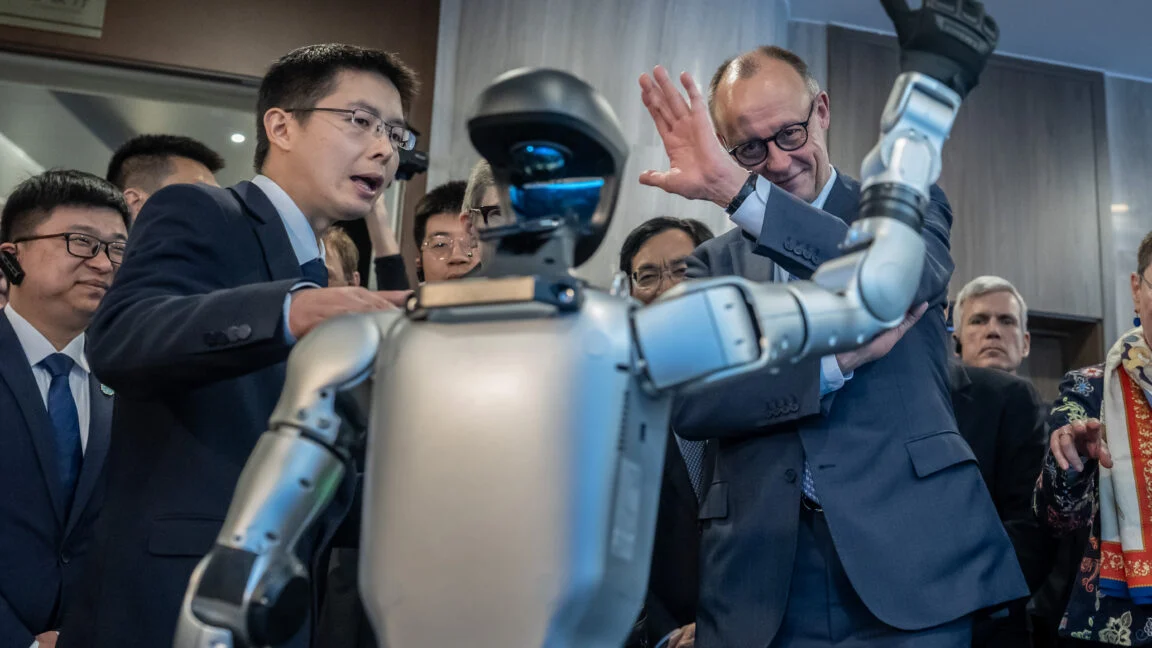
The rapid ascent of the humanoid robotics sector has placed companies like Unitree Robotics at the forefront of a technological race to bridge the gap between mechanical dexterity and cognitive autonomy. As Unitree moves through its recent initial public offering (IPO), the company finds itself caught between the promise of revolutionary physical AI and the constraints of a centralized, high-pressure management culture. While founder Wang Xingxing pivots toward integrating large AI models into the company’s robotics stack, internal reports suggest that the firm’s operational style is creating significant friction, leading to record levels of staff attrition and concerns regarding the scalability of its leadership model.
The Shift Toward Physical AI Foundations
For years, the robotics industry has grappled with the "General-Purpose Autonomy" problem—the ability of a machine to navigate, manipulate, and learn from novel environments without bespoke programming. Historically, Wang Xingxing has been a vocal skeptic of large world models, often citing the immense computational costs and the potential for latency issues in real-time robotic control systems. However, the landscape of 2026 has forced a strategic reappraisal.
During the company’s recent IPO proceedings, Wang outlined a new vision for Unitree, moving away from rigid, task-specific automation toward a more fluid "physical AI." According to industry reports from Caijing Magazine, the company is now actively developing a framework designed to achieve what Wang describes as an "autonomous loop." This cycle encompasses perception, decision-making, execution, evaluation, learning, and systemic evolution. By embedding large-scale neural architectures directly into the robot’s hardware stack, Unitree aims to enable its machines to perceive their surroundings with human-like contextual awareness.
This shift marks a significant pivot. By attempting to unify the mechanical prowess of their bipedal platforms with the predictive capabilities of large models, Unitree is positioning itself to compete with industry giants like Tesla’s Optimus and Boston Dynamics. Yet, the technical feasibility of running such "compute-heavy" models on edge hardware remains a point of contention among robotics engineers, who argue that the latency inherent in massive model inference could compromise the safety and reaction times of a humanoid robot in dynamic environments.
The Management Paradox: Scaling a Startup Culture
While the technical roadmap points toward an ambitious, automated future, the human reality at Unitree appears increasingly strained. Wang Xingxing, a hardware structural engineer by trade, has cultivated a corporate culture that reflects his own intense, hyper-focused work ethic. This "hard-charging" style, while perhaps instrumental in the early days of a bootstrapping startup, is currently facing scrutiny as the company scales.
Current and former employees describe a workplace environment defined by extreme micromanagement. Wang is reportedly a fixture in the office seven days a week, often communicating with staff via work chats at 2:00 or 3:00 a.m. His communication style is described as blunt and strictly business-oriented, with reports indicating that he frequently cuts off subordinates during discussions to expedite decision-making.
The most striking indicator of this centralized control is the company’s expense approval process. Employees have reported that any reimbursement exceeding 100 yuan—roughly equivalent to $15—requires the direct, personal approval of the founder. In a company that has ballooned to at least 480 employees, this bottleneck creates significant administrative friction. Management experts note that such a structure, while designed to keep "burn rates" low and operational efficiency high, typically creates a "chokepoint effect," where middle management is disempowered and innovation is throttled by the need for constant executive validation.
Chronology of Growth and Internal Friction
The growth trajectory of Unitree Robotics has been nothing short of meteoric. Founded in the mid-2010s, the company quickly established itself as a leader in quadrupedal robotics before transitioning to humanoids.
- 2023–2024: Unitree releases several iterations of its humanoid platforms, gaining global attention for the cost-efficiency of its designs compared to Western counterparts.
- Early 2025: As the company expands its workforce to meet production demands, the first signs of structural stress emerge. The shift toward AI-heavy robotics necessitates a massive influx of software talent, clashing with the existing hardware-centric culture.
- Late 2025–2026: The period identified by employees as the "highest attrition in history." The intensity of the work environment, coupled with the IPO pressure, leads to a significant exodus of core engineering and managerial staff.
- Mid-2026: Unitree files for an IPO. During the roadshow and investor outreach, Wang publicly pivots his stance on large world models, signaling a shift in the company’s R&D priority.
- Late 2026: Reports from Caijing Magazine and Rest of World surface, detailing the disconnect between the company’s public technical vision and its internal culture.
The Incentive Structure and Staff Attrition
Central to the internal complaints is the company’s incentive architecture. Employees report that the reward system is heavily skewed toward punitive measures rather than positive reinforcement. In a competitive, high-stakes environment, the internal culture has reportedly devolved into a contest of "who receives the least criticism" rather than "who achieves the most success."
The reported performance review system is equally unconventional. Sources claim that senior executives were assigned performance scores on a scale of 0 to 1.5, with many receiving a score of 1—a metric that, in the context of the company’s high-pressure environment, reportedly served as a blunt instrument for discipline rather than a developmental tool. This environment has resulted in what observers describe as a "brain drain," as highly skilled engineers—who are in short supply in the global robotics sector—leave the firm for competitors with more stable or collaborative work cultures.
Official Responses and Media Controversy
Following the publication of these reports, Unitree Robotics issued a broad, company-wide statement characterizing the media coverage as containing "substantial misinformation." However, the company stopped short of providing specific rebuttals or clarifying which aspects of the reporting were factually inaccurate. This lack of transparency has done little to quell concerns among investors, who are increasingly wary of "key-person risk"—the danger that a company’s fortunes are too tightly tethered to the singular, potentially volatile, vision of a founder.
In the robotics industry, where human capital is the primary driver of value, high attrition rates are not merely a human resources issue; they are a direct threat to intellectual property retention and product velocity. If the talent responsible for developing the "autonomous loop" continues to depart, the company’s long-term technical roadmap could be severely compromised.
Broader Implications for the Humanoid Sector
The situation at Unitree offers a case study in the broader challenges facing the "AI-in-a-box" movement. As humanoid robotics moves from the laboratory to the factory floor, the requirements for success are shifting. It is no longer enough to build a mechanically sound robot; companies must now build stable organizations capable of managing the complex, cross-disciplinary integration of hardware, software, and artificial intelligence.
The tension at Unitree highlights three critical risks for the sector:
- The Scalability of Leadership: Founders who thrive in the "garage stage" often struggle to transition to the "corporate stage." The inability to delegate, exemplified by the $15 expense approval rule, is a classic warning sign that a company may be outgrowing its leadership structure.
- The Talent War: The competition for AI and robotics talent is fierce. Companies that fail to provide a sustainable or rewarding culture will inevitably lose their best engineers to competitors, potentially stalling the very "AI evolution" Wang hopes to lead.
- The Gap Between Vision and Execution: While a "perception-to-evolution" loop is an ambitious and scientifically valid goal, it requires a massive, coordinated effort. If the internal culture is defined by fear and micromanagement, the collaborative environment necessary to solve such complex technical problems may not exist.
As Unitree moves forward, it faces a dual challenge. On one hand, it must convince investors that its pivot to large world models is a viable pathway to market-leading autonomy. On the other, it must stabilize its internal operations to prevent further loss of the human capital necessary to realize that vision. Whether the company can move past its current period of friction will depend on its ability to evolve its leadership style as rapidly as it evolves its machines. For now, the robotics world is watching closely, noting that in the quest for artificial intelligence, human culture remains the most difficult variable to program.