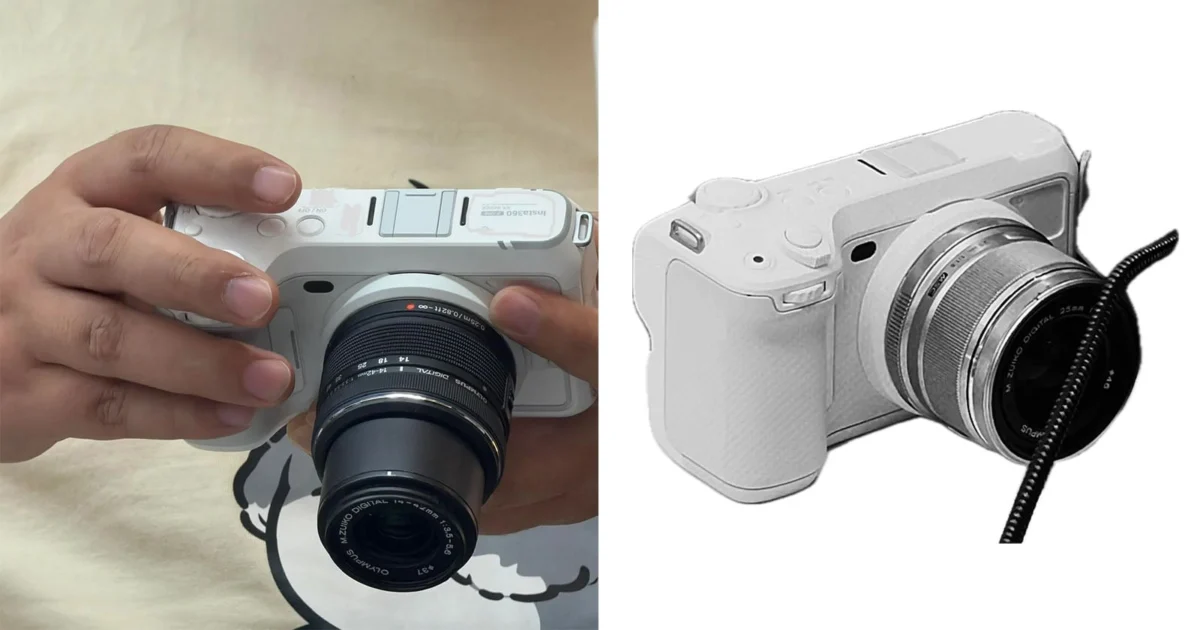
In a development that has sent ripples of intrigue through the photography and videography communities, leaked images have emerged, strongly suggesting that Insta360, a company renowned for its innovative 360-degree and action cameras, is preparing to enter the highly competitive Micro Four Thirds (MFT) interchangeable lens camera market. This potential move represents a significant departure from Insta360’s established product lines and raises compelling questions about the company’s strategic direction and its intentions for the future of imaging technology.
The genesis of this speculation can be traced back to January of this year, when Jingkang “JK” Liu, CEO and founder of Insta360, shared an enigmatic image on the Chinese social media platform Weibo. The photograph depicted Liu holding an as-yet-unidentified white camera while seemingly capturing an image of another new product. At the time, the details were scarce, obscured by the angle and the inherent mystery of a teaser. However, the recent leak, initially appearing on the Chinese video-sharing platform Bilibili before being swiftly removed, provides a far more comprehensive glimpse, aligning strikingly with the camera hinted at by Liu.
Leaked Images Reveal Traditional Camera Design
The leaked images, which have since been widely circulated across photography news outlets and forums, showcase a camera with a distinctively traditional form factor, a significant contrast to Insta360’s typically avant-garde designs. The camera boasts a white chassis, echoing the color scheme of the device Liu displayed on Weibo. Crucially, the leaked photographs reveal a series of familiar camera controls on the top and front of the body, including a command dial, a shutter release button, and a mode dial. This suggests a user interface geared towards manual control and a photography-centric experience.
Perhaps the most definitive detail emerging from the leaks is the camera’s lens mount. The images clearly indicate that the camera utilizes the Micro Four Thirds standard. This revelation is particularly noteworthy for several key reasons. The Micro Four Thirds system, jointly developed by Panasonic and Olympus (now OM System), is a well-established standard known for its compact camera bodies and a wide array of high-quality lenses from various manufacturers.
A Strategic Pivot for Insta360?
Insta360 and its parent company, Arashi Vision, are not currently members of the Micro Four Thirds System Group. This absence from the official consortium raises immediate questions about how the company intends to integrate its MFT camera into the existing ecosystem. However, this situation is not entirely unprecedented. GoPro, a major player in the action camera space and a significant competitor to Insta360, recently announced its own upcoming camera featuring a Micro Four Thirds mount, despite also not being an official member of the group. This suggests a growing trend of companies outside the traditional MFT fold exploring the benefits of the mount standard.

The implications of Insta360’s potential MFT entry are multifaceted. Firstly, it signals a bold strategic diversification. Insta360 has built its reputation on pioneering technologies like 360-degree videography with its ONE X series and robust action cameras like the ONE RS and GO series. Venturing into the interchangeable lens camera market, particularly with a system as established as MFT, indicates a desire to capture a broader segment of the imaging market, potentially targeting photographers and videographers who value flexibility and image quality.
Secondly, the design itself is a departure. Insta360’s products are often characterized by their unique form factors, designed to push the boundaries of what is possible with portable imaging. A camera that appears to embrace a more conventional SLR-style design suggests that Insta360 might be aiming to offer a compelling alternative within a familiar framework, rather than reinventing the camera body itself. This approach could be a strategic move to appeal to users who are accustomed to traditional camera ergonomics and workflows.
The Micro Four Thirds Advantage and Its Challenges
The choice of the Micro Four Thirds mount is strategically significant. The MFT system offers a unique balance between sensor size and camera/lens dimensions. The smaller sensor size compared to APS-C or full-frame formats allows for more compact and lighter camera bodies and lenses, making them highly portable. This aligns with Insta360’s general philosophy of creating accessible and portable imaging solutions. Furthermore, the MFT mount benefits from a vast and mature lens ecosystem, providing users with a wide range of optical choices, from ultra-wide-angle to telephoto, often at competitive price points.
However, entering the MFT market is not without its challenges. The interchangeable lens camera market is mature and intensely competitive, dominated by established brands like Sony, Canon, Nikon, Fujifilm, and Panasonic and OM System themselves. Insta360 will need to differentiate its offering significantly to carve out a niche. Key considerations will include the camera’s sensor performance, autofocus capabilities, video features, user interface, and, crucially, its price point.
While the leaked images do not appear to show a built-in electronic viewfinder (EVF), this is not uncommon for some MFT cameras, particularly those aimed at specific user segments or designed with extreme compactness in mind. The presence of a hot shoe suggests the possibility of attaching external viewfinders or other accessories.
A Glimpse into Insta360’s Imaging Prowess
Insta360’s expertise in imaging technology is undeniable. The company has consistently pushed the envelope in areas such as image stabilization, artificial intelligence-driven editing, and advanced computational photography, particularly within its 360-degree and action camera lines. Applying this deep understanding of imaging hardware and software to a traditional camera platform could result in a product with unique selling propositions.

The development of a full-fledged interchangeable lens camera is a complex undertaking. It requires mastery of intricate optical design, advanced sensor technology, sophisticated autofocus systems, robust internal processing, and an intuitive user experience. While Insta360 has demonstrated considerable skill in these areas for its existing product categories, the demands of an MFT camera represent a different scale of challenge. The company’s experience with hardware design, autofocus algorithms, image stabilization, and user interface/user experience (UI/UX) will be invaluable. However, the integration of these elements into a system that directly competes with established mirrorless cameras will be a critical test of its engineering capabilities.
Timeline and Future Outlook
The initial tease from CEO JK Liu in January provided the first hint of something new. The subsequent leak, though unconfirmed by Insta360, offers concrete visual evidence and points towards a potential product launch in the not-too-distant future. Given the typical product development cycles in the camera industry, and the fact that leaks of this nature often precede official announcements by a few months, it is plausible that an official unveiling could occur later in 2024 or early 2025.
The broader implications of Insta360’s potential entry into the MFT market extend beyond the company itself. It signals a dynamic and evolving landscape in digital imaging, where established players face increasing pressure from innovative newcomers. The success or failure of Insta360’s MFT camera could influence future market strategies for other tech companies considering diversification into traditional camera segments. It also highlights the enduring appeal of the Micro Four Thirds standard, which continues to attract new manufacturers looking to leverage its established advantages.
As the photography world awaits an official confirmation from Insta360, the leaked images have ignited a fervent discussion about what this new camera might offer. Will it bring Insta360’s signature innovation to a more traditional form factor? Will it incorporate unique AI-powered features or advanced stabilization that sets it apart from its competitors? The answers to these questions will undoubtedly shape the future of the Micro Four Thirds system and further solidify Insta360’s position as a formidable force in the imaging technology arena. The MFT revolution, as some are calling it, may indeed be gaining significant momentum.