










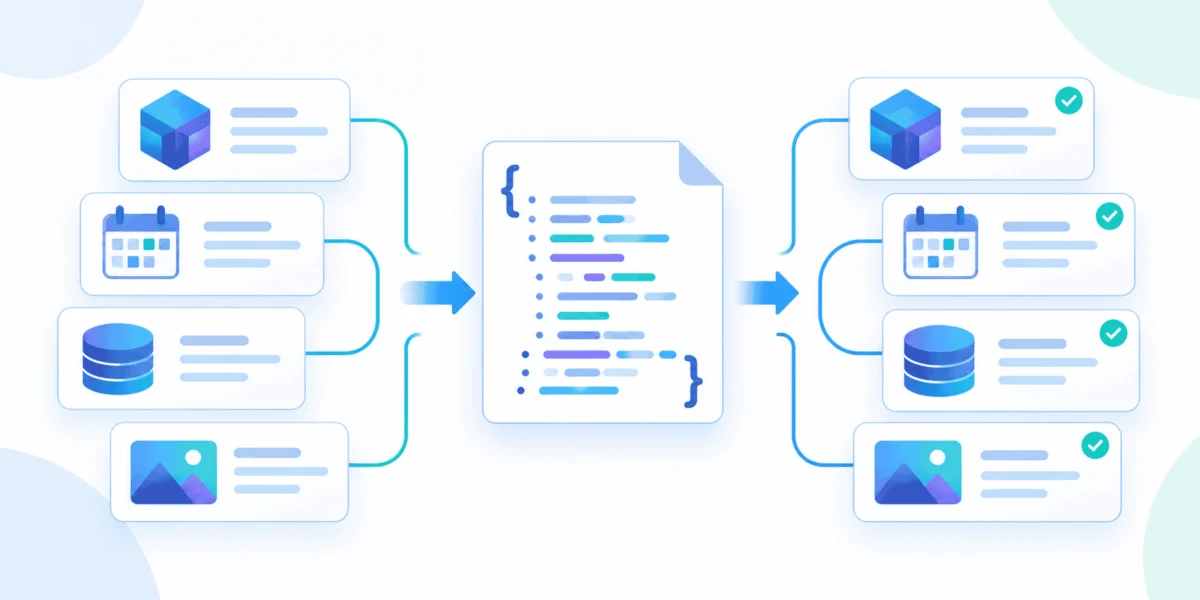
In modern machine learning engineering, data plumbing—the meticulous cleaning, preprocessing, and structuring of datasets—frequently occupies the vast majority of an engineer’s operational bandwidth, often overshadowing the actual design of model architectures. As machine learning systems scale into production environments across distributed microservices, APIs, and cloud-based file repositories, the demand for reliable data serialization and deserialization becomes paramount. Standard data exchange formats like JavaScript Object Notation (JSON) serve as the backbone of modern web infrastructure and configuration management; however, native JSON libraries are inherently limited. They fail to natively parse standard Python-specific types such as datetime objects, sets, pathing constructs, and enumerations. When an engineer attempts to serialize an advanced experiment configuration containing these complex types using standard methods, the execution immediately halts with a TypeError. Addressing these systemic constraints requires the implementation of a comprehensive, production-grade serialization pipeline that not only manages custom data types but also provides graceful error recovery and robust schema migration capabilities.
The Architectural Limitations of Native Serialization in Machine Learning
The evolution of machine learning operations (MLOps) has driven the need for highly detailed, reproducible experiment tracking. Researchers and machine learning engineers routinely store comprehensive configuration parameters, ranging from hyperparameters and feature subsets to file system directories and timestamps. In a typical development lifecycle, an experiment configuration script might declare variables using specialized Python classes. For instance, defining a model type using an Enum, establishing a feature space as a native Python set, referencing dataset locations via the pathlib library, and capturing execution timestamps with datetime objects creates a rich, highly typed runtime environment.
When developers attempt to persist this state using Python’s built-in json.dumps() utility, the runtime environment encounters primitives it cannot map to standard JSON equivalents—strings, numbers, booleans, lists, and dictionaries. The resulting TypeError: Object of type ModelType is not JSON serializable is a frequent bottleneck in automated pipelines. Historically, engineering teams have resorted to ad-hoc conversion scripts, manually casting objects to strings before serialization and writing brittle parsing logic upon ingestion. These manual interventions introduce significant technical debt, heightening the risk of silent data corruption, runtime exceptions, and pipeline failures during critical batch training phases.
Developing a Custom Encoder for Complex Data Structures
To overcome the native limitations of the JSON specification without sacrificing code readability or structural integrity, developers must construct a custom encoder class that inherits from json.JSONEncoder. By subclassing this foundational encoder and overriding its default() method, engineers can intercept unhandled data types during the serialization phase and apply explicit transformation logic.
The implementation of a RobustEncoder class relies on conditional type-checking via isinstance() evaluations. When the encoder encounters a datetime object, it converts the instance into an ISO 8601 standardized string. Sets are transformed into standard Python lists to satisfy JSON array constraints, while pathlib.Path objects are converted to standard string representations. Enumerations are safely reduced to their underlying scalar values.
from datetime import datetime
from enum import Enum
from pathlib import Path
import json

class ModelType(Enum):
    RANDOM_FOREST = "rf"
    NEURAL_NET = "nn"

class RobustEncoder(json.JSONEncoder):
    def default(self, obj):
        if isinstance(obj, datetime):
            return "__type__": "datetime", "value": obj.isoformat()
        if isinstance(obj, set):
            return "__type__": "set", "value": list(obj)
        if isinstance(obj, Path):
            return "__type__": "path", "value": str(obj)
        if isinstance(obj, Enum):
            return obj.value
        return super().default(obj)
A critical architectural pattern in this encoding process is the injection of a type-hinting dictionary wrapper containing a __type__ meta-key alongside the primitive value. Because converting a Python set into a JSON list strips away its distinctive collection properties, embedding this explicit type marker ensures that the subsequent decoding phase can accurately reconstruct the original data structure. Without this metadata marker, downstream ingestion processes would lose vital type fidelity, treating complex configurations as generic scalar collections.
Reconstructing State with Custom Decoders and Error Recovery
The inverse operation—deserializing a JSON string back into a fully typed Python object graph—requires leveraging the object_hook parameter within the json.loads() function. Rather than inheriting from a base class, developers implement a standalone parsing function that evaluates every nested dictionary encountered during the JSON parsing traversal.
When the decoder identifies the presence of the __type__ marker, it extracts the associated type name and value, dispatching them to reconstruction routines that instantiate the appropriate Python classes, such as datetime.fromisoformat() or pathlib.Path(). Crucially, production-grade pipelines must anticipate malformed payloads, network corruptions, or manual edits that violate expected typing structures. Wrapping these instantiation blocks in robust exception-handling clauses ensures that if a parsing error occurs for a specific field, the system logs a comprehensive warning and falls back to a safe raw value rather than triggering a cascading pipeline failure.
import logging

def robust_decoder(dct):
    if "__type__" in dct and "value" in dct:
        type_name = dct["__type__"]
        val = dct["value"]
        try:
            if type_name == "datetime":
                return datetime.fromisoformat(val)
            elif type_name == "set":
                return set(val)
            elif type_name == "path":
                return Path(val)
        except (ValueError, TypeError) as e:
            logging.warning(f"Malformed type_name data detected: e. Falling back to raw value.")
            return val
    return dct
This fault-tolerant design philosophy is essential for enterprise-scale machine learning systems, where pipeline continuity directly impacts operational efficiency. By isolating parsing anomalies and preventing them from halting automated execution, engineering teams can maintain high availability across distributed training clusters.
Managing Schema Evolution and Version Migration
Beyond data typing constraints, machine learning infrastructure frequently contends with rapid schema evolution. As models mature and evaluation methodologies advance, experiment configuration schemas undergo constant revision. Engineers routinely introduce new hyperparameters, deprecate legacy metrics, or alter default training parameters. Consequently, attempting to load historical JSON configuration files into modern iterations of a codebase often results in structural mismatches or missing key exceptions.
To resolve this challenge, robust serialization pipelines incorporate an explicit schema validation and migration layer immediately following the deserialization phase. Factory functions can be established to parse raw dictionaries, inject safe defaults for newly introduced parameters, and gracefully handle missing legacy fields.
def load_experiment_config(json_data: str) -> dict:
    raw_dict = json.loads(json_data, object_hook=robust_decoder)
    validated_config =
        "experiment_id": raw_dict.get("experiment_id", "unknown"),
        "model_type": raw_dict.get("model_type", "rf"),
        "features": raw_dict.get("features", set()),
        "data_path": raw_dict.get("data_path", Path("./default_data.csv")),
        "timestamp": raw_dict.get("timestamp", datetime.now()),
        "learning_rate": raw_dict.get("learning_rate", 0.001),
        "nested_meta": raw_dict.get("nested_meta", )

    return validated_config
In this implementation, even if an older configuration file lacks newly mandated parameters such as a specific learning_rate or updated metadata structures, the validation factory guarantees that the downstream model training script receives a complete, type-safe dictionary populated with predictable default values. This eliminates runtime configuration errors and ensures backward compatibility across historical experiment logs.
Broader Implications for Enterprise Machine Learning Infrastructure
The adoption of a standardized, fault-tolerant serialization and schema migration pipeline yields profound operational benefits for data science and engineering organizations. By establishing strict serialization protocols, teams eliminate an entire class of subtle bugs related to silent type coercion and configuration drift.
Furthermore, as artificial intelligence systems become increasingly integrated into mission-critical enterprise environments, the reproducibility of machine learning models is subjected to rigorous regulatory and auditing standards. Being able to reliably serialize, store, and rehydrate complex experiment states—including exact data paths, feature sets, and precise execution timelines—ensures full auditability and compliance.
Ultimately, investing engineering hours into robust data plumbing and serialization pipelines transforms brittle, experimental codebases into resilient, production-ready systems. By treating serialization not as an afterthought, but as a core architectural component of the MLOps lifecycle, organizations can significantly accelerate model deployment velocity while safeguarding the integrity of their data pipelines.