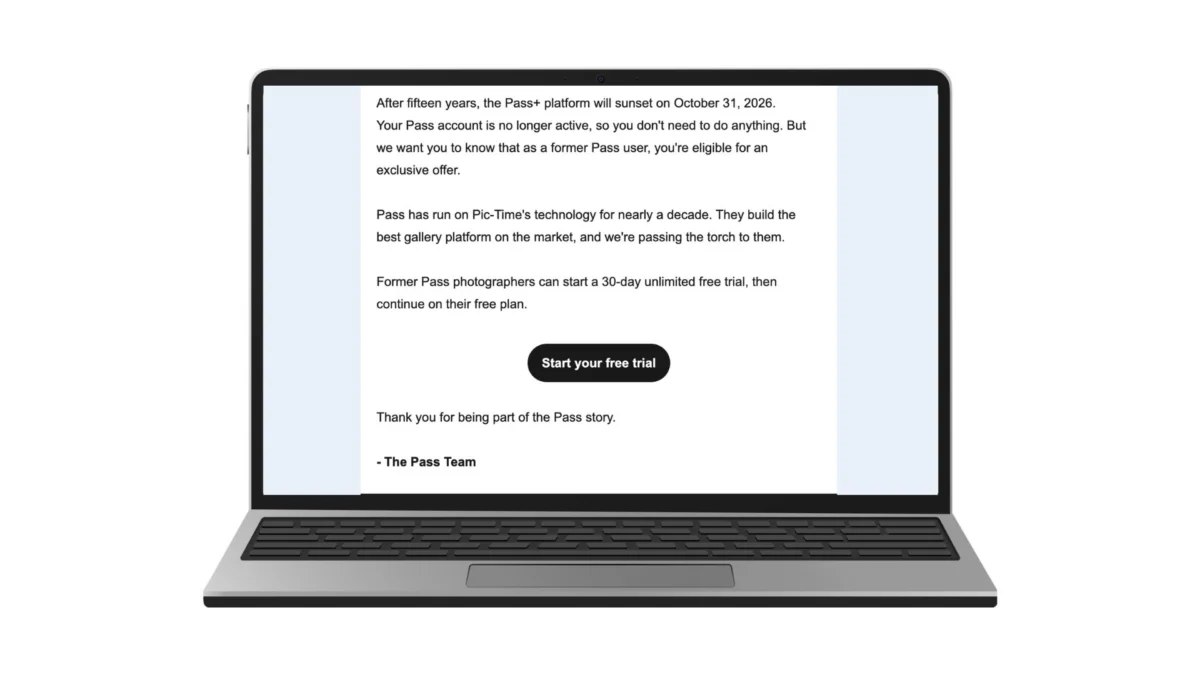
The professional photography industry is currently navigating a significant logistical transition following the quiet announcement that the online gallery hosting service Pass Plus will cease operations on October 31. The platform, which has served as a primary delivery and storage solution for wedding and portrait photographers for over a decade, began notifying its user base in early September through targeted email correspondence and in-dashboard notifications. While the company has facilitated a streamlined transition path to the platform Pic-Time, the sudden nature of the shutdown has exposed the fragility of cloud-based client delivery systems and the ongoing challenge of long-term digital asset management.
The Chronology of a Platform Sunset
The dissolution of Pass Plus did not occur as a singular, public-facing event. Instead, news of the closure emerged organically within professional photography communities, most notably on the r/WeddingPhotography subreddit. Users began reporting the appearance of a banner across their administrative dashboards, indicating that the service would be discontinued in its entirety by the end of October.
This development marks the third time the platform has undergone significant structural change, following a series of acquisitions and management shifts over the past ten years. For many long-term subscribers—particularly those who had purchased "lifetime" access plans during the platform’s early iterations—the announcement serves as a sobering reminder of the limitations inherent in digital service agreements. Historical analysis of similar platform closures, such as those seen with Exposure Manager and various iterations of Zenfolio, suggests that the term "lifetime" in software-as-a-service (SaaS) contracts generally applies to the duration of the company’s existence rather than the life of the user or the intent of the photographer.
While the notification process appears to be active, there is significant regional inconsistency. Users based in the United States have confirmed receipt of direct communications, but international users, particularly those based in Europe, have reported a lack of proactive outreach. This discrepancy highlights the necessity for account holders to log in to their administrative portals immediately to verify their status, rather than relying solely on email notifications that may be caught in spam filters or regional distribution delays.
The Migration Protocol and Technical Reality
Despite the anxiety surrounding the platform’s exit, the technical migration process has proven more robust than industry analysts initially anticipated. Pass Plus has entered into an agreement with Pic-Time to offer a free, automated migration service. This tool is designed to transfer entire library structures—including images, folder hierarchies, and client information—directly to the new provider.
Data from the affected user base indicates that the migration is largely efficient. Reports from photographers managing thousands of galleries suggest that the system can process substantial volumes of data in a matter of hours. However, users have noted that the progress indicators within the dashboard can be unreliable, frequently appearing frozen at zero percent while the backend transfer continues unabated. Technical observers note that this relative ease of migration is likely due to the underlying architecture of both platforms, which share significant software lineage, effectively making the transition a move between "sister" environments rather than a migration between incompatible systems.
The Hidden Crisis: Client Communication and Asset Retrieval
The most significant implication of the Pass Plus shutdown is not the migration of the files themselves, but the sudden realization of how many clients treat professional galleries as permanent cloud storage. Photographers who have been in business for over a decade are currently facing a surge in inquiries as they scramble to notify past clients of the platform change.

One veteran photographer, who maintains a repository of over 1,500 galleries, reported that a routine announcement regarding the migration led to an immediate influx of requests from clients dating back as far as 2017. This phenomenon reveals a consistent disconnect between the photographer’s contractual terms—which often state that files are only guaranteed for one year—and the client’s assumption that their wedding or portrait session will remain accessible indefinitely.
This crisis has prompted a shift in how studios manage their delivery workflows. Industry leaders are now advocating for more aggressive "end-of-life" communication strategies. Tactics currently being adopted include:
- Automated Lifecycle Emails: Implementing a chain of notification emails starting at the one-year anniversary of the shoot, encouraging clients to download high-resolution files.
- Storage Fee Transparency: Explaining to clients that hosting providers charge recurring fees, which necessitates the eventual removal of galleries to keep business costs sustainable.
- Gallery Pruning: Reducing legacy galleries from full event coverage to a curated selection of "favorites," which encourages clients to take action while maintaining a footprint for the photographer.
Broader Industry Implications and Data Sovereignty
The closure of Pass Plus serves as a case study for the risks of centralized cloud reliance. In the modern photography landscape, the gallery host is often viewed as an archive, a role for which these platforms were never primarily intended. The professional consensus, bolstered by this recent event, is that photographers must decouple their delivery tools from their archival strategy.
The primary takeaway for the industry is a reaffirmation of the "3-2-1" backup rule: three copies of data, on two different media types, with one off-site. For many photographers, the Pass Plus shutdown has forced an immediate return to local, redundant hard drives. Those who failed to maintain local masters are now facing the arduous task of manual re-uploads, a process that can take weeks of intensive labor.
Alternative Platforms and Market Shifts
As photographers look for replacements, the market has seen a surge in interest toward competitors like Pixieset, ShootProof, and emerging products from companies like Aftershoot and Sprout Studio. Each of these platforms offers different feature sets, ranging from built-in slideshow capabilities and enhanced print store functionality to advanced AI-driven sorting and screenshot protection.
The choice of a new platform is no longer just about storage capacity or aesthetic appeal; it is now deeply tied to the company’s stability and the ease with which data can be exported should another closure occur. Photographers are increasingly prioritizing "data portability"—the ability to easily move their entire body of work to another provider—as a core requirement when vetting new gallery partners.
Conclusion
The sunsetting of Pass Plus is a definitive moment for the professional photography community, serving as a reminder that the digital infrastructure supporting creative businesses is subject to the same volatility as any other sector of the tech economy. With the October 31 deadline approaching, the priority for practitioners remains twofold: the technical migration of current client assets and the urgent communication to past clients who may still have unarchived data on the platform.
As the industry moves forward, the reliance on third-party cloud hosting for archival purposes is likely to diminish, replaced by a more disciplined approach to local data redundancy. While platforms like Pic-Time offer a temporary safe harbor for migrating users, the broader lesson remains clear: the longevity of a client’s memories should not depend on the lifespan of a single software company. Photographers who treat their gallery provider as a temporary delivery conduit rather than a permanent archive are better positioned to weather the inevitable, yet unpredictable, churn of the digital marketplace.