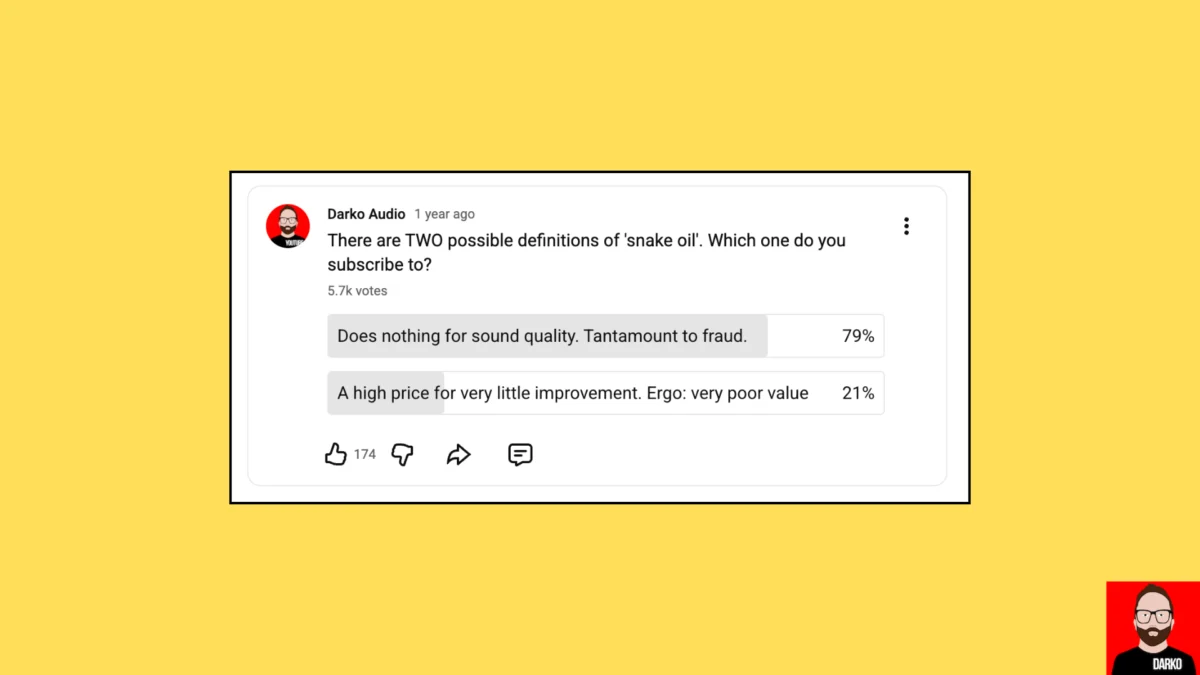
The question of whether power cables significantly impact audio fidelity is a perennial topic of debate within the audiophile community, often igniting passionate discussions. This fervor intensifies when the term "snake oil" enters the fray, a descriptor that itself carries a spectrum of interpretations. A recent informal poll conducted among John Darko’s YouTube audience revealed a distinct division in understanding, with nearly 6,000 participants weighing in on the definition of this contentious term. The results underscore a fundamental disagreement on where the line between deception and disappointment is drawn in the realm of high-fidelity audio.
The poll offered two primary definitions for "snake oil." The first, a more stringent interpretation, posits that snake oil does nothing to improve sound quality and constitutes outright fraud. The second, a more lenient definition, characterizes snake oil as a product that offers minimal, if any, improvement for an exorbitant price, thereby representing exceptionally poor value. A substantial majority, 79%, aligned with the stricter definition, reserving the term for products that are demonstrably ineffective. Conversely, 21% opted for the broader definition, encompassing products that, while potentially offering some infinitesimal benefit, are deemed fraudulent in spirit due to their disproportionate cost relative to perceived improvement. This divergence in perspective is crucial for understanding the nuances of consumer perception and industry practices.

The Strict Camp: A Hard Line on Ineffectiveness
Proponents of the strict definition draw a clear demarcation between products that are genuinely useless and those that are merely overpriced. For this group, a loudspeaker cable priced at $5,000 that exhibits a marginal, even if measurable, improvement over a $50 counterpart is considered a matter of poor value, not outright deception. The critical distinction lies in whether the product does something. A sticker intended to "harmonize the electrical field" by being affixed to a mains fuse box, however, would unequivocally fall under the umbrella of snake oil, as it offers no discernible physical or sonic effect. The core tenet of this viewpoint is that the label "snake oil" should only be applied when a product is verifiably ineffective, both in terms of objective measurements and subjective listening experiences.
Under this strict interpretation, many of the more extravagant offerings in the audio industry are afforded a significant degree of benefit of the doubt. A $3,000 power conditioner, while potentially being wildly overpriced, is not automatically dismissed as snake oil. Similarly, the impact of a fuse within a power strip might be audibly negligible, but unless its effect can be proven to be absolutely zero – both measurably and perceptibly – the strict camp will refrain from using the term "snake oil." Instead, they will categorize such items as "bad value." This linguistic precision is important to them, as terms like "fraud" carry considerable legal and moral weight, as well as the potential for defamation, which the more benign descriptor "overpriced" does not. This careful application of terminology reflects a desire for clarity and a reluctance to make accusations that could have serious repercussions.
The Loose Camp: Perceived Value and Deceptive Marketing
The proponents of the looser definition find the strict camp’s distinction somewhat overly pedantic. They argue that if a manufacturer charges a premium of several hundred percent for a product whose benefit is practically imperceptible to the vast majority of users with competent hi-fi systems, then the marketing surrounding that product is, in itself, a form of deception. This perspective encompasses premium cables, expensive accessories, and exotic audio tweaks. If the sonic improvement offered by such products is so minute as to be indistinguishable from zero for 99 out of 100 listeners, the 21% consider the product to be fraudulent in spirit, irrespective of whether the underlying physics are technically operative. Unlike the strict adherents, they are not solely focused on laboratory measurements or audition results; their primary objection stems from the exorbitant price point.

This viewpoint suggests that the perceived value proposition is intrinsically linked to the price. When a product’s performance improvement is so marginal that it fails to justify its cost in the eyes of a significant portion of the target audience, the marketing employed to sell it can be seen as misleading. This often involves highlighting subtle sonic differences or employing subjective language that amplifies minor perceived benefits to create a sense of necessity and superiority. The "loose camp" therefore prioritizes the consumer’s experience of value, arguing that a product that fails to deliver a meaningful return on investment, particularly at extreme price points, borders on the deceptive.
Where Definitions Break Down: The Blurry Edges of Perception and Measurement
Both the strict and loose definitions, while internally coherent, encounter challenges when applied to the complex realities of audio reproduction and consumer perception. The strict definition grapples with the ambiguity of "measurable but inaudible" versus "nothing." What constitutes an insignificant measurement? And what about subjective listening experiences that elude objective verification?
Consider a $5,000 loudspeaker cable that a listener unequivocally describes as imparting a more "open and airy" sound compared to a $50 cable, yet no objective measurement can definitively explain this perceived difference. Does this cable "do something"? If the $5,000 cable exhibits marginally lower capacitance than its $50 counterpart, it has technically "done something." However, whether this difference is perceptually relevant is debatable. The reality of audio perception and measurement often blurs at these edges, leading to disagreements.

At the heart of this debate lies a deeper, long-standing schism: the philosophical divide between those who believe that all audible phenomena are measurable and that all measurable phenomena are audible, and those who do not subscribe to this absolute correlation. This fundamental disagreement fuels much of the "snake oil" controversy, making it a proxy war for a more entrenched debate within the scientific and audiophile communities.
The loose definition, conversely, faces the opposite problem: dilution of meaning. When the criterion for "snake oil" shifts to simply "overpriced relative to benefit," the term loses its power. Virtually every premium product in every market segment could face such a charge from someone. Are Focal’s Utopia headphones "snake oil" when compared to their more affordable Azurys? Is a $10,000 amplifier inherently "snake oil" if a $1,000 amplifier delivers ninety percent of its sonic performance? Applying the loose definition consistently would essentially encompass the entirety of the high-end audio market, rendering the term almost meaningless. Therefore, neither definition escapes unscathed from these practical considerations.
The Author’s Perspective: Intent and the Burden of Proof
John Darko, the author of the original article, leans towards the strict definition but with a crucial caveat: the element of manufacturer intent. For Darko, the label "snake oil" is reserved for products where the manufacturer knowingly sells something they understand to be ineffective. This aligns with the historical context of snake oil salesmen, who were charlatans that deliberately peddled fraudulent remedies. This understanding of intent is vital because it distinguishes between genuine deception and honest mistakes or misguided product development.

Tying "snake oil" accusations to manufacturer fraud, in Darko’s view, sharpens the focus on technical proof – both from listening and measurement perspectives. It also provides a degree of leniency for manufacturers who may have inadvertently encountered false positives during their product development cycles, essentially acknowledging the possibility of honest errors.
However, proving intent is significantly more challenging than conducting listening tests or measurements. While analyzing a product with an Audio Precision analyzer or engaging in critical listening is relatively straightforward (provided the experimental design, execution, and interpretation are sound, and placebo effects are controlled for), demonstrating that a manufacturer knowingly sold a useless product is another matter entirely. Without irrefutable evidence, such as internal documentation or whistleblower testimony, the accusation of fraud struggles to gain traction.
The 21% who subscribe to the looser definition, of course, are not burdened by the need to prove intent. Their objection is fundamentally a complaint about price. A $5,000 cable in a market where $50 cables exist is, to them, an act of exploitation, regardless of what any test might reveal. This perspective prioritizes market fairness and consumer protection from what they perceive as predatory pricing practices.

Darko speculates that most audio manufacturers genuinely believe in the products they sell. While this belief does not necessarily translate into good value or even audibly beneficial products for all listeners, it suggests that the "fraud" framing often doesn’t fit neatly. The absence of proven malicious intent shifts the conversation from an accusation of fraud to a critique of value and market economics.
Ultimately, the article concludes that one term, two distinct definitions, and over 5,700 votes have yielded no clear consensus on the precise meaning of "snake oil" within the audiophile community.
Navigating Muddy Waters: The Practical Implications of Ambiguity
The fact that a significant majority adheres to one definition while a substantial minority adheres to another presents a practical problem in real-world discussions. When the term "snake oil" is deployed in online forums or social media groups, there is often no clear indication of which definition is being invoked. Is the accuser alleging deliberate deception by the manufacturer, or are they simply expressing dissatisfaction with the product’s price relative to its perceived performance? These are vastly different accusations with distinct implications, yet the same two words are used, often leading to heated and unproductive debates where the core claims remain unclear. This ambiguity is not merely an academic point; it actively derails conversations that could otherwise lead to constructive dialogue.

When "snake oil" is applied loosely to anything deemed overpriced, its impact diminishes. Like the boy who cried wolf, frequent and indiscriminate use of the term can lead to it being disregarded altogether, thus losing its power to highlight genuine cases of deception.
Darko proposes a more precise application of the term, suggesting that "snake oil" should be reserved exclusively for products where the manufacturer possesses absolute certainty of their uselessness. All other instances of perceived poor value, while potentially valid criticisms, should be categorized differently. This nuanced approach aims to restore clarity and focus to discussions about product efficacy and value in the high-fidelity audio market, encouraging more informed and productive exchanges among enthusiasts and industry professionals alike. The ongoing debate, fueled by differing interpretations of value, efficacy, and intent, underscores the complex relationship between consumer expectations, technological advancements, and the enduring allure of the audiophile pursuit.