Anthropic, a leading artificial intelligence research company, has recently introduced Claude Design as a research preview, marking a significant stride in AI-driven creative tools. This latest offering is engineered to revolutionize the process of digital product creation, ranging from web page prototypes and application wireframes to pitch decks and marketing collateral. While demonstrating an impressive capacity to generate sophisticated designs from simple prompts, early assessments highlight a substantial operational cost, primarily linked to its intensive consumption of AI tokens, positioning it as a powerful yet potentially expensive solution for users, particularly those on standard subscription tiers.
Anthropic’s Vision and the Evolving Claude Ecosystem
Anthropic was founded in 2021 by former members of OpenAI, driven by a mission to develop safe and beneficial artificial intelligence. Central to their philosophy is "Constitutional AI," an approach that aims to align AI systems with human values through a set of guiding principles, reducing the need for extensive human feedback. This commitment to ethical AI development has garnered significant investment from tech giants like Google and Amazon, propelling Anthropic to the forefront of the competitive AI landscape. The company has rapidly expanded its product portfolio, with the Claude family of large language models (LLMs) being its flagship offering.
The evolution of Claude models has been swift and impactful. Starting with initial iterations, Anthropic has consistently pushed the boundaries of conversational AI. The introduction of the Claude 3 family—comprising Haiku, Sonnet, and Opus—represented a major leap forward, offering varying levels of intelligence, speed, and cost-efficiency. Claude 3 Opus, the most advanced model, is renowned for its state-of-the-art performance across complex tasks, including reasoning, coding, and mathematical problem-solving. It is this powerful underlying technology, particularly the recommended Opus 4.7, that forms the backbone of Claude Design, enabling its advanced generative capabilities. This strategic expansion into specialized AI applications, moving beyond general-purpose conversational agents, signals Anthropic’s ambition to embed its AI directly into critical professional workflows, from code generation with Claude Code to now, digital design with Claude Design. This move places Anthropic in direct competition with other major players like OpenAI’s DALL-E and Google’s Gemini-powered creative tools, all vying for dominance in the burgeoning AI-assisted creative market, which Grand View Research estimates could reach over $600 billion globally by 2030.
Diving into Claude Design’s Capabilities: A New Paradigm for Digital Creation
Claude Design represents a novel approach to digital content creation, allowing users to generate a wide array of digital products with unprecedented speed and flexibility. Its core functionality lies in its ability to translate natural language prompts into tangible design outputs. Users can simply describe their desired outcome—be it a landing page for a new product, a mobile app’s user interface, a compelling investor pitch deck, or engaging marketing materials—and Claude Design sets to work. The system is designed to create complete, exportable prototypes, not just static images or text.

The versatility of Claude Design extends to its output formats and integration capabilities. Once a design is generated, users can export the results into various industry-standard formats, including ZIP files containing all necessary assets, PPTX for presentations, HTML for web deployment, and PDF for shareable documents. Furthermore, Claude Design is engineered for seamless integration with other popular creative tools and Anthropic’s own ecosystem. Users can hand off generated designs to Canva for further graphical refinement or to Claude Code for converting prototypes into functional, production-ready code. This interoperability is crucial, positioning Claude Design not as a standalone, isolated tool but as a central component in a broader creative and development pipeline.
A key insight from early trials suggests that while Claude Design can generate impressive results from minimal input, its true potential is unlocked through human collaboration and detailed guidance. The article highlights that optimal and distinctive results are achieved when the AI is fed existing design assets, brand guidelines, or even an existing codebase. For instance, an established online business could provide Claude Design with its website’s HTML and CSS files, along with representative graphical assets like logos and font specifications. This contextual input allows Claude to understand the existing aesthetic and functional parameters, ensuring that new designs align perfectly with the brand’s established look and feel. This human-in-the-loop approach elevates Claude Design beyond a mere "black box" generator, transforming it into a powerful augmentation tool for professional designers, enabling them to rapidly iterate on ideas and focus on higher-level strategic decisions rather than manual execution.
First Impressions: A Practical Test of Claude Design’s Efficiency
The initial hands-on experience with Claude Design, as detailed in the early review, provided a compelling demonstration of its capabilities. The process begins with accessing the research preview via a web interface, where users are greeted with a tabbed chatbox. This interface offers various starting points: initiating a new prototype, crafting a slide deck, or working from an existing template. Advanced options allow for integrating external resources, such as linking a GitHub repository, connecting a local folder for design assets, or directly uploading specific elements like custom fonts and logos.
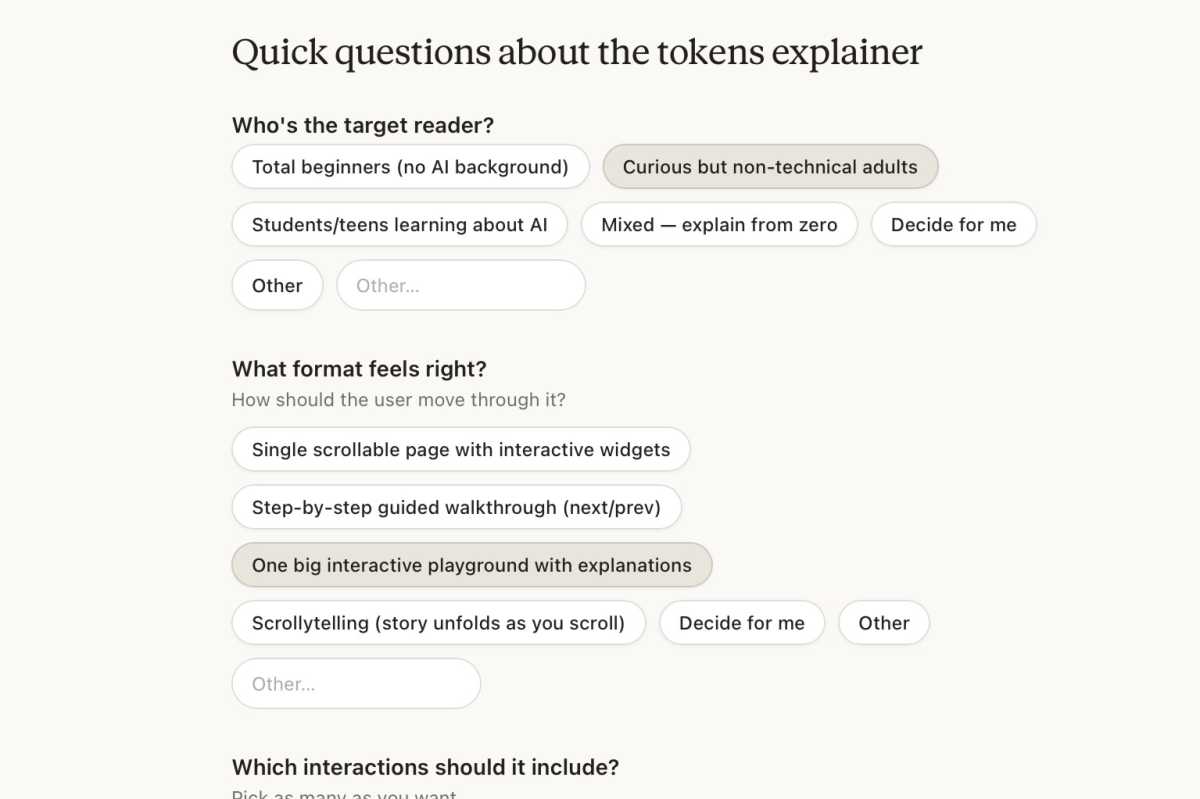
For the purpose of the test, a minimalist approach was adopted, starting from scratch with a straightforward prompt: "Let’s create an interactive graphic that explains AI tokens to everyday users." This seemingly simple request immediately triggered Claude Design’s sophisticated iterative questioning process. The AI didn’t just proceed blindly; instead, it engaged in a series of multiple-choice questions designed to refine the user’s vision. These questions probed crucial aspects such as the target audience (e.g., total beginners, curious non-technical adults, students), preferred format, desired types of interactions, overall aesthetic style (e.g., New York Times-style editorial, cartoonish), and the desired scope or expansiveness of the graphic. This consultative phase, taking only about a minute, is critical for the AI to align its generative efforts with the user’s specific requirements, ensuring a more tailored and relevant output.
Following this initial Q&A, Claude Design articulated its proposed approach: a "clean editorial explainer" with a "NYT/Pudding feel," characterized by serif headlines, generous whitespace, and a single accent color. It then outlined a list of five project milestones before commencing the actual design work. The user experience was highly interactive; the Claude conversation moved to a left-hand sidebar, while the main canvas on the right displayed the work in progress in real-time. Tabs at the top of the canvas allowed for viewing multiple variations of the project simultaneously and browsing the underlying project files.
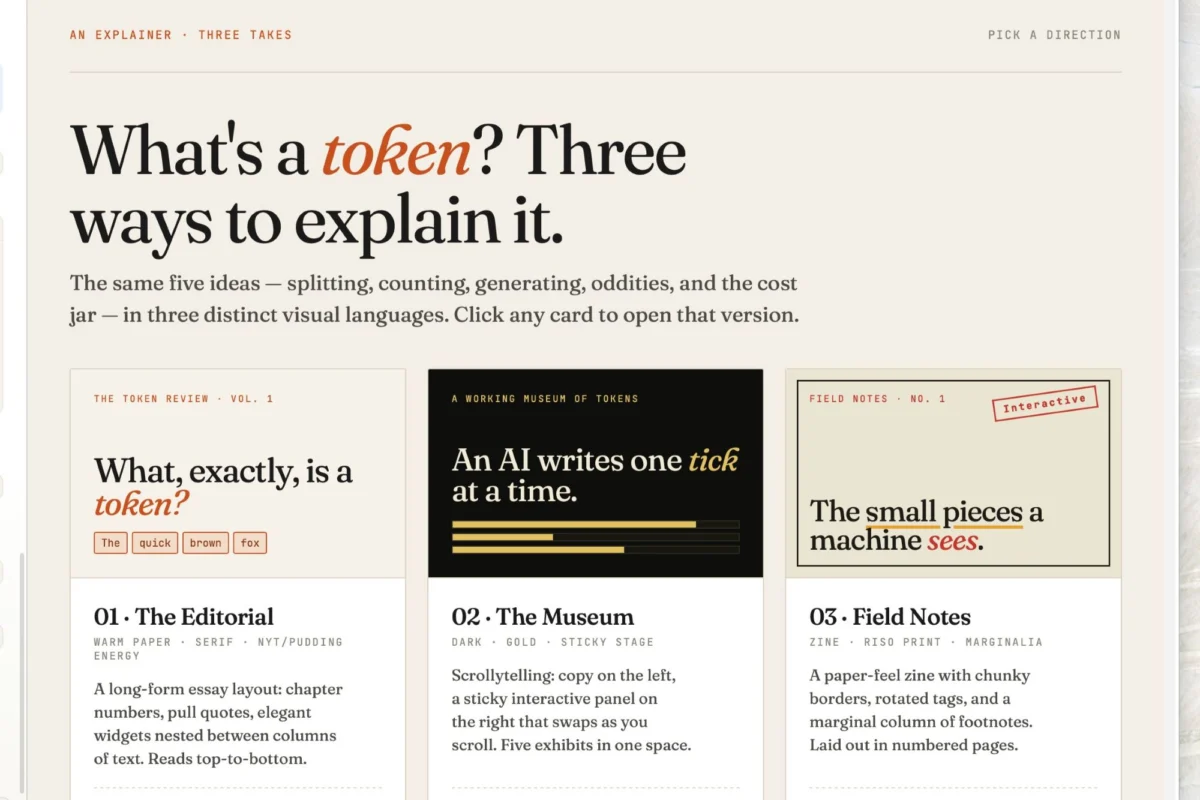
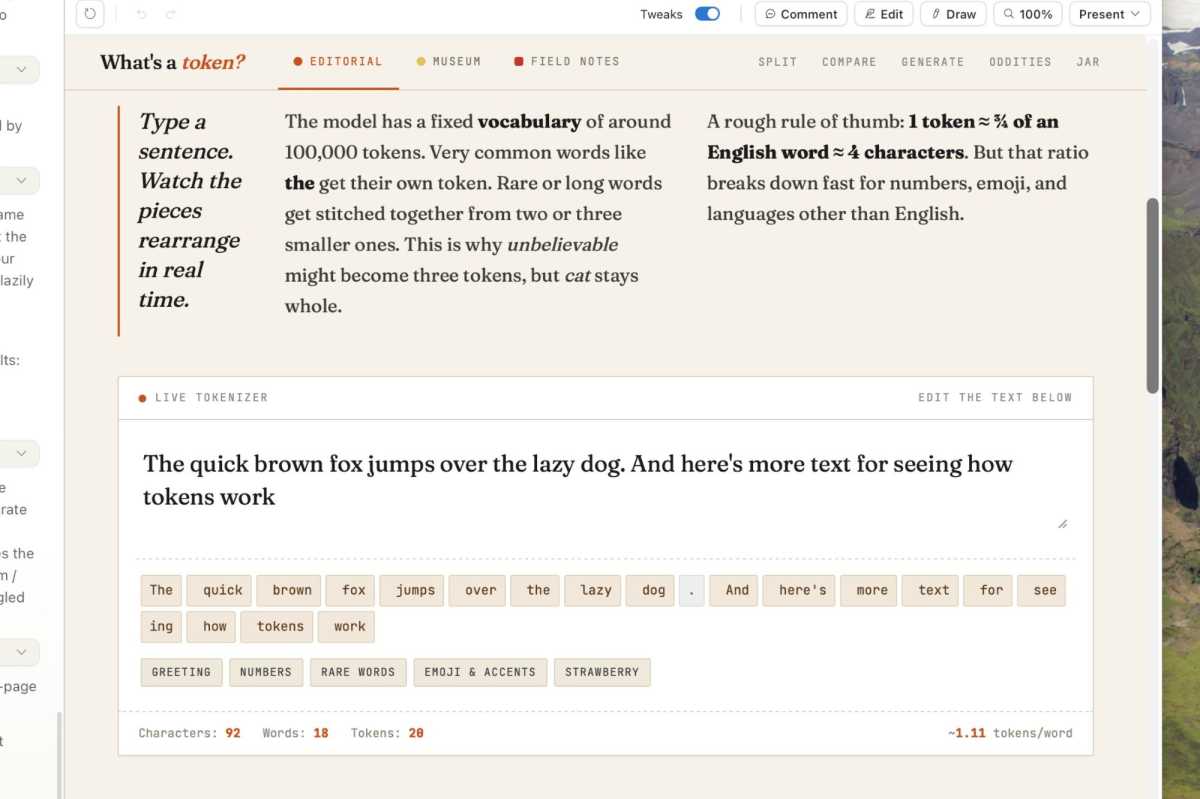
Within a mere five minutes, Claude Design presented a draft—a visually appealing webpage designed to guide users through the concept of AI tokens step-by-step. The prototype included interactive sections, such as a feature where users could type in words and observe the token count update dynamically, providing a tangible illustration of a complex AI concept. The generated copy was praised for its clarity, friendliness, and accuracy. Remarkably, this initial output closely matched the user’s expectations, showcasing the AI’s ability to grasp and execute a nuanced design brief effectively. Over approximately 25 minutes, Claude Design completed three distinct variations of this AI token-explainer prototype, demonstrating significant efficiency in generating diverse design options.
The High Price of Innovation: Unpacking Claude Design’s Tokenomics
While the efficiency and quality of Claude Design are undeniably impressive, the practical test quickly unveiled a critical aspect: its substantial operational cost, primarily measured in AI tokens. AI tokens are fundamental units of text or data that large language models process. For text, a token might be a whole word, part of a word, or punctuation. For image and design generation, tokens also represent visual elements, code structures, and computational steps involved in rendering complex graphical interfaces. Generating sophisticated designs, especially with interactive elements and multiple variations, involves processing vast amounts of information and executing numerous computational steps, making it an inherently token-intensive task.
The reviewer, operating on a Claude Pro plan, which is typically tailored for individual and everyday users, encountered immediate and significant limitations. Within just 25 minutes of active use, 80 percent of the weekly Claude Design allowance was consumed. This rapid depletion highlights a key distinction: Claude Design usage appears to be metered separately from the general Claude quota, indicating its specialized and resource-heavy nature. For individual users or small businesses accustomed to the typical usage patterns of conversational AI, this separate and accelerated consumption rate presents a considerable challenge.
Adding to the cost implications was a user error during the testing phase. Mistaking an "undo" button for a "back" button resulted in the accidental deletion of all generated work, necessitating a complete rebuild. This incident underscored the unforgiving nature of AI usage metering; every generative action, even a re-generation due to a mistake, consumes valuable tokens. Although the model was downshifted to the cheaper Sonnet 4.6 for the rebuild, the weekly Claude Design meter still hit zero within minutes. Fortunately, Anthropic had recently distributed overage credits to Claude users—a gesture made after the company restricted third-party AI agents from accessing Claude subscriptions directly without using the official API. These credits allowed the reviewer to complete the designs, but without them, the review process would have been cut short well before a comprehensive evaluation could be performed.
This early experience strongly suggests that Claude Design, while powerful, is "token-hungry" and could be "impressively expensive" for regular or extensive use, especially for those on standard Pro plans. The pricing structure likely targets enterprise clients, large design agencies, or well-funded startups that can absorb higher operational costs for the sake of accelerated prototyping and development cycles. For these organizations, the efficiency gains and speed of iteration offered by Claude Design might justify the premium, potentially saving significant time and human capital in the long run. However, for individual designers or smaller businesses, the current pricing model could be a prohibitive barrier to adoption, necessitating a careful cost-benefit analysis before integrating the tool into their workflows. This situation underscores a broader trend in the AI industry where advanced capabilities often come with a substantial price tag, pushing the boundaries of what users are willing to pay for generative intelligence.
Implications for the Design Industry and Beyond
The emergence of tools like Claude Design carries profound implications for the design industry and broader creative economy. One of the most significant debates it fuels is the ongoing discussion about AI’s role in augmenting human capabilities versus potentially replacing human jobs. Claude Design, with its ability to rapidly generate prototypes and design assets, appears to fall firmly into the augmentation category. It can drastically accelerate the initial phases of design, allowing human designers to offload repetitive or time-consuming tasks such as wireframing, mood boarding, and generating multiple variations. This frees up human creatives to focus on higher-level strategic thinking, conceptual innovation, client communication, and the nuanced refinement that only human intuition can provide. Instead of designing from scratch, professionals might become more akin to "AI orchestrators," guiding intelligent systems to produce desired outcomes with increasing precision.
Moreover, Claude Design has the potential to democratize design and prototyping. Individuals or small businesses without access to professional designers or expensive software can now, theoretically, generate high-quality digital assets with relative ease. This lowering of the barrier to entry could foster a new wave of entrepreneurship and innovation, allowing more ideas to be visually represented and tested quickly. However, the current cost structure, as observed in the research preview, may temper this democratizing effect, at least for now, suggesting that its immediate impact might be felt more within well-resourced organizations.
From a business workflow perspective, the efficiency gains offered by Claude Design are substantial. The ability to move from concept to interactive prototype in minutes or hours, rather than days or weeks, can significantly shorten development cycles. This speed is invaluable in fast-paced markets where time-to-market is a critical competitive advantage. Companies can test more ideas, iterate faster based on user feedback, and bring products to market with greater agility. This agility, however, must be balanced against the operational costs associated with continuous AI usage, requiring businesses to optimize their prompting strategies and design workflows to maximize efficiency per token.
The competitive landscape for AI-driven design tools is rapidly expanding. Beyond Anthropic, companies like Figma offer AI plugins for design automation, Adobe is integrating AI capabilities across its Creative Suite, and generative art platforms like Midjourney and DALL-E are already transforming visual asset creation. Claude Design distinguishes itself by focusing on the entire prototype generation, including structure, interactivity, and copy, rather than just individual visual elements. This holistic approach makes it a powerful contender, but its success will ultimately depend on its balance of capability, cost, and user-friendliness in a crowded market.
Looking ahead, Anthropic’s move into specialized AI tools like Claude Design signifies a broader trend in the AI industry: the shift from general-purpose LLMs to highly specialized applications. This strategy allows AI developers to leverage their core models to solve specific industry problems, creating targeted solutions that offer deep utility within particular domains. As these tools evolve, ethical considerations, such as maintaining brand consistency, intellectual property rights for AI-generated content, and the potential for "good enough" designs to proliferate, will become increasingly important discussion points for both developers and users.
Conclusion
Anthropic’s Claude Design is an undeniably powerful and innovative tool, showcasing the cutting-edge capabilities of AI in the realm of digital design and prototyping. Its ability to translate abstract prompts into sophisticated, interactive designs with remarkable speed and accuracy is a testament to the rapid advancements in generative AI. However, early user experiences underscore a significant hurdle: the high cost associated with its intensive AI token consumption. This dual nature – groundbreaking technology coupled with a premium operational cost – suggests that Claude Design is strategically positioned for enterprise-level adoption, where the efficiency gains and accelerated development cycles can justify the investment. While potentially democratizing design processes for some, its current tokenomics may limit widespread accessibility for individual users and smaller entities. As Anthropic continues to refine this research preview, balancing its formidable capabilities with a more accessible and sustainable pricing model will be crucial for its broader impact and integration into the evolving landscape of AI-augmented creativity.