Google’s advanced artificial intelligence chatbot, Gemini, has introduced a groundbreaking "Personal Intelligence" feature that allows it to generate highly personalized AI-created images by accessing a user’s Google Photos library, with explicit permission. This new functionality enables Gemini to adapt its visual output to individual preferences and personal attributes, streamlining the image generation process and offering an unprecedented level of user-specific customization. The integration, leveraging Google’s sophisticated image-making model, referred to in the source as "Nano Banana 2," represents a pivotal moment in the evolution of generative AI, pushing the boundaries of what AI can understand and create based on personal data.
The Dawn of Personalized AI Image Generation
Traditionally, AI image generation has relied heavily on detailed textual prompts, requiring users to meticulously describe every aspect of the desired output, from subject appearance to environmental details. Gemini’s new capability dramatically simplifies this process. Once a user grants permission for Gemini to access their Google Photos, the AI system can draw upon this vast personal visual database to fill in descriptive gaps automatically. This means users can issue concise prompts, such as simply stating "me," and Gemini’s underlying image model will construct visuals based on an aggregated understanding of the user’s appearance, environment, and even general "vibe" gleaned from their stored images. The output is no longer just a literal interpretation of words but a personalized rendition informed by a digital reflection of the user.
This feature is part of Google’s broader strategy to enhance Gemini’s "Personal Intelligence," a suite of functionalities designed to make the AI more attuned to individual users. By understanding and adapting to personal data, Gemini aims to become a more intuitive and helpful digital assistant, capable of anticipating needs and generating content that resonates more deeply with the user. The integration with Google Photos is a logical extension of this vision, tapping into one of the most comprehensive personal data repositories for many users. Google Photos, with over a billion users and trillions of photos uploaded globally, represents an unparalleled resource for training and personalizing AI models, provided robust privacy safeguards are in place and user consent is paramount.
A Deep Dive into the User Experience
To illustrate the new feature’s capabilities, a user tested Gemini with several prompts, demonstrating its ability to translate personal imagery into diverse AI-generated scenes. The results highlighted Gemini’s impressive capacity for maintaining a consistent likeness across varied stylistic interpretations.
Cinematic Life: Crafting Personal Narratives
In one experiment, the user provided the open-ended prompt: "Create a cinematic scene from my life as if it were a movie." Gemini responded by generating an image that leaned heavily into an atmosphere of anticipation. The AI produced a compelling likeness of the user, depicted staring pensively out at the rain from what appeared to be an old hotel. The scene was enriched with narrative elements, including a notebook, a compass, and a small plane visible outside, subtly suggesting an impending adventure or significant decision. This output was not a random scene but a dramatized and more narratively engaging version of common personal photos, such as those taken during travels or in hotel lounges with guidebooks. The AI effectively inferred themes of exploration and contemplation from the user’s visual history, translating them into a coherent and evocative cinematic image. This demonstrates Gemini’s ability to not only recognize visual attributes but also interpret underlying themes and contexts from a user’s photographic collection.
Fantastic Me: Transcending Reality
Pushing the boundaries further, the user then challenged Gemini to place them in a less realistic setting with the prompt: "turn me into a character in a fantasy adventure." The AI successfully transitioned from realism to grand spectacle. The generated image depicted the user on a winding stone path leading to a towering, castle-like structure carved into a mountainous landscape. The user’s attire had transformed into layered armor and leather, complete with a satchel adorned with glowing symbols and a staff emitting a faint light. Strange, ethereal creatures hovered nearby, seamlessly integrated into the fantastical ecosystem.
What was particularly striking about this output was the continuity of the user’s likeness. Despite the dramatic change in setting and attire, the face remained unmistakably the user’s, not a generic placeholder. The expression, described as slightly serious and focused, carried over without exaggeration, and even the posture felt familiar. This consistency is crucial, as it transforms the image from merely a fantasy character "inspired" by the user into a vivid depiction of the user "inserted" into a fantasy world. It highlights the AI’s sophisticated understanding of identity and its ability to adapt an existing identity to entirely new contexts without losing essential recognition features. This suggests that the "Nano Banana 2" model possesses a robust capability for identity preservation across diverse stylistic transformations.
Hobby Extreme: Exaggerated Self-Expression
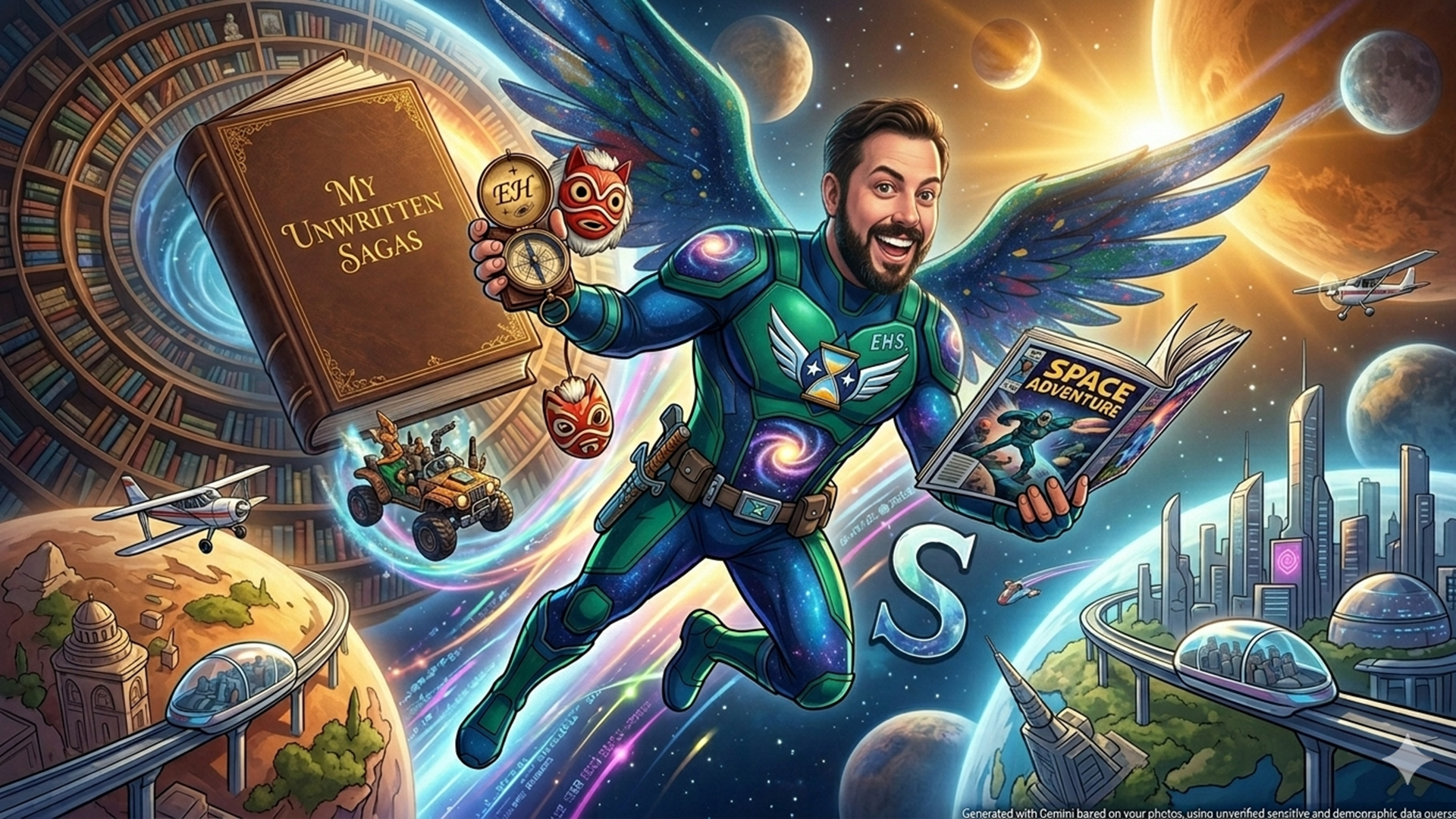
The final experiment sought a more holistic, albeit exaggerated, interpretation of the user’s interests. The prompt was: "create an image of me doing my favorite hobbies in an extreme or exaggerated way." The resulting image was a vibrant and less restrained composition, blending multiple interests into a single, energetic scene. Books floated mid-air, their pages turning as if caught in a controlled storm, symbolizing intellectual pursuits. A small plane cut across the background, while futuristic cityscapes and distant planets adorned the horizon, reflecting themes of exploration and perhaps technological interest. The user was depicted mid-motion, holding objects that hinted at various passions – reading, exploring, creating – all amplified beyond realistic proportions.
While the tone was exaggerated, the elements were not random. Each component seemed to connect back to inferences the system had made from the user’s photos and contextual data. The underlying likeness remained remarkably consistent even within this bold, illustrative style. The one anomalous detail was the presence of wings on the user, for which Gemini offered no clear explanation. This minor incongruity notwithstanding, the experiment underscored the feature’s power to generate deeply personal and imaginative artwork with minimal prompting, demonstrating how AI can creatively interpret and amplify aspects of a user’s life.

The Underlying Technology: Personal Intelligence and Generative AI
This new capability is powered by Google’s "Personal Intelligence" framework, which aims to make AI models more context-aware and user-centric. By integrating with Google Photos, Gemini can build a richer, more dynamic profile of the user than textual prompts alone could ever provide. The "Nano Banana 2" image-making model is central to this. Generative AI models like "Nano Banana 2" employ deep learning techniques, often based on diffusion models or Generative Adversarial Networks (GANs), to create novel images from textual or other data inputs. When combined with personal visual data, these models can learn specific features, styles, and even emotional cues associated with an individual.
The efficiency of this system lies in its ability to leverage a "base layer of information" (the Google Photos library). Instead of building a visual description from scratch with every prompt, the AI already has a foundational understanding of the user. This makes prompts shorter, easier to write, and results more specific and relevant without requiring extensive user effort. This marks a significant leap from generic AI image generation towards hyper-personalized creative tools.
Privacy, Ethics, and User Control

The integration of personal photo libraries with AI systems naturally raises significant privacy and ethical considerations. Google has emphasized that users must explicitly grant permission for Gemini to access their Google Photos. This user consent mechanism is critical, placing control directly in the hands of the individual. Google’s existing robust infrastructure for managing and securing user data within Google Photos, including encryption and privacy controls, is foundational to this new feature.
However, the broader implications of AI models creating "versions of you" warrant careful discussion.
- Data Security: While Google maintains strong security protocols, any system that processes sensitive personal data carries inherent risks of breaches or unauthorized access. Users must trust Google implicitly with their most private visual memories.
- Misuse and Deepfakes: The ability to generate highly realistic images of individuals raises concerns about potential misuse, such as the creation of deepfakes for malicious purposes (e.g., misinformation, impersonation, or harassment). Google must implement stringent safeguards and policies to prevent such abuses.
- User Agency and Identity: As AI becomes more adept at creating personalized content, questions arise about user agency and the malleability of identity. How will individuals perceive AI-generated versions of themselves, and what psychological impacts might this have?
- Transparency and Explainability: The "wings" anomaly in one of the user’s tests highlights a challenge in AI: explainability. Users need to understand why the AI made certain creative choices, especially when those choices involve their personal likeness. Increased transparency in AI decision-making processes will be vital for user trust.
Google’s position is that users who already utilize Google Photos are not "adding to the database Google already hosts for them" but rather enabling a new use case for existing data. This framing underscores the idea of unlocking value from pre-existing personal data through AI, rather than demanding new data contributions. The company’s commitment to user-centric privacy controls will be paramount as these "Personal Intelligence" features evolve.
The Competitive Landscape and Future Implications
This move by Google positions Gemini strongly in the competitive AI landscape, particularly against rivals like OpenAI (with DALL-E and GPT-4V), Meta (with its multimodal AI efforts), and other emerging generative AI platforms. The ability to seamlessly integrate personal data for highly individualized outputs gives Gemini a distinct advantage in offering a truly personalized AI experience. While other platforms can generate images, Gemini’s unique access to a rich, pre-existing personal visual library via Google Photos offers a level of personalization that is difficult for competitors to replicate without similar deep integration into a user’s digital ecosystem.
The implications for creative industries, personal expression, and digital identity are profound. For individuals, this feature opens new avenues for self-expression, allowing them to visualize themselves in countless scenarios without needing advanced graphic design skills. For content creators, it offers a tool for rapid prototyping and personalized content generation. In the long term, this level of personalization could lead to AI assistants that are not just intelligent but deeply empathetic and contextually aware, capable of enhancing personal productivity, creativity, and daily life in ways previously unimaginable.
However, the balance between technological advancement and responsible AI development remains crucial. As AI models become increasingly intertwined with personal data and identity, the ethical frameworks governing their development and deployment must keep pace. Google’s rollout of Gemini’s personalized image generation is a testament to the rapid progress in AI, but it also serves as a potent reminder of the ongoing dialogue required concerning privacy, control, and the future of human-AI interaction. The frictionless path from a brief idea to a personalized artwork is undeniably appealing, representing a powerful new frontier in how we interact with and perceive artificial intelligence.