
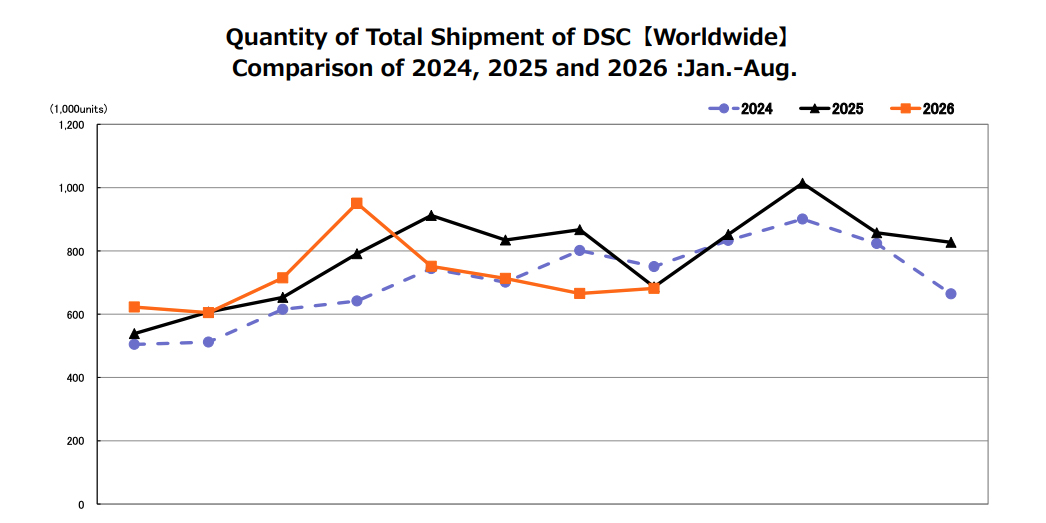
The global digital camera industry has experienced a distinct bifurcation through the first eight months of 2026, characterized by a persistent summer slump in overall shipments offset by an extraordinary surge in production and demand for fixed-lens compact cameras. According to the latest monthly trade data released by the Camera and Imaging Products Association (CIPA), total worldwide camera shipments for the January-through-August period dropped slightly to 96.8 percent of the figures recorded during the same timeframe in 2025.
While this metric underscores a four-month consecutive dip below the previous year’s performance, industry analysts emphasize that these figures must be contextualized against 2025, which marked the most lucrative and robust year for the global imaging market since 2019. Despite the recent contraction, cumulative shipments for 2026 continue to comfortably outperform the totals registered in 2024, signaling that the broader post-pandemic photographic recovery remains largely intact.
A Chronology of the 2026 Summer Slump
The downward trend in international camera shipments did not begin abruptly, but rather evolved across the spring and summer quarters of 2026. Following a relatively stable start to the year, macroeconomic conditions, shifting consumer priorities, and seasonal buying habits contributed to a noticeable cooling off period.

From May through August, monthly shipments consistently fell short of their 2025 counterparts. However, a closer inspection of month-to-month data reveals nuanced shifts within the market. August 2026 bucked the immediate downward monthly trajectory by posting a modest increase, reaching 102.5 percent of July’s volume. This late-summer uptick provided a welcome, albeit temporary, reprieve for manufacturers grappling with softening demand in core high-end segments.
The primary driver of the year-to-date deficit lies in the performance of mirrorless interchangeable-lens systems, which historically account for the lion’s share of industry value. For the first eight months of 2026, mirrorless shipments settled at 93.8 percent of the volume recorded during the corresponding period in 2025. Concurrently, production metrics for mirrorless cameras hovered at roughly 93.1 percent of previous-year levels by August, reflecting a strategic alignment by manufacturers to match slowing consumer acquisition rates.
The Compact Camera Renaissance and Production Surges
In stark contrast to the contraction observed in the mirrorless sector, fixed-lens compact and bridge cameras are enjoying an unprecedented multi-year renaissance that originated around 2024 and has accelerated aggressively throughout 2026.
For the first eight months of the year, fixed-lens camera shipments surged to 115.3 percent of the previous year’s volume. More telling are the production statistics: CIPA data reveals that manufacturing output for compact cameras reached 125.7 percent compared to the same period in 2025. Major optical brands are now producing over 25 percent more compact units year-over-year to combat severe, persistent inventory shortages that have left highly sought-after models chronically backordered across global retail channels.

Industry giants such as Canon have publicly acknowledged the strain of this consumer-driven craze, confirming plans to ramp up compact camera production further through the latter half of 2026. This trend is fueled largely by a cultural shift among younger demographics—particularly Gen Z and millennial content creators—who favor the tactile, analog-adjacent shooting experience, distinctive color profiles, and physical portability of premium pocket-sized cameras like the Fujifilm X100VI and Ricoh GR series over smartphones.
Interestingly, this surge in fixed-lens popularity has not entirely cannibalized other legacy segments. Traditional Digital Single-Lens Reflex (DSLR) cameras, which have been on a secular decline for nearly a decade as manufacturers phase out production in favor of mirrorless technology, experienced a bizarre localized anomaly. DSLR sales plummeted overall to 65 percent of 2025 figures, yet August registered a sudden monthly spike, shipping more than double the volume recorded in July. Industry logicians note that the majority of these shipments were absorbed by the Americas, alongside unexpectedly robust demand from China and Europe. While analysts view this as a temporary inventory redistribution rather than a permanent resurgence of the DSLR format, it highlights the unpredictable fluctuations currently animating the global supply chain.
Sensor Sizes and Regional Disparities
A granular breakdown of CIPA’s August 2026 metrics by sensor size further illuminates shifting consumer preferences. Cameras equipped with sensors smaller than full-frame experienced positive growth in August, climbing to 103.6 percent of the previous year’s tally. Conversely, full-frame and medium-format systems lagged behind, capturing just 89.4 percent of the volume recorded in August 2025. This divergence suggests that budget-conscious hobbyists and casual creators are increasingly gravitating toward accessible, lightweight crop-sensor bodies and advanced compacts, while high-end professional upgrades have temporarily plateaued.
Geographically, the distribution of shipments has remained dynamic. While North and South America continue to represent the primary consumer base for both legacy equipment like DSLRs and trendy compacts, emerging markets in Asia—specifically China—continue to exert an outsized influence on monthly sales volumes and localized retail demand.
Scope and Limitations of CIPA Data
While CIPA statistics remain the gold standard for tracking the macroeconomic health of the imaging sector, industry observers frequently remind stakeholders of the inherent limitations within the dataset. CIPA exclusively aggregates shipment and production figures reported by its participating member corporations based in Japan.
Consequently, the index comprehensively covers powerhouse brands such as Canon, Sony, Nikon, Fujifilm, OM System, Panasonic, and Ricoh. However, it entirely omits independent European luxury manufacturers like Leica and Hasselblad, mass-market novelty point-and-shoots bearing the Kodak brand, and the rapidly expanding ecosystem of action camera and drone manufacturers headquartered outside Japan, notably DJI, GoPro, and Insta360. As a result, CIPA data offers an authoritative blueprint of the traditional photographic hardware market while leaving broader consumer capture devices outside its official ledger.
Market Implications and Future Outlook
The broader market implications of the 2026 CIPA data point to an industry in transition. Camera manufacturers are no longer relying on a one-size-fits-all approach. Instead, they are forced to balance declining upgrade cycles in the professional mirrorless category with frantic, high-volume manufacturing efforts to satisfy the viral demand for pocketable, aesthetic-driven compact devices.
As the industry enters the crucial final quarter of 2026—historically anchored by end-of-year holiday shopping and major retail promotional events—manufacturers are expected to fine-tune supply chains to alleviate ongoing compact camera deficits. Whether the late-summer stabilization in monthly shipments will translate into a robust fourth-quarter recovery remains to be seen, but the enduring baseline demand ensures that the global camera market retains structural stability well into the future.