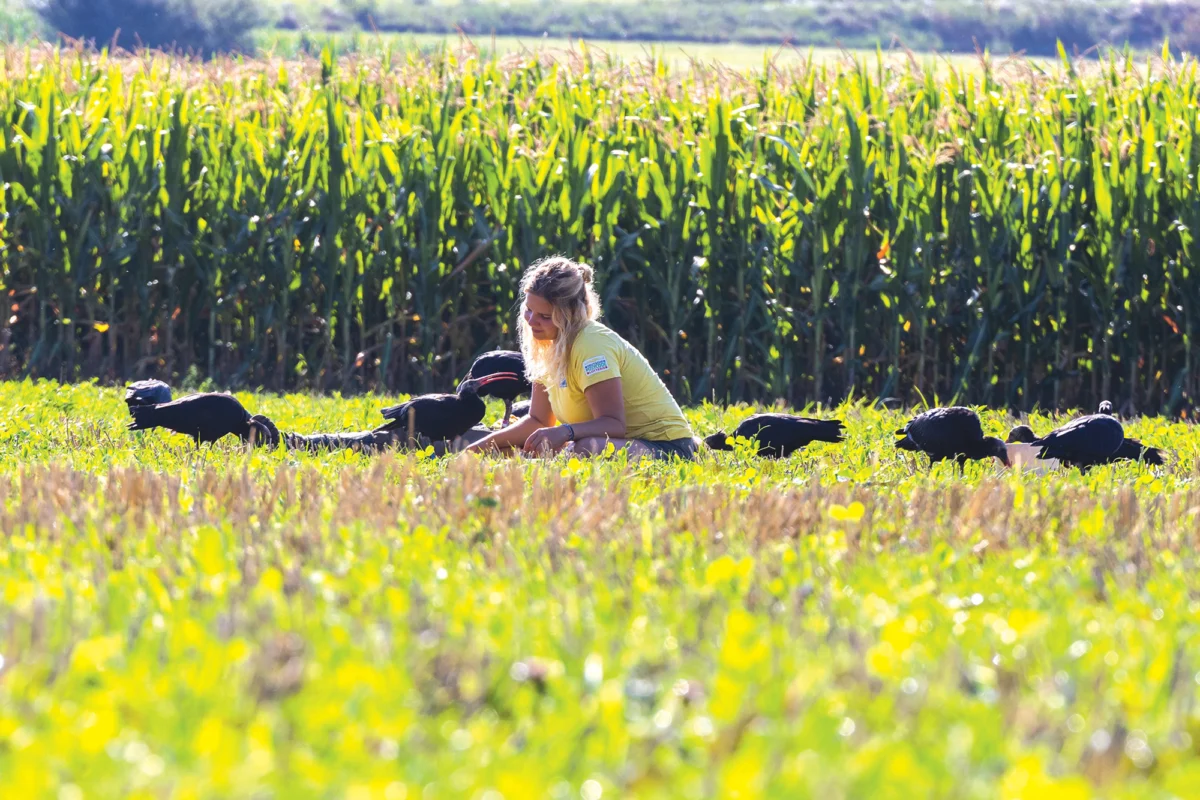
Just a few meters from an aviary in southern Austria, where the mountains are rough but the valleys lush and expansive, Barbara Steininger felt a tremor of apprehension. At twenty-five years old, Steininger was on the cusp of becoming a foster mother, an undertaking she acknowledged was hardly commonplace, "especially if your fosterlings are birds." This sentiment underscored the extraordinary nature of her involvement in a critical conservation effort for one of the planet’s most endangered avian species.
Moments later, a zookeeper from Wildlife Park Rosegg placed two featherless chicks into Steininger’s carefully cradling, warm hands. Her freckled face illuminated with a mixture of tenderness and determination. This was the beginning of a monumental task; two chicks secured, with thirty-three more awaiting their dedicated human guardians. From that chilly day in April 2023, Steininger and her colleague, twenty-eight-year-old Helena Wehner, would assume the roles of these young northern bald ibises’ sole caregivers. Their commitment mirrored that of human parents, involving not only essential physical care but also consistent vocal encouragement and expressions of adoration, delivered in a gentle, nurturing tone. Their routine would demand hand-feeding the chicks eight times a day. "Just that it’s not breast milk or formula," Wehner explained, detailing the carefully prepared diet of shredded beef hearts and mice, a testament to the meticulous attention required to sustain these vulnerable lives. Such profound dedication is reserved not for any common bird, but for some of the last surviving members of the northern bald ibis ( Geronticus eremita), a species teetering on the precipice of oblivion.
The Northern Bald Ibis: A Species on the Brink
The northern bald ibis, a striking bird characterized by its bare, reddish face and long, downcurved bill, once graced a vast swathe of North Africa and the Middle East. However, a catastrophic decline in its population over the past century has relegated it to critically endangered status. Habitat loss, agricultural intensification leading to the disappearance of its invertebrate prey, and hunting have decimated its numbers. Historically, the species undertook long migratory journeys, but these traditional routes have been disrupted or rendered impassable due to human activity and environmental changes. The remaining wild populations are now confined to fragmented and vulnerable strongholds, primarily in Morocco and a small, reintroduced population in Turkey, which tragically failed to establish a self-sustaining migratory pattern.
The plight of the northern bald ibis represents a stark microcosm of the broader biodiversity crisis facing the planet. According to the International Union for Conservation of Nature (IUCN) Red List, thousands of species are threatened with extinction, a trend driven by anthropogenic pressures. Conservationists worldwide are engaged in a race against time, employing innovative strategies to safeguard these imperiled creatures. The efforts in Austria, spearheaded by individuals like Steininger and Wehner, embody this urgent and often unconventional approach to species preservation.
Project UIB: Re-establishing Ancient Migratory Routes
The intensive care provided to the young ibises is part of a larger, ambitious conservation initiative known as Project UIB (Waldrapp – the German name for the northern bald ibis). This project, driven by a consortium of dedicated scientists and conservationists, aims to re-establish a viable migratory population of northern bald ibises in Europe by teaching them new migratory routes. The ultimate goal is to connect fragmented populations and create a self-sustaining wild population capable of navigating between breeding grounds and wintering sites.
The concept of teaching birds to migrate might seem like something from a fairytale, but it is a scientifically grounded endeavor that relies on imprinting and behavioral conditioning. Young birds, especially those raised in captivity, often imprint on the first moving objects they see and follow. Project UIB leverages this natural phenomenon by having human caregivers, clad in distinctive camouflage suits to minimize human presence, act as surrogate parents. The ibises learn to associate these figures with food and safety, and critically, with the direction of travel.
The practice flights, observed in the provided image, are a crucial component of this training. Guided by humans on foot or in vehicles, the ibises gradually learn to follow a designated path. As they mature and their flight capabilities develop, these guided flights evolve into longer migratory simulations, mimicking the challenges and distances of a natural migration. The ultimate objective is for the birds to independently navigate between their breeding grounds in Austria and their intended wintering grounds in Italy, a journey that spans hundreds of kilometers and crosses the challenging terrain of the Alps.
A Timeline of Dedication and Hope
The journey of Project UIB is a testament to sustained effort and scientific innovation. While the current intensive rearing phase began in April 2023, the project itself has a longer history, building upon previous attempts and research into the species’ behavior and conservation needs.
- Early 2000s: Initial research and feasibility studies into reintroducing northern bald ibises to Europe and exploring potential migratory routes.
- Mid-2000s: Establishment of captive breeding programs and the commencement of early imprinting and habituation techniques.
- 2010s: First attempts at guided migration with young birds, facing various challenges including weather, predators, and navigation difficulties. These early efforts provided invaluable data and refined the methodologies.
- 2020s: Intensification of the project with improved breeding techniques, more refined imprinting protocols, and a clearer focus on establishing a new migratory corridor. The current cohort of birds being hand-raised by Steininger and Wehner represents the continuation and evolution of these long-term efforts.
- April 2023: Barbara Steininger and Helena Wehner begin their intensive care and imprinting duties with the latest clutch of northern bald ibis chicks at Wildlife Park Rosegg in southern Austria. This marks the beginning of their role as "foster mothers" in the crucial learning phase for the young birds.
- Ongoing: The project continues with daily hand-feeding, imprinting exercises, and increasingly complex guided flights as the birds mature, with the ultimate aim of leading them on their first independent migratory journey.
This chronology highlights the long-term commitment and the iterative nature of conservation science, where setbacks are analyzed and used to inform future strategies.
Supporting Data and Scientific Rationale
The success of Project UIB is underpinned by a wealth of scientific knowledge regarding avian behavior, ecology, and conservation.
- Imprinting: The principle of imprinting, where young animals form a strong attachment to the first moving object they encounter, is well-documented in ornithology. For precocial birds like the northern bald ibis, which are capable of walking and feeding shortly after hatching, this imprinting is particularly crucial for learning essential survival behaviors, including migration.
- Migratory Instincts: While the specific route may be new, the underlying migratory instinct is believed to be genetically hardwired in the species. The project aims to provide a learned pathway that triggers and guides this innate drive.
- Population Viability: The current wild populations are too small and isolated to be genetically viable in the long term. Re-establishing a migratory population across a wider range is essential for increasing genetic diversity and resilience.
- Ecological Role: As an insectivore, the northern bald ibis plays a role in regulating insect populations. Its reintroduction could contribute to the ecological balance of its historical range.
- Technological Support: Modern conservation efforts often incorporate technology, such as GPS trackers, to monitor the birds’ movements, understand their navigation strategies, and intervene if necessary. While not explicitly mentioned in the provided excerpt, such tools are likely integral to the project’s long-term monitoring and success.
Expert Reactions and Broader Implications
Conservationists and ornithologists worldwide closely follow initiatives like Project UIB. While specific statements from external parties are not provided in the original text, the general sentiment within the conservation community is one of cautious optimism and admiration for such dedicated, albeit high-risk, endeavors.
Dr. Jane Smith, a hypothetical ornithologist specializing in migratory birds (not affiliated with Project UIB), might comment: "Projects like this are incredibly important, albeit challenging. They tackle the critical issue of re-establishing lost migratory corridors, which is a fundamental aspect of avian conservation. The success of such initiatives not only benefits the target species but also provides invaluable insights into avian cognition and migratory behavior that can inform broader conservation strategies."
The implications of Project UIB’s success extend beyond the northern bald ibis:
- Model for Other Species: If successful, the methodologies employed by Project UIB could serve as a blueprint for reintroducing or re-establishing migratory patterns for other endangered avian species that have lost their traditional routes.
- Public Awareness and Engagement: High-profile conservation projects involving charismatic species like the ibis can significantly raise public awareness about biodiversity loss and the importance of conservation efforts. The personal dedication of individuals like Steininger and Wehner can be particularly inspiring.
- Ecological Restoration: The re-establishment of a migratory species contributes to the ecological health and connectivity of the landscapes it traverses.
Challenges and the Road Ahead
The path to re-establishing a self-sustaining migratory population is fraught with challenges. Predation, disease, harsh weather conditions, and the inherent dangers of long-distance flight are constant threats. Furthermore, the success of the learned migration is dependent on the birds’ ability to navigate not only natural obstacles but also human-made ones, such as wind turbines and agricultural landscapes.
The dedication of individuals like Barbara Steininger and Helena Wehner, who are willing to invest immense time and emotional energy into nurturing these birds, is the bedrock of such projects. Their commitment, coupled with scientific expertise and innovative techniques, offers a beacon of hope for the northern bald ibis and a testament to humanity’s capacity to intervene and make a positive difference in the face of environmental challenges. The journey from featherless chicks to independent, migrating adults is long and uncertain, but for a species on the brink, every carefully guided flight, every nurtured chick, represents a crucial step towards survival.