AXPONA 2026, the United States’ largest high-fidelity audio exhibition, recently concluded its three-day run at the Renaissance Schaumburg Convention Centre. The event, a cornerstone of the audiophile calendar, once again convened a diverse assembly of manufacturers, distributors, and dedicated enthusiasts. As is customary, social media platforms buzzed with a torrent of shared experiences: meticulously arranged room shots, glimpses of nascent prototypes, and official pronouncements from participating companies.
However, for many industry observers and dedicated followers, the necessity of physical attendance to glean this information has become increasingly questionable. The economic and temporal investment required for such an endeavor, particularly for international attendees, presents a compelling counter-argument to the traditional notion of show attendance as the primary conduit for industry news. A round-trip flight from Berlin to Chicago, coupled with accommodation, sustenance, and local transportation, can easily amount to US$3000, consuming a significant portion of a work week. The tangible benefits, such as attending loudspeaker demonstrations of inherently variable acoustic quality due to unpredictable hotel room acoustics, and experiencing amplification and other electronics in environments ill-suited for meaningful evaluation, raise questions about the return on investment. A show report, by its nature, cannot equate to a comprehensive review, and for electronic components, it often falls short of even a basic demonstration. The financial calculus, therefore, suggests a diminishing marginal utility for physical presence solely for information acquisition.
The core question that remains is "What’s new?" This query, however, is largely preempted by the immediate and pervasive nature of digital communication. By the time the AXPONA exhibition halls were fully operational, the internet had already disseminated a substantial volume of information. Instagram reels, offering instant visual impressions from Day One, Reddit threads meticulously cataloging every new product announcement, and smartphone-shot YouTube walkthroughs from attendees created an information deluge. X (formerly Twitter) provided real-time photographic evidence as soon as the doors opened. By the time most attendees had settled into their accommodations, the industry’s news cycle had effectively completed its primary dissemination phase.
This observation is not intended as a wholesale indictment of hi-fi shows. The intrinsic value of a physical audio event remains. The serendipitous discovery of a room that captivates the senses unexpectedly, the invaluable opportunity for direct conversation with product designers to understand their creative intent beyond the sterile confines of a press release, and the chance to encounter audio components that one might never have sought out independently – these experiences are irreplaceable and cannot be replicated through digital aggregation. Yet, the assertion that attending a show is the preeminent method for staying abreast of industry developments has become increasingly anachronistic. The current ecosystem of coverage is so comprehensive, immediate, and geographically unbound that physical attendance is becoming almost superfluous as a sole information-gathering exercise. News and product introductions now reach the global audience irrespective of their physical location.

Against this backdrop of accelerated digital dissemination, a select few product debuts at AXPONA 2026 managed to transcend the general noise, capturing significant attention through innovation, ambition, or a compelling fusion of established excellence with novel approaches.
Dutch & Dutch 15c Active Loudspeaker: A New Pinnacle of Precision (US$130,000/pair)
The Dutch & Dutch 15c represents the most ambitious undertaking to date from the company, with a price tag of US$130,000 per pair. Where its predecessor, the 8c, democratized active, DSP-controlled monitoring for a discerning segment of the audio market, the 15c positions itself at a significantly higher echelon of sonic aspiration and technological integration.
The stereo pair of 15c loudspeakers comprises a total of eight drivers, each a substantial 15-inch unit. Every cabinet is engineered to house two rear-firing 15-inch subwoofers dedicated to low-frequency reproduction. Complementing these are a dedicated 15-inch midrange driver and a high-frequency transducer, which is strategically mounted within a 15-inch waveguide. This driver configuration results in a formidable radiating surface area. Dutch & Dutch asserts that this design facilitates exceptionally high sound pressure levels (SPLs) while maintaining stringent control over directivity and mitigating off-axis reflections through an active cardioid dispersion pattern.
The proprietary RoomMatching technology, a hallmark of Dutch & Dutch designs, is integrated into the 15c. This advanced Digital Signal Processing (DSP) system actively calibrates the loudspeaker’s output to the specific acoustic characteristics of the listening environment. The primary focus is on addressing bass resonance issues prevalent at frequencies below the Schroeder frequency, a critical consideration for achieving accurate low-end reproduction. While issues of reverberation above this frequency remain the purview of acoustic room treatment, the stated objective of the 15c is to achieve a linear frequency response from 20Hz to 20kHz, substantially reducing reliance on traditional bass traps. The critical question of whether this promise translates effectively from controlled studio environments to real-world domestic listening rooms remains to be conclusively determined. Given the substantial investment, the listening room itself must be considered an equally vital component of the overall sonic equation.

It is important to note that the AXPONA lobby demonstration likely offered an incomplete picture of the 15c’s true sonic capabilities. The fundamental design principle of Dutch & Dutch’s cardioid bass loading relies on the interaction of rear-firing drivers with a front wall to effectively control low-frequency directivity. When operated in free space, as was the case in the exhibition setting, this crucial design element is compromised. Consequently, the bass performance observed at the show provides a limited indication of how the 15c will perform when integrated into a properly configured and positioned room. While undoubtedly an impressive spectacle, its informative value regarding bass reproduction in an ideal setting was, by necessity, curtailed.
Jones & Cerreta Troubadour Loudspeaker: A Modern Take on a Classic Principle (US$34,000/pair)
Andrew Jones, a designer with a distinguished pedigree that includes influential work with Pioneer, TAD, ELAC, and Mo-Fi, has unveiled his latest creation under the newly established Jones & Cerreta brand: the Troubadour loudspeaker. Priced at US$34,000 per pair, this 3-way floorstanding loudspeaker marks a significant philosophical evolution, embracing a retro-inspired enclosure while incorporating a unique technological innovation that sets it apart in the contemporary market.
The distinctive technological feature of the Troubadour is its field-coil motor system. This system replaces the conventional permanent magnet found in most speaker drivers with an electromagnet powered by a dedicated external DC supply. In a traditional driver, a permanent magnet generates the magnetic field necessary for voice coil movement. In contrast, a field-coil driver utilizes a densely wound coil of copper wire around an iron core. When supplied with a steady DC current from an external power source, this coil generates its own magnetic flux, which can be maintained with a degree of uniformity and stability often exceeding that of permanent magnets.
Jones & Cerreta posit that field-coil drivers generate a stiffer and more precisely controlled magnetic flux field, leading to reduced electrical distortion and enhanced transient response. This advanced motor system is integrated with Jones’s well-established dual-concentric tweeter and midrange array, ensuring superior phase coherence and precise time alignment across the frequency spectrum.

Field-coil drivers have historically garnered a dedicated following among a specific segment of audiophiles, often found within vintage horn-loaded systems. The application of this technology within a contemporary, Andrew Jones-engineered architecture, complete with the rigorous crossover design and time-alignment principles characteristic of his work, represents a genuinely compelling development. The necessity of an external power supply may present a logistical consideration for some prospective buyers, while others will likely view it as an integral and appealing aspect of the system’s advanced design.
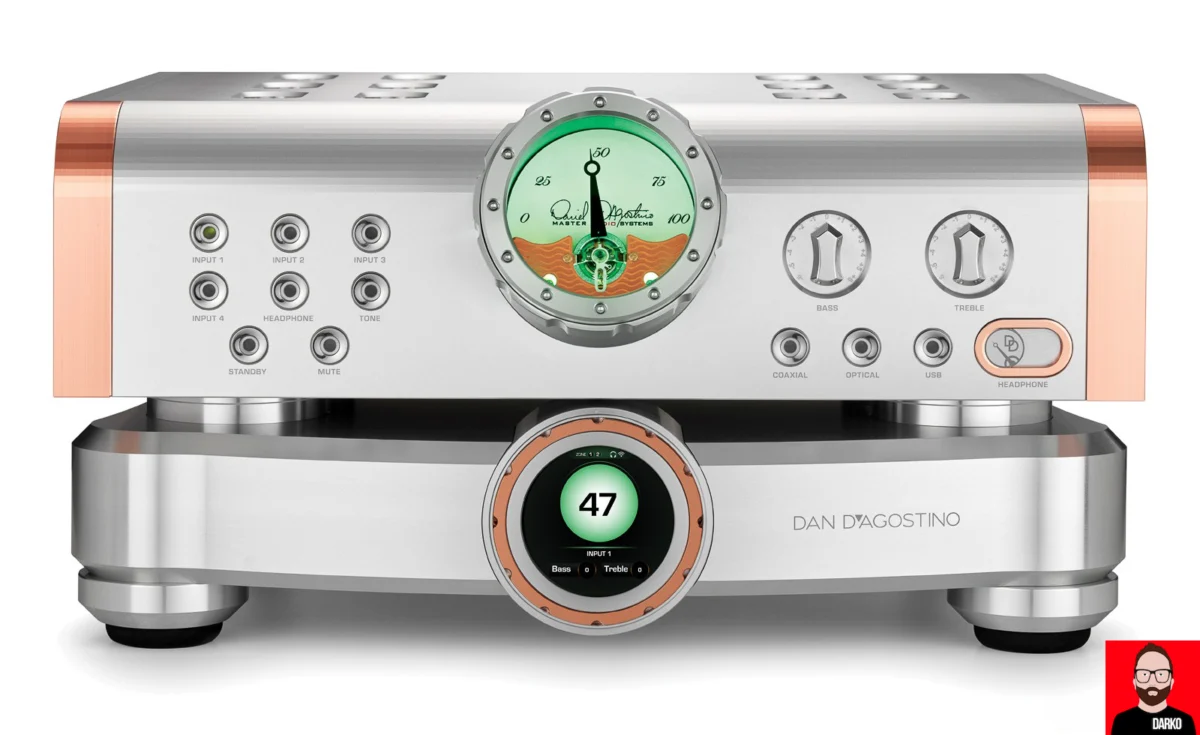
Dan D’Agostino Momentum C2Z Pre-amplifier: A Bespoke Partner for Ultimate Amplification (US$TBC)
Dan D’Agostino’s Momentum Z Monoblocks are widely recognized as among the most exigent and high-performance amplifiers available in the current market. The introduction of a pre-amplifier specifically engineered to complement these formidable monoblocks, with pricing yet to be disclosed (TBA), can be interpreted as a testament to the company’s unwavering confidence in its product synergy, or perhaps a sophisticated strategy to cater to a highly specialized and exclusive client base. It is probable that both factors are at play.
The C2Z represents a significant revision of the Momentum C2 pre-amplifier, which itself commands a price point in the vicinity of US$100,000. The central engineering enhancement lies in a newly developed output stage. This stage is built around a current-capable Field-Effect Transistor (FET) design, meticulously matched to the specific low input impedance characteristics of the Z Monoblocks. According to D’Agostino, this direct electrical coupling allows the amplifiers to draw a substantially higher current directly from the pre-amplifier. This design aims to improve low-frequency control, enhance dynamic contrast, and elevate overall system resolution compared to conventional high-impedance interconnections.
While the exact retail price remains undisclosed, the context of its development provides an indication of expectations. Given that the C2 retails for nearly US$100,000 and the C2Z is positioned as its superior successor, designed as the dedicated companion to amplifiers that can cost up to a quarter of a million dollars, prospective buyers should anticipate a commensurate premium. The phrase "significant premium" is an apt descriptor for the likely cost of this specialized component.

The Economic Stratification of High-End Audio Debuts
The three standout product debuts from AXPONA 2026 – the Dutch & Dutch 15c loudspeakers, the Jones & Cerreta Troubadour, and the Dan D’Agostino Momentum C2Z pre-amplifier – all carry price tags exceeding US$30,000, with two significantly surpassing that threshold. This concentration of ultra-high-end introductions offers a telling insight into the primary demographic that such flagship events are increasingly catering to. It suggests a shift away from the enthusiast with a modest system and aspirational tastes towards the "one percent" of the audiophile world, for whom a six-figure loudspeaker or a bespoke pre-amplifier represents a considered, albeit substantial, purchase rather than a distant abstract concept. For the broader audience, the internet remains the most accessible and comprehensive avenue for engaging with these aspirational products.
The Broader Landscape of AXPONA 2026 Product Debuts
Beyond these headline-grabbing introductions, AXPONA 2026 saw a wider array of new products formally announced, many of which had been previewed in the weeks leading up to the event. This continuous stream of innovation underscores the dynamic nature of the high-fidelity audio industry, even as the economics of attending major shows continue to be debated.
The exhibition floor provided a platform for established brands to showcase updated models and for emerging companies to introduce their latest offerings. While the specific details of every product launch are too numerous to enumerate exhaustively here, the general trends indicated a continued focus on technological advancements in areas such as digital-to-analog conversion, advanced driver technologies, and integrated streaming solutions. The emphasis on active loudspeakers, particularly those with sophisticated digital signal processing capabilities for room correction and driver integration, was a recurring theme. Similarly, the pursuit of sonic purity through refined analog circuitry and robust power delivery remained a core tenet for many amplifier and pre-amplifier manufacturers.
The sheer volume of new products, even those not commanding headline attention, serves as a testament to the enduring passion and investment within the high-fidelity audio community. However, the cost and accessibility of these innovations continue to define distinct tiers within the market, a stratification clearly exemplified by the premium offerings that commanded the most attention at AXPONA 2026. The digital realm now serves as the primary gateway for most enthusiasts to explore these advancements, making the physical show an increasingly specialized experience for those at the very apex of the market or those seeking the intangible benefits of direct engagement.