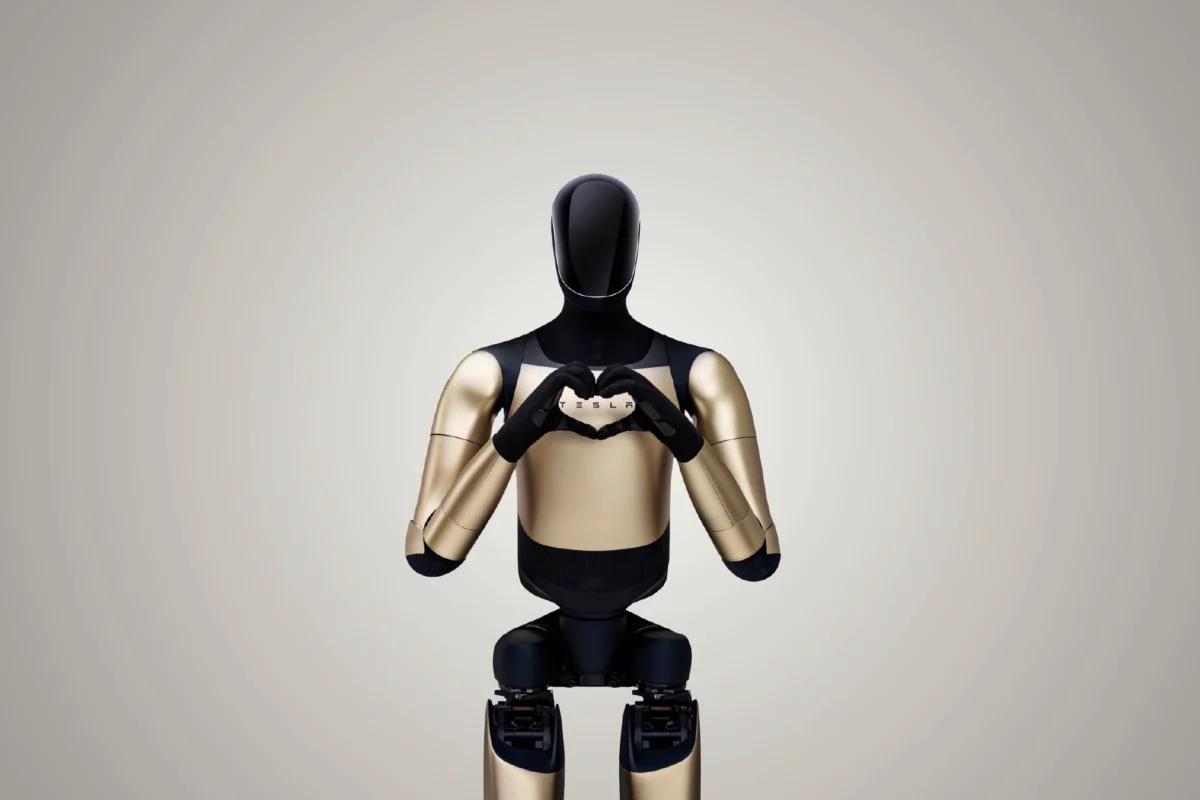
Tesla is on the cusp of unveiling a significantly advanced iteration of its Optimus humanoid robot, with recent patent filings for its hands and arms signaling a major leap forward in tackling one of the most complex engineering challenges in robotics. These new patents, focusing on a sophisticated mechanically actuated, tendon-driven architecture, underscore Tesla’s commitment to achieving human-like dexterity and enabling high-volume manufacturing for its ambitious humanoid project. The unveiling is anticipated to coincide with or follow closely after Tesla’s internal discussions and potential public demonstrations of Optimus’s evolving capabilities.
The innovation detailed in these patents addresses the persistent difficulties in replicating the intricate functionality of the human hand. Tesla’s approach relocates heavy actuators to the forearm, utilizes a meticulously designed wrist for cable routing, and incorporates novel joint assemblies. This strategy is aimed at achieving a level of fine motor control and agility previously considered a significant hurdle for humanoid robots, while simultaneously ensuring the design is conducive to mass production. The company has consistently highlighted the hand as the most challenging component of Optimus, with CEO Elon Musk likening the engineering difficulty to a task "harder than Cybertruck or Model X… somewhere between Model X and Starship."
Core Tendon-Driven Hand Architecture: Mimicking Human Anatomy
At the heart of Tesla’s latest advancements lies a patent titled "Mechanically Actuated Robotic Hand," which elaborates on a cable/tendon-driven system. This design philosophy moves away from placing bulky actuators directly within the hand, a common approach that can lead to bulkier, less agile digits. Instead, Tesla’s patent outlines a system where the primary actuation occurs in the forearm.
Each finger is designed to possess four degrees of freedom (DoF), allowing for a nuanced range of motion. The wrist further contributes to this dexterity by incorporating an additional two degrees of freedom. This configuration provides the robot with a comprehensive set of movements essential for grasping, manipulating, and interacting with objects in a human-like manner.
The technical details reveal a system employing three thin, flexible control cables, or tendons, for each finger. These tendons originate from the forearm actuators, traverse through the specialized wrist design, and connect to various segments of the finger. The patent illustrates integrated channels within the finger phalanges that precisely guide these cables. This routing is crucial, as it allows for selective tensioning and independent bending of each finger segment without causing unintended movements in adjacent joints. The diagrams accompanying the patent filings depict substantial cable bundles extending from the wrist into the palm and fingers, complete with labeled pivot points and routing guides. This anatomical mimicry of human forearm muscles and their associated tendons, which power hand movements from a proximal location, is a key element of Tesla’s design.
Advanced Wrist Routing Innovation: Overcoming Dexterity Bottlenecks
A particularly noteworthy aspect of Tesla’s patented design is the sophisticated cable transition mechanism within the wrist. This mechanism addresses a critical bottleneck in many robotic hand designs: the efficient and precise transfer of control signals from the forearm to the hand. The patented geometry facilitates a transition from a lateral stack of cables on the forearm side to a vertical stack on the hand side through a specialized transition zone.
This innovative geometry is engineered to significantly reduce common failure points found in simpler tendon systems. These include cable stretch, torque limitations, friction, and crosstalk – issues that can manifest as imprecise, jerky, or unreliable movements, particularly during combined yaw and pitch wrist rotations. By minimizing these detrimental effects, Tesla’s design promotes smoother, more consistent, and more reliable multi-axis wrist operation. This enhanced wrist functionality is indispensable for Optimus to perform complex real-world tasks that require delicate manipulation and precise positioning.
Companion Patents on Appendage and Joint Design: Enabling Mass Production
Complementing the core hand and wrist patents are two supporting filings that provide a more comprehensive view of Optimus’s upper limb design and manufacturing strategy. The patent for "Robotic Appendage" covers the entire forearm-to-palm-to-finger assembly. It details how the palm body is movably coupled to the forearm, with the finger phalanges interconnected and actuated by tensile cables that return to the forearm actuators. The precise tensioning of these cables is described as the mechanism for repositioning the phalanges with high accuracy.
The "Joint Assembly for Robotic Appendage" patent further elaborates on the mechanical integrity and ease of assembly. This patent describes the use of curved contact surfaces on mating joint structures, paired with a composite flexible member. This combination is designed to facilitate smooth pivoting motion while maintaining consistent tension across the joint. Such an approach not only enhances the durability of the robotic joints but also simplifies the assembly process, a critical factor for achieving high-volume manufacturing targets. The emphasis on durable, easily assembled components aligns directly with Tesla’s stated goal of producing humanoid robots at scale.
Executive Insights on Hand Development Challenges: A Multi-Year Endeavor
Tesla executives have repeatedly acknowledged the formidable challenge of developing the Optimus hand. Elon Musk has been particularly vocal, stating that the hand represents "the majority of the engineering difficulty of the entire robot." He has underscored the complexity by noting that human hands possess approximately 27-28 degrees of freedom, powered by an intricate network of tendons and muscles primarily located in the forearm. This comparison highlights the profound engineering undertaking involved in replicating such sophisticated biological functionality.
The timeline of Optimus’s development reveals a consistent focus on overcoming these hand-related hurdles. In mid-2025, Musk candidly admitted that Tesla was "struggling" to finalize the hand and forearm design. However, by early 2026, he expressed optimism, indicating that the company had successfully navigated the "hardest" problems. These included achieving human-level manual dexterity, integrating advanced real-world AI for robotic interaction, and ensuring scalability for volume production. Musk further estimated that the electromechanical hand alone accounted for approximately 60 percent of the overall Optimus challenge. This complexity was compounded by the absence of an existing supply chain capable of providing such precision components.
The recently filed patents directly address these acknowledged pain points. The relocation of actuators to the forearm, for instance, significantly reduces the mass and inertia of the hand itself, leading to improved speed, efficiency, and control. The advanced wrist routing and joint geometry are specifically designed to mitigate friction and crosstalk, ensuring smoother and more reliable movements. Moreover, the simplified, stackable components visible in the patent diagrams strongly suggest a design optimized for streamlined, high-volume manufacturing processes.
Implications for Optimus Production and Leadership: A Production-Oriented System
Collectively, these patent filings paint a picture of the Optimus v3 hand not merely as a developmental prototype, but as a robust, production-oriented system engineered from fundamental principles. The described 22-DoF architecture, coupled with the forearm-driven tendon system and the crosstalk-minimizing wrist, offers a clear competitive advantage in terms of robotic dexterity. This approach aligns precisely with Elon Musk’s conviction that high-volume manufacturing is a critical differentiator, a capability he believes is lacking in many other humanoid robotics projects.
For Optimus to achieve its stated goal of becoming the most capable humanoid robot, its hand design needed to effectively replicate the functional elegance of its human counterpart. These patent filings demonstrate that Tesla has successfully transformed years of intensive engineering challenges into patented, sophisticated solutions. This strategic advancement positions Tesla at the forefront of the global race toward developing general-purpose humanoid robots capable of performing a wide array of tasks, from industrial applications to domestic assistance. The company’s progress in solving these complex mechanical and control issues underscores its potential to redefine the landscape of robotics and automation in the coming years. The success of Optimus, particularly its advanced manipulation capabilities, could pave the way for widespread adoption of humanoid robots, fundamentally altering industries and daily life.