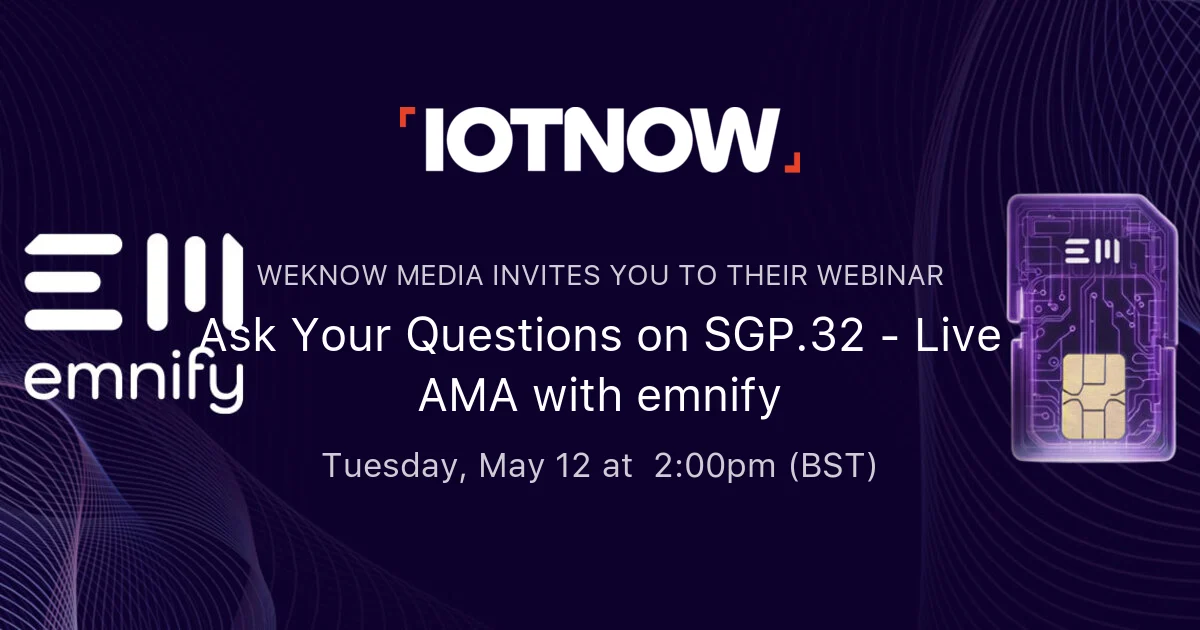
The global Internet of Things (IoT) landscape is currently undergoing its most significant architectural transformation in a decade with the introduction of the GSMA SGP.32 specification. As enterprises transition from legacy machine-to-machine (M2M) communication standards toward more flexible, software-defined environments, emnify has announced a live, interactive "Ask Me Anything" (AMA) session designed to demystify the complexities of this new connectivity model. This session features technical experts currently implementing the SGP.32 standard, providing a rare opportunity for industry stakeholders to move beyond theoretical whitepapers and into the practicalities of deployment.
For years, the IoT sector relied on the SGP.02 M2M specification, a framework that, while functional, often struggled with the complexities of remote SIM provisioning and carrier switching. The SGP.32 standard represents a fundamental shift, moving away from static SIM management toward a fully programmable, software-defined control mechanism. This transition is expected to unlock unprecedented levels of operator independence, resilience, and scalability for global IoT fleets.
The Evolution of IoT Connectivity Standards
To understand the weight of the SGP.32 introduction, one must look at the chronology of SIM technology. The original SIM cards were physical, hardware-locked assets. In the early 2010s, the GSMA introduced the first eSIM (embedded SIM) specifications for M2M (SGP.01/02). While these allowed for remote provisioning, they were hampered by a cumbersome architecture that required complex integrations between Subscription Manager Data Preparation (SM-DP) and Subscription Manager Root (SM-SR) servers. This often led to "carrier lock-in," where switching providers was technically difficult and commercially prohibitive.
Later, the consumer eSIM standard (SGP.21/22) was developed for smartphones and wearables. This model was much more user-friendly, utilizing a "pull" mechanism where the user initiates a profile download. However, it lacked the automation required for IoT, where thousands of devices may need to be updated simultaneously without human intervention.
SGP.32, often referred to as the "eSIM for IoT" specification, bridges this gap. It takes the best elements of the consumer model—specifically the use of the SM-DP+ (Subscription Manager Data Preparation+)—and adds an automation layer tailored for the industrial and commercial IoT sectors. This allows for a "push" mechanism that can be managed centrally, making it possible to handle massive deployments with the ease of a consumer device.
Technical Architecture: The eIM and IPA
The core of the SGP.32 model lies in two new components: the eSIM IoT Manager (eIM) and the IoT Profile Assistant (IPA). In the legacy SGP.02 model, the SM-SR was the central hub for managing SIM states. In SGP.32, the eIM takes over as the orchestration point. The eIM is a platform-agnostic tool that allows enterprises to manage large groups of eSIMs, sending commands to download, enable, disable, or delete profiles.
The IPA resides on the device side, either within the eUICC (the hardware chip) or the device’s operating system. This component facilitates the secure download of carrier profiles from the SM-DP+. By offloading the complexity of the handshake to the IPA and eIM, SGP.32 removes the need for expensive, carrier-specific integrations. This technical shift effectively turns connectivity into a programmable lifecycle asset, rather than a fixed hardware limitation.
The Strategic Importance of Operator Independence
One of the primary drivers behind the adoption of SGP.32 is the quest for true operator independence. In the current geopolitical and economic climate, IoT enterprises face various risks, including fluctuating roaming costs, sunsetting of legacy networks (such as 2G and 3G), and changing data sovereignty regulations.
Under the SGP.32 model, an enterprise is no longer tethered to the initial carrier that provided the SIM. Because the standard uses a unified architecture, switching to a local carrier in a new region—or moving to a different provider to take advantage of better pricing or network coverage—becomes a software update rather than a logistics nightmare. This capability is particularly critical for the automotive, logistics, and smart grid industries, where devices are expected to remain in the field for 10 to 15 years.
Enabling "Instant-On" Connectivity and Global Scalability
The concept of "instant-on" connectivity is a central theme of the upcoming AMA session. Traditionally, manufacturing a device for global distribution required either SKU-specific SIM cards or complex pre-provisioning. SGP.32 simplifies this by allowing a single "bootstrap" profile to be embedded during manufacturing. Once the device is powered on anywhere in the world, the eIM can automatically trigger the download of the most appropriate local operational profile.
This "zero-touch" provisioning significantly reduces the operational overhead associated with global scaling. It eliminates the need for manual SIM swapping in the field, a process that is often cost-prohibitive or physically impossible for devices located in remote or hazardous environments. According to industry analysts, the reduction in truck rolls and manual interventions could save large-scale enterprises millions of dollars in lifecycle management costs over the next decade.
Resilience and Fallback Mechanisms
Resilience remains a top priority for mission-critical IoT applications, such as medical monitoring and industrial automation. SGP.32 introduces enhanced fallback mechanisms. If a primary network fails or loses signal, the software-defined nature of the SIM allows for an automated switch to a secondary profile. Unlike previous iterations, where fallback could be slow or unreliable, the SGP.32 framework is designed to handle these transitions with minimal latency, ensuring that "always-on" devices stay connected even in volatile network environments.
The Role of emnify in the SGP.32 Ecosystem
As a leader in cloud-native IoT connectivity, emnify has been at the forefront of the SGP.32 transition. Their platform is designed to integrate seamlessly with the new standard, providing enterprises with a single interface to manage global fleets. By leveraging a cloud-native infrastructure, emnify allows for the real-time monitoring and management of connectivity assets, which is essential for maximizing the benefits of the SGP.32 model.
The decision to host an AMA session rather than a traditional webinar reflects the current state of the industry. While the SGP.32 specification has been finalized by the GSMA, the practical implementation involves navigating a complex ecosystem of hardware vendors, module manufacturers, and mobile network operators (MNOs). The AMA format allows attendees to ask specific questions regarding hardware compatibility, migration strategies from SGP.02, and the nuances of eIM orchestration.
Industry Reactions and Market Implications
The shift to SGP.32 has been met with widespread approval from IoT hardware manufacturers and enterprise end-users, though it presents a challenge to traditional MNOs who have historically benefited from "locked" SIM cards. Market analysts suggest that SGP.32 will democratize the connectivity market, forcing providers to compete on network quality and service levels rather than contractual lock-in.
"SGP.32 is the missing link for massive IoT," says a lead connectivity architect involved in the standard’s development. "It finally aligns the technical capabilities of the SIM with the business requirements of modern enterprises. The ability to manage connectivity via API and software-defined protocols is a game-changer for anyone managing more than a few thousand devices."
Data from recent industry reports indicates that by 2027, over 70% of new industrial IoT deployments will utilize some form of eSIM technology, with SGP.32 expected to be the dominant standard. The move toward this model is also seen as a crucial step in supporting the rollout of 5G RedCap (Reduced Capability), which is designed for mid-tier IoT devices that require the longevity and efficiency SGP.32 provides.
Navigating the Transition: What to Expect at the AMA
The upcoming session hosted by emnify aims to provide a roadmap for this transition. Key topics of discussion will include:
- Legacy Compatibility: How to manage a fleet that contains both legacy SGP.02 and new SGP.32 devices.
- Security Protocols: Understanding the enhanced security layers within the SGP.32 architecture, including mutual authentication between the eIM and the IPA.
- Cost Structure: How the shift from physical SIMs to software-defined profiles impacts the Total Cost of Ownership (TCO).
- Implementation Timelines: Realistic expectations for when SGP.32-compliant modules and eUICC hardware will be available at scale.
The complexity of shifting from static to programmable connectivity cannot be overstated. It requires a rethink of the entire supply chain, from device design to post-deployment management. For enterprises currently planning their next generation of connected products, understanding SGP.32 is not just a technical advantage—it is a strategic necessity.
Conclusion and Outlook
The introduction of the SGP.32 connectivity model marks the end of the "static SIM" era. By transforming connectivity into a dynamic, software-defined asset, the GSMA has provided the industry with a framework capable of supporting the projected billions of IoT devices coming online in the next few years.
The live AMA session hosted by emnify represents a critical touchpoint for the industry, offering a platform for direct engagement with experts who are navigating these changes in real-time. As IoT continues to integrate into every facet of global industry, standards like SGP.32 will provide the foundation for a more resilient, independent, and scalable future. Space for the session is limited to ensure an interactive environment, highlighting the high demand for clarity in this rapidly evolving field. For those with SGP.32 on their roadmap, the message is clear: the era of programmable connectivity has arrived, and the time to adapt is now.