The Evolution of Consumer Skepticism in the Knife Industry
The current discourse surrounding knife steel performance has evolved through several distinct phases. Initially, the "indifference" argument served as a critique of collectors who purchased expensive knives but rarely subjected them to rigorous use. The logic was simple: if a knife never leaves a display case or only cuts the occasional envelope, the specific alloy composition is irrelevant to the owner’s experience. Over time, this sentiment morphed into a broader claim that the differences between "premium" steels—such as CPM-S30V, M390, or MagnaCut—are so minute that they represent a point of diminishing returns for the consumer.

In its most extreme form, this skepticism posits that there is no real-world difference between any modern steels, categorizing the entire field of knife metallurgy as a product of marketing hype rather than engineering progress. This perspective, however, often overlooks the specific industrial applications for which these steels were designed. The transition from simple carbon steels to complex high-speed steels and powder metallurgy represents decades of material science advancement intended to solve specific mechanical failures, such as premature dulling, chipping under impact, or rapid oxidation in saline environments.
Empirical Data: The CATRA Edge Retention Benchmarks
To understand the objective differences between steels, researchers rely on standardized testing to eliminate the variables of human error and inconsistent materials. The CATRA test is the industry standard for measuring edge retention. In this test, a machine subjects a knife with a specific edge geometry to repeated cutting cycles against abrasive cardstock infused with silica. The total amount of cardstock cut (measured in millimeters) provides a quantitative value for a steel’s wear resistance.

Data from these tests show a massive performance spectrum. For example, lower-alloy steels like 8670 may test at under 300 mm of cardstock cut. In contrast, ultra-high wear resistance steels like Rex 121 can cut up to 1,150 mm under identical conditions. This represents a nearly 400% difference in cutting longevity. In a side-by-side comparison where both blades are sharpened to the same angle and used to cut the same material, the distinction would be immediately apparent to any user. The disparity confirms that while a user might not notice a 5% difference between two similar steels in the same category, the gap between different categories of steel is statistically and practically enormous.
The Variable Usage Paradox: The Car Mileage Analogy
The reason many users claim they cannot tell the difference between steels often lies in the lack of a controlled environment. Metallurgists frequently use the "commuter vs. soccer parent" car analogy to explain this phenomenon. If a driver uses a car solely for a fixed daily commute on a flat highway, they can easily detect even a minor improvement in fuel efficiency because the variables (distance, speed, and terrain) remain constant. However, a "soccer parent" who drives a variable schedule—sometimes idling at practice, sometimes driving on the highway, and sometimes navigating stop-and-go city traffic—would find it nearly impossible to notice a 20% increase in gas mileage without carefully tracking the data.

The same principle applies to knives. Most users cut random items—cardboard one day, rope the next, and food the following week—at varying frequencies. This inconsistency makes it difficult to perceive how much work a knife has performed between sharpenings. A high-performance steel may be lasting twice as long as a budget steel, but because the user is not "counting the miles," the improvement remains invisible. This lack of perception does not negate the existence of the performance boost; it simply highlights the limitations of anecdotal observation compared to data-driven analysis.
The Dominance of Edge Geometry over Material Composition
One of the most significant factors that complicates the "steel debate" is edge geometry. Industry experts emphasize that the thickness and angle of a knife’s edge often have a more profound impact on perceived performance than the steel itself. A common or "budget" steel, such as AUS-6, can actually outlast a premium "super steel" like CPM-S110V if the AUS-6 is sharpened to a thin, acute angle (e.g., 12.5 degrees per side) while the S110V is left with a thick, obtuse factory edge (e.g., over 20 degrees per side).

Thin edges reduce the force required to move the blade through a material, which in turn reduces the wear on the apex. When a consumer experiences a premium knife that performs poorly, the culprit is frequently a thick edge geometry designed by the manufacturer to prevent warranty claims, rather than a failure of the steel itself. This leads to the mistaken conclusion that the steel type is "hype," when in reality, the engineering of the blade’s shape is masking the potential of the material.
Trade-offs in Toughness and Hardness
Engineering is a discipline defined by trade-offs, and knife metallurgy is no exception. The "perfect" steel does not exist because the properties required for edge retention (wear resistance) often come at the expense of toughness (resistance to chipping and breaking).

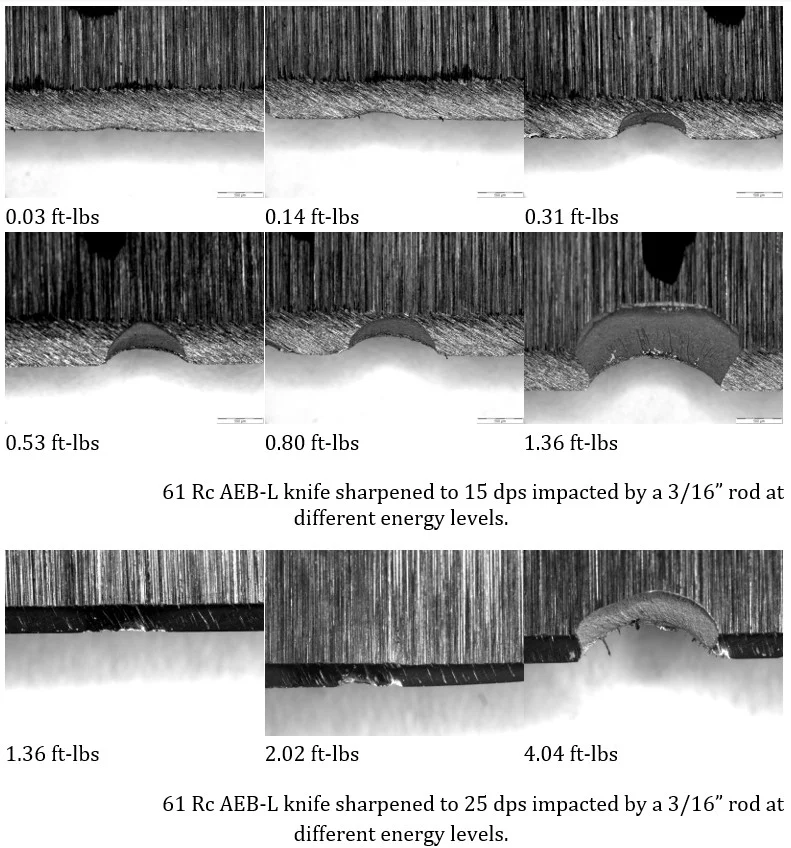
High-wear steels like Maxamet and Rex 121 are pushed to extreme hardness levels, often reaching 68-70 on the Rockwell C scale (Rc). While these knives can cut for incredible durations, they are more prone to catastrophic failure—snapping or chipping—if they encounter a hard object or are subjected to lateral stress. Conversely, tougher steels like AEB-L or 8670 are designed to flex or dent rather than shatter.
A notable demonstration of this involves the "nail chop" test, which compares the structural integrity of different steels. In tests conducted by custom bladesmiths, softer steels like 1095 often fail due to deformation (the edge rolls or flattens) when struck against a hard object. In contrast, a modern steel like MagnaCut, heat-treated to a higher hardness, can pass the same test without damage because it possesses the strength to resist deformation without the brittleness that causes chipping. This distinction is a direct result of the steel’s chemical composition and heat treatment, proving that the choice of material has tangible consequences for the knife’s durability.

Corrosion Resistance and Maintenance Realities
While edge retention is the most debated topic, corrosion resistance is perhaps the most universally recognized area of difference. The distinction between a non-stainless carbon steel and a high-chromium stainless steel is objective and easily observed. However, even within the stainless category, there are significant tiers of performance.
Nitrogen-based steels like Vanax or LC200N offer near-total immunity to saltwater corrosion, a feat that standard stainless steels like 440C cannot match. For users in maritime environments or those who use their knives for food preparation without immediate cleaning, these metallurgical differences are the difference between a functional tool and a rusted relic. Similarly, the "sharpenability" of a steel is a tangible factor. Steels with high vanadium carbide content require diamond or cubic boron nitride (CBN) abrasives for efficient maintenance. A user attempting to sharpen a high-vanadium steel with a traditional Arkansas stone will immediately "tell the difference," as the stone will fail to cut the harder carbides, leading to a frustrating and ineffective sharpening experience.

Broader Impact and Industry Implications
The ongoing refinement of knife steels has significant implications for the future of the tool industry. As engineers continue to develop alloys that bridge the gap between toughness and wear resistance—such as the recent rise of MagnaCut—the "categories" of steel are being redefined. These advancements allow manufacturers to create thinner, higher-performing tools that do not sacrifice durability.
For the consumer, the takeaway is not that they must always buy the most expensive steel, but rather that they should match the steel to their specific needs. A professional chef, a wilderness survivalist, and an office worker carrying a pocket knife for opening boxes all have different metallurgical requirements. The "spicy opinions" found on internet forums often ignore this nuance, but the data remains clear: the differences in knife steel are real, measurable, and vital to the evolution of tool performance. Whether or not a user "notices" the difference in a casual setting, the engineering progress represented by modern metallurgy continues to provide more capable, durable, and specialized tools for the modern world.