Finnish startup Donut Lab, a company that has garnered significant attention for its claims of developing the world’s first production-ready solid-state battery for vehicles, has recently released new information and insights into its groundbreaking technology. In a recent video published on the company’s YouTube channel, Ville Piippo, co-founder and CTO of Donut Lab, provided a closer look at the solid-state battery pack powering the Verge TS Pro Gen2 electric motorcycle. This collaboration marks what Donut Lab asserts is the world’s first solid-state-powered electric bike and boasts the fastest charging capabilities in its class.
Unpacking the Verge TS Pro Gen2 Battery System
The Verge TS Pro, specifically its Standard Range variant, integrates 192 of Donut Lab’s 94 Wh cells. This configuration yields a nominal battery capacity of approximately 18 kilowatt-hours, with a maximum capacity reaching around 20 kWh. For riders seeking extended range, a Long Range version is available, featuring a nominal capacity of approximately 30 kWh, all within the same battery enclosure size as the smaller pack. This packaging efficiency is a critical design consideration, particularly in the often space-constrained architecture of electric motorcycles.
Delving into the internal structure of the 18 kWh model, each module is designed with a 2P 96S configuration. This translates to two cells connected in parallel and 96 cells arranged in series, culminating in a maximum system voltage of approximately 400 volts. The battery pack is comprised of four such modules, stacked vertically with a slight offset between each layer. To manage thermal performance, heat transfer plates are strategically placed between each cell layer. These plates are engineered to efficiently conduct heat away from the cells and towards the exterior of the battery pack.
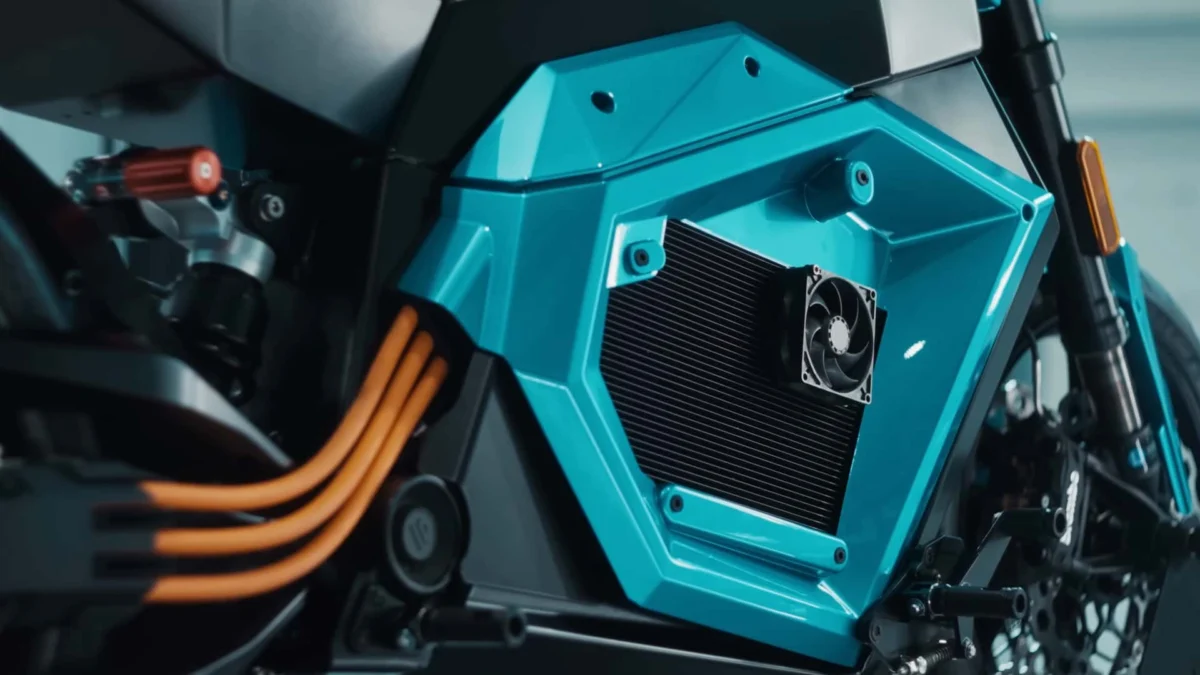
The thermal management system is further enhanced by heatsinks and compact fans positioned on each side of the pack. These components resemble those found in high-performance PC processors and are crucial for dissipating heat into the ambient air, classifying the battery pack as an air-cooled system. "So it’s a fully air-cooled design, and a very compact design," Piippo stated in the video, highlighting the engineering ingenuity required for such a system.
Charging Performance: A New Benchmark for Electric Motorcycles
In terms of charging speed, the solid-state Verge TS Pro Gen 2 is reported to achieve a peak charging rate of approximately 100 kW when connected to a DC fast charger. This allows for a significant charge from 10% to 80% in roughly 11 minutes, with a complete 10% to 90% top-up taking just under 15 minutes.
While this peak charging power of 100 kW is half of the 200 kW figure previously touted by Donut Lab, the company attributes this difference to the limitations imposed by the motorcycle’s compact design, which precludes the use of liquid cooling systems. Donut Lab suggests that in automotive applications, where ample space allows for liquid-cooled battery packs, its 94 Wh cells could potentially achieve much higher charging speeds, with claims of reaching 0% to 80% charge in as little as five minutes.
Even with a maximum input of 103 kW, the Verge TS Pro Gen 2 operates at a C-rate of slightly over 5C. The C-rate is a metric that quantifies how quickly a battery can be charged or discharged relative to its total capacity. For the Verge TS Pro Gen 2 Standard Range, with its maximum capacity of 20 kWh, a 1C rate would correspond to a charging speed of 20 kW. Most contemporary electric vehicle batteries typically operate at C-rates below 4C, making the reported performance of Donut Lab’s battery particularly noteworthy.
Donut Lab asserts that the Verge TS Pro, equipped with its solid-state battery technology, now holds the title of the world’s fastest-charging motorcycle. In practical terms, this translates to approximately 12 miles of additional range being replenished for every minute of charging, considering the new TS Pro’s estimated total range of 217 miles. Production of this upgraded electric bike reportedly commenced last month, although independent verification of the solid-state TS Pro Gen2’s performance is still awaited by the industry.
The Unfolding Narrative of Donut Lab’s Solid-State Technology
The recent disclosures from Donut Lab follow a period of intense scrutiny and skepticism from industry experts. While the company has made bold assertions, including an impressive energy density of 400 watt-hours per kilogram, the complete absence of rare-earth materials, and an extraordinary lifespan of 100,000 charge cycles, concrete evidence, such as patents or comprehensive validation reports detailing the specific chemistry of their cells, has been largely undisclosed. This lack of transparency has led many to question the veracity of their claims, with some experts expressing considerable doubt about the figures presented.
Despite the controversies, Donut Lab has gradually released details of its cells through a series of independent tests. The latest video offers a glimpse into how these cells are integrated into a functional vehicle-level battery pack, providing valuable insights into both Donut Lab’s technical approach and the unique engineering challenges inherent in designing electric two-wheelers.
Broader Implications and Industry Context
The pursuit of solid-state battery technology represents a significant frontier in the evolution of electric vehicles. Unlike conventional lithium-ion batteries that rely on liquid or gel electrolytes, solid-state batteries utilize solid electrolytes, which theoretically offer enhanced safety, higher energy density, and faster charging capabilities. These advantages could be transformative for the EV industry, potentially addressing key consumer concerns related to range anxiety and charging times.
Major automotive manufacturers, including Toyota, Volkswagen, and BMW, are heavily investing in solid-state battery research and development, signaling the technology’s immense potential. However, the path to mass production has proven to be complex, with challenges in scaling up manufacturing, ensuring long-term durability, and achieving cost-competitiveness.
Donut Lab’s claims, if substantiated, would represent a significant leap forward. The company’s focus on an air-cooled system for the motorcycle, while potentially limiting peak charging power compared to liquid-cooled systems, highlights an innovative approach to thermal management in a compact form factor. The reported charging speeds, even with these constraints, are a considerable advancement for electric motorcycles.
The Road Ahead: Verification and Validation
The automotive and battery industries will be closely watching Donut Lab’s progress. The company’s ability to provide independent, verifiable data that confirms its technological claims will be crucial in solidifying its position in the market and gaining the trust of both consumers and industry stakeholders. The upcoming independent tests of the solid-state TS Pro Gen2 will be a critical juncture, offering an objective assessment of the technology’s real-world performance.
The successful commercialization of production-ready solid-state batteries would not only revolutionize the electric motorcycle segment but also pave the way for broader adoption across the electric vehicle landscape. The ongoing developments from Donut Lab, while still subject to rigorous validation, underscore the dynamic and rapidly evolving nature of battery technology and its profound implications for the future of sustainable transportation. The company’s journey, marked by ambitious claims and gradual disclosures, continues to be a focal point in the global race to unlock the full potential of solid-state battery technology.