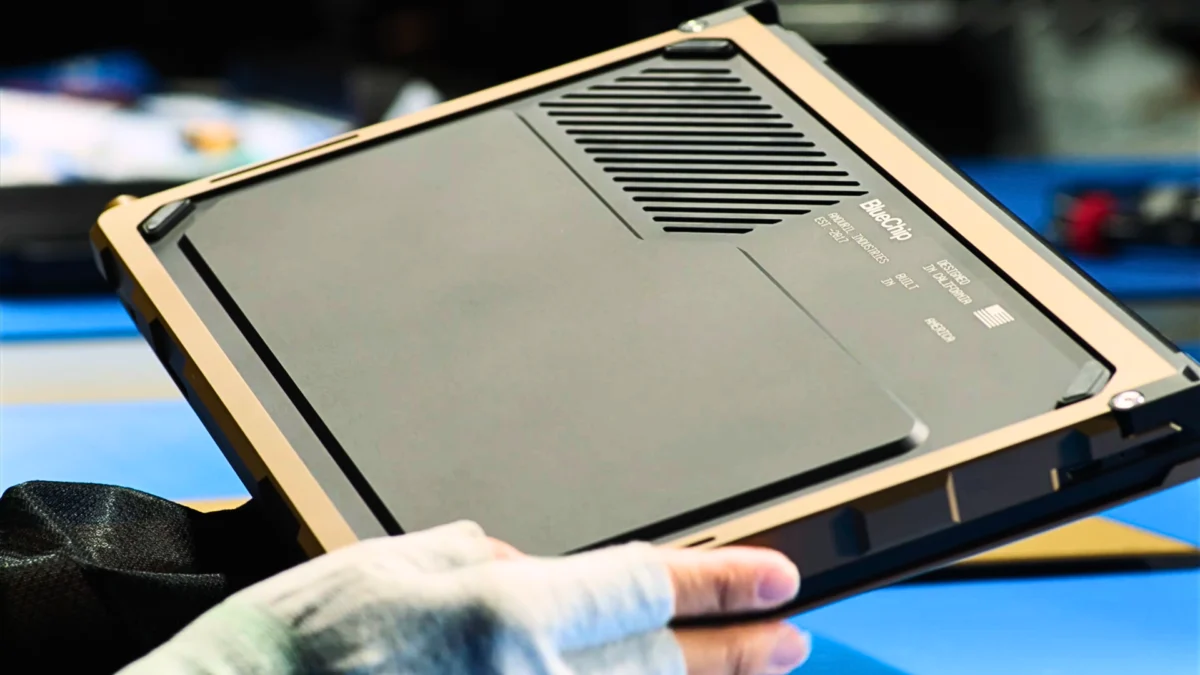
Defense technology innovator Anduril Industries has officially announced a strategic venture into domestic computer manufacturing, unveiling plans to produce a new line of secure, domestically built laptops designated under the moniker BlueChip. Best known for its cutting-edge autonomous military drones, counter-unmanned aerial systems (C-UAS), and advanced command-and-control software, Anduril is broadening its hardware portfolio to address critical vulnerabilities in the United States technology supply chain. According to the official corporate announcement released in collaboration with semiconductor giant Qualcomm, the company will begin accepting commercial and enterprise orders for the BlueChip devices in 2027.
The initiative marks a significant departure from traditional consumer electronics manufacturing paradigms, which have historically relied heavily on overseas fabrication plants, particularly in East Asia. By leveraging Qualcomm’s Snapdragon X Series systems-on-chip (SoCs), Anduril aims to deliver high-performance, power-efficient computing solutions built upon trusted hardware foundations. The move reflects a growing consensus among defense contractors, federal policymakers, and enterprise security leaders that the modern digital infrastructure requires a completely verifiable and secure hardware provenance to protect against foreign espionage, supply chain interdiction, and intellectual property theft.
The Technological Architecture of BlueChip
At the core of the BlueChip laptop lineup is Qualcomm’s advanced Snapdragon X Series architecture. Known for delivering robust processing power alongside exceptional energy efficiency and integrated artificial intelligence acceleration through dedicated neural processing units (NPUs), the Snapdragon platform provides a modern foundation for secure mobile computing. Anduril has indicated that the choice of Qualcomm silicon aligns with its broader strategy of integrating high-performance edge computing into tactical and enterprise environments without compromising on battery life or thermal management.
While functional prototypes of the BlueChip hardware are already operational and undergoing rigorous internal testing, the company’s most ambitious metric lies in its supply chain composition. Anduril has disclosed that approximately 90 percent of the procurement cost for the components utilized in the current prototypes originates from suppliers located within the United States or its close geopolitical allies. This localized sourcing model is designed to mitigate the risks associated with single points of failure in global manufacturing logistics, such as those experienced during the semiconductor shortages and geopolitical trade tensions of recent years.
Furthermore, the company has stated that achieving a fully domestic supply chain remains its ultimate long-term objective. Transitioning the remaining 10 percent of component procurement—which often involves specialized sub-components, rare earth element processing, and advanced packaging—onto American soil will require substantial capital investment, public-private partnerships, and the revitalization of domestic electronics manufacturing ecosystems.
Strategic Background and Geopolitical Context
The launch of the BlueChip initiative occurs against a backdrop of escalating geopolitical competition and heightened awareness regarding national security vulnerabilities inherent in globalized technology supply chains. For decades, the vast majority of personal computers, laptops, and microchips have been manufactured overseas, primarily in China, Taiwan, South Korea, and Southeast Asia. While this model optimized production costs and scaled global consumer electronics markets, it created severe strategic liabilities for defense agencies, critical infrastructure operators, and enterprise organizations handling sensitive data.
In recent years, the U.S. federal government has taken aggressive steps to decouple critical technological infrastructure from foreign adversaries. Legislation such as the CHIPS and Science Act of 2022 injected tens of billions of dollars into domestic semiconductor manufacturing, seeking to rebuild the nation’s capacity to fabricate advanced microelectronics. However, while semiconductor fabrication has received significant policy and financial attention, the downstream assembly of end-user devices—such as laptops, servers, and communication terminals—has remained largely dependent on foreign infrastructure.
Anduril Industries, founded in 2017 by Palmer Luckey, Trae Stephens, Brian Schimpf, and Matt Grimm, has built its corporate identity on disrupting traditional defense procurement. By applying Silicon Valley software development methodologies and commercial off-the-shelf (COTS) hardware adaptations to military challenges, the company has rapidly scaled to become a primary prime contractor for the Department of Defense. Expanding into domestic computer manufacturing represents a natural evolution of Anduril’s mission to secure the tactical and strategic edge for the United States and its allies, ensuring that command-and-control hardware cannot be easily compromised at the point of origin.
Chronology of Development and the 2027 Commercial Horizon
The development of the BlueChip laptop line is the culmination of years of internal strategic planning and supply chain mapping by Anduril Industries. Although the public unveiling occurred recently, preliminary engineering and architectural alignment with Qualcomm began well in advance of the official announcement.
- Phase 1: Conceptualization and Architectural Alignment (2023–2024): Anduril identified a persistent gap in the market for high-security, domestically produced end-user computing devices capable of meeting rigorous defense and enterprise specifications. Discussions with Qualcomm solidified the choice of the Snapdragon X Series architecture as the foundational compute engine.
- Phase 2: Prototyping and Supply Chain Sourcing (2024–2025): Engineering teams developed functional prototypes. Concurrently, procurement specialists mapped out supply networks, achieving the current milestone where 90 percent of component costs are tied to U.S. and allied manufacturing partners.
- Phase 3: Validation, Security Hardening, and Pilot Testing (2025–2026): Over the next twenty-four months, the BlueChip hardware will undergo exhaustive security audits, firmware hardening, and field testing within controlled defense and enterprise environments to validate performance, durability, and resilience against sophisticated cyber threats.
- Phase 4: Commercial Order Intake and Production Scale-Up (2027): Anduril is scheduled to officially open order intake for the BlueChip product line in 2027, marking the transition from development prototypes to scaled commercial and governmental deployment.
Industry Reactions and Stakeholder Perspectives
The announcement of the BlueChip initiative has drawn considerable commentary from across the technology and defense sectors, reflecting both the promise and the formidable challenges of rebuilding domestic computer manufacturing.
Defense analysts have widely praised the move as a necessary step toward closing critical security loops. In modern military and intelligence operations, laptops and mobile workstations serve as the primary interfaces for deploying tactical software, reviewing surveillance feeds, and executing mission-critical communications. Ensuring that these devices are free from unauthorized hardware backdoors or compromised firmware components is a paramount priority for national security agencies. By taking control of the hardware supply chain, Anduril positions itself to offer an unprecedented level of provenance and trust.
Conversely, supply chain economists and manufacturing experts have pointed out the immense economic hurdles associated with scaling domestic electronics production. Building a laptop is a complex orchestration involving hundreds of distinct sub-assemblies, display panels, memory modules, batteries, and mechanical chassis components. Achieving cost competitiveness with established global manufacturers while maintaining a 100 percent domestic supply chain will require sustained demand, advanced automation, and continued federal support.
Qualcomm’s involvement as the foundational technology partner lends significant technical credibility to the project. As Qualcomm expands its footprint in the personal computing space with its Snapdragon X architecture, partnerships with innovative defense primes like Anduril open new avenues for deployment in high-security, mission-critical sectors that demand stringent reliability and performance standards.
Broader Implications for the Technology and Defense Sectors
The introduction of the BlueChip laptop line signals a broader structural shift in how hardware security is conceptualized within the United States. For decades, cost efficiency has been the primary driver of supply chain decisions. However, the rising frequency of sophisticated cyber-attacks, intellectual property theft, and geopolitical instability has fundamentally altered the risk calculus for both government agencies and Fortune 500 enterprises.
If Anduril successfully executes its roadmap and begins fulfilling orders in 2027, it could establish a new benchmark for trusted hardware manufacturing. Such a development could prompt other defense contractors and technology firms to reconsider their manufacturing footprints, accelerating a broader trend toward regionalized or resourced supply chains. Furthermore, the success of the BlueChip initiative may encourage federal policymakers to extend subsidization and procurement incentives beyond semiconductor fabrication to encompass full-system end-user device manufacturing.
Ultimately, Anduril’s venture into laptop production underscores the convergence of national security and commercial technology. As the boundaries between digital infrastructure and physical defense continue to blur, the ability to build secure, verifiable computers on domestic soil will transition from a desirable objective to an absolute operational necessity.