The specialty steel industry has undergone a seismic shift following the bankruptcy and subsequent dissolution of Crucible Industries, a cornerstone of American powder metallurgy. This transition has fundamentally altered the supply chain for high-performance knife steels, leading to a strategic partnership between Niagara Specialty Metals and the European steel giant Erasteel. While the collapse of a domestic manufacturing titan initially sparked concerns regarding the availability and quality of proprietary alloys like MagnaCut, recent metallurgical testing and production data suggest that the move to European manufacturing may have inadvertently raised the ceiling for knife steel performance.

The Collapse of a Domestic Titan and the Rise of the Niagara-Erasteel Alliance
Crucible Industries, headquartered in Syracuse, New York, was for decades the primary innovator in the field of Crucible Particle Metallurgy (CPM). The company’s bankruptcy marked the end of an era for American-made specialty alloys, leaving a vacuum in the production of high-demand steels such as S30V, S45VN, and the revolutionary MagnaCut. In the wake of this collapse, Niagara Specialty Metals (NSM), a long-time partner of Crucible that specialized in the hot rolling, annealing, and distribution of steel ingots, stepped in to secure the future of these essential materials.
To maintain the continuity of the CPM catalog, Niagara Specialty Metals negotiated a complex arrangement involving the acquisition of trademarks and production rights. Erasteel, a French-headquartered company with its primary powder metallurgy production facilities located in Sweden, purchased the rights to the Crucible Steel trademarks. Under this new framework, Niagara Specialty Metals retained exclusive rights to purchase MagnaCut ingots from Erasteel, ensuring that the steel remains available to both major knife manufacturers and individual custom makers. To further support the artisan community, Niagara recently launched a direct-to-consumer online store, providing smaller-scale knifemakers with access to professional-grade materials that were previously difficult to source in small quantities.

Chronology of the Transition and Production Continuity
The transition from American to European production was not instantaneous, requiring months of logistical coordination and technical calibration. Following the initial bankruptcy filings, Niagara Specialty Metals worked to ensure that existing stock was distributed while simultaneously vetting potential manufacturing partners capable of replicating the precise requirements of the CPM process.
By mid-2024, the partnership with Erasteel was formalized. A critical component of this transition was the recruitment of Bob Skibitski, who had served as the head of powder metallurgy steel production at Crucible Steel for two decades. His move to Erasteel provided the necessary institutional knowledge to bridge the gap between the two companies. Skibitski’s oversight has been instrumental in ensuring that the "European versions" of these steels do not merely mimic the originals but capitalize on Erasteel’s advanced manufacturing technologies.

As of early 2025, production is fully operational for a wide range of alloys, including MagnaCut, CPM154, S30V, S35VN, S45VN, S90V, 3V, 4V, CruWear (rebranded as NSM Wear), 154CM, 20CV, M4, and CPM D2. Looking forward, the roadmap includes the introduction of MagnaMax, a new high-performance alloy slated for availability in early 2026.
Technical Analysis: The Impact of Steel "Cleanliness" and Oxide Inclusions
A primary concern during any manufacturing shift is whether the new producer can maintain the material’s integrity. In the world of powder metallurgy, "cleanliness" refers to the absence of non-metallic inclusions, particularly oxides. Oxygen is considered an impurity in steel; high oxygen content leads to the formation of oxide inclusions, which act as stress risers and can significantly degrade the toughness and fatigue resistance of the final blade.

Historically, European producers like Bohler-Uddeholm and Erasteel have marketed their processes as producing "cleaner" steel than their American counterparts. Previous studies comparing M390 (European) with 20CV (American) noted that while the carbide structures were similar, the European variants often exhibited lower oxygen content. However, in high-carbide steels, the sheer volume of carbides often masks the effects of these microscopic oxides, making the practical difference in toughness negligible.
The transition of MagnaCut, however, presented a different scenario. MagnaCut was designed with a specific chemistry to eliminate chromium carbides, resulting in a fine-grained structure that relies on vanadium and niobium carbides. Because it has a lower overall carbide volume than steels like S90V, it was hypothesized that the reduction of oxide inclusions through Erasteel’s production methods might have a more pronounced effect on the steel’s mechanical properties.

Comparative Performance: Erasteel vs. Crucible MagnaCut
Recent empirical testing has provided a detailed look at how the Erasteel-produced MagnaCut compares to the original Crucible batches. The evaluations focused on three critical metrics: corrosion resistance, hardness response, and toughness.
Corrosion Resistance and Salt Spray Testing
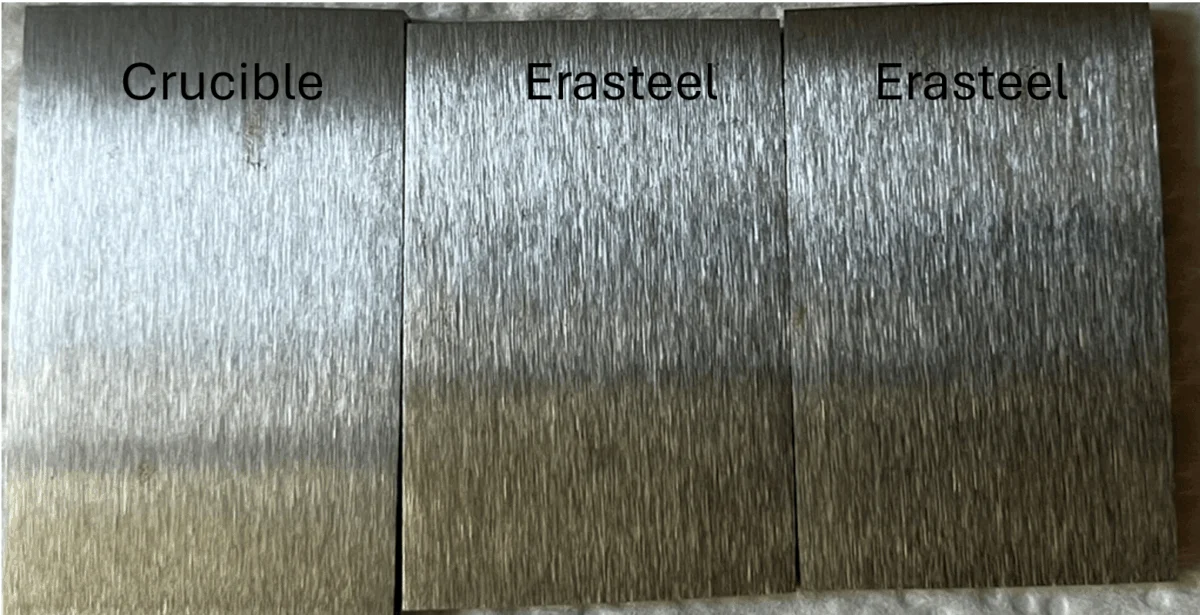
MagnaCut’s primary claim to fame is its "stainless-tool-steel" nature, offering high toughness and wear resistance without sacrificing corrosion resistance. Standardized 1% saltwater spray tests were conducted on both versions. Most conventional stainless knife steels show at least minor pitting or rust spots under these conditions. In the comparative study, both the Crucible and Erasteel materials showed zero rust spots, confirming that the move to European production has not compromised the alloy’s industry-leading corrosion resistance.

Hardness Response and Heat Treatment
The hardening response of the Erasteel material was found to be nearly identical to the Crucible original, with a slight trend toward higher hardness for the same heat treatment parameters. This suggests that the chemical composition is being held to extremely tight tolerances. However, a significant discovery was made regarding the optimization of the heat treatment process. While Crucible MagnaCut often performed best with an austenitizing temperature of 2050°F (1120°C), the Erasteel variant showed a superior property balance when pushed to 2150°F (1175°C). Using the higher temperature allowed for a hardness increase of approximately 2.5 Rc without a corresponding loss in toughness.
The Toughness Breakthrough
The most striking result of the transition is the measurable increase in toughness. While Crucible MagnaCut was already considered a top-tier performer, the Erasteel version has shown the ability to match or exceed the toughness of AEB-L, a steel renowned for its fine grain and durability, even at higher hardness levels (62-64 Rc).

In broader comparisons, the Erasteel MagnaCut now matches or exceeds the toughness values of non-stainless high-alloy steels like CPM-CruWear and Z-Wear. This is a significant development, as it bridges the gap between stainless and tool steels more effectively than the original domestic production. Metallurgists suggest this improvement is likely due to the "cleaner" Swedish production process, which reduces the oxide inclusions that previously served as the limiting factor for MagnaCut’s toughness.
Industry Implications and Official Responses
The successful transition has drawn positive reactions from the metallurgical community. Bob Skibitski, now representing Erasteel, has reported that the production yields are "higher-quality and cleaner" than what was achievable under previous manufacturing constraints. This sentiment is echoed by Bob Shabala of Niagara Specialty Metals, who emphasized that the partnership with Erasteel was not merely about survival, but about refining the product for a demanding market.

The implications for the knife industry are twofold. First, the supply of high-performance PM steels is now more secure, backed by the industrial stability of Erasteel and the distribution network of Niagara. Second, the "log scale" nature of toughness means that these incremental improvements in foot-pounds of energy absorption result in a significantly more durable edge for the end user, particularly in thin-ground geometry where micro-chipping is a concern.
Broader Market Impact and Future Outlook
The shift of MagnaCut production to Europe reflects a broader trend in the specialty steel market, where manufacturing is increasingly consolidated among a few high-tech facilities capable of the complex gas atomization required for powder metallurgy. While the loss of Crucible as a primary manufacturer is a blow to American industrial heritage, the result for the consumer is a more refined product.

The upcoming launch of MagnaMax in 2026 suggests that the Niagara-Erasteel partnership is not content with simply maintaining the status quo. Development continues on optimizing chemistry targets and tightening acceptable ranges for alloying elements. As Niagara continues to monitor "heats" (production batches), they have expressed a willingness to shift targets based on performance data—a level of quality control that is rarely seen at the consumer level.
For knifemakers, the availability of these materials through Niagara’s new online platform represents a democratization of high-end metallurgy. By providing direct access to the same steel used by major production houses, the barrier to entry for creating world-class cutlery has been lowered. As the industry moves toward 2026, the focus will remain on whether these European-produced alloys can continue to push the boundaries of what is possible in edge retention and durability. For now, the data suggests that MagnaCut is not only here to stay but is arguably better than ever.