Intel has officially launched its new non-Ultra Core Series 3 processors, codenamed "Wildcat Lake," marking a significant strategic shift for the silicon giant. These new chips represent a departure from Intel’s recent practice of refreshing older architectures for its mainstream Core lineup, instead introducing entirely new silicon with modern CPU, GPU, and AI capabilities. This move is poised to reshape the landscape of everyday computing, bringing advanced features previously reserved for premium segments to a broader audience.
Intel’s Evolving Processor Branding and Strategy
For years, Intel’s processor branding was synonymous with the familiar i3, i5, i7, and i9 designations, coupled with clear generational numbering (e.g., 12th Gen, 13th Gen). This scheme, while long-standing, faced increasing complexity as Intel diversified its product offerings and introduced new architectural innovations. In late 2023, Intel initiated a major rebranding effort, retiring the traditional generational numbering and the i-series nomenclature for its flagship laptop CPUs. This transition heralded the era of "Core Ultra" processors, designed to signify Intel’s most advanced offerings, particularly those incorporating a dedicated Neural Processing Unit (NPU) for AI acceleration and a new tile-based architecture.
The Core Ultra Series 1, starting with the "Meteor Lake" platform in December 2023, was positioned as the vanguard of Intel’s AI PC initiative. It introduced a modular, tile-based design featuring improved integrated graphics (Xe-LPG), a dedicated NPU, and a new manufacturing process (Intel 4). This was followed by the Core Ultra Series 2 ("Lunar Lake") in 2024 and the anticipated Core Ultra Series 3 ("Panther Lake") slated for 2026, each building upon the foundational innovations of its predecessor with further enhancements in performance, efficiency, and AI capabilities. These "Ultra" chips have consistently featured Intel’s newest CPU and GPU designs, along with cutting-edge manufacturing technology.
However, the initial implementation of this new branding left a noticeable gap in the mainstream segment. While Core Ultra processors represented the pinnacle of Intel’s innovation, the non-Ultra Core CPUs (e.g., Core Series 1 and Core Series 2) were largely based on older architectures. Specifically, both the Core Series 1 and Core Series 2 chips for laptops continued to leverage Intel’s "Raptor Lake" architecture.
The Precedent: Raptor Lake’s Extended Tenure
Raptor Lake, initially released in 2022 as the 13th-generation Core family, was primarily an optimization and refresh of the 12th-generation "Alder Lake" architecture. Alder Lake itself was revolutionary, introducing Intel’s hybrid architecture with a mix of Performance-cores (P-cores) and Efficient-cores (E-cores). Raptor Lake enhanced clock speeds, increased E-core counts, and improved cache sizes, but fundamentally reused much of the same silicon design as its predecessor.
When Intel introduced the new Core/Core Ultra branding, the decision to use Raptor Lake for the non-Ultra Core Series 1 and Series 2 meant that mainstream laptop buyers were still largely receiving technology that, in some core aspects, dated back to 2022. This created a perception among consumers and industry observers that the non-Ultra Core processors lacked the significant architectural advancements found in their "Ultra" counterparts. While these chips still offered solid performance for everyday tasks, they didn’t push the envelope in terms of power efficiency, integrated graphics, or dedicated AI processing in the same way the Core Ultra line did. This strategy risked alienating a crucial market segment that seeks modern features without necessarily needing flagship-tier performance or price. The continued reliance on Raptor Lake for the mainstream chips led to questions about Intel’s commitment to broad innovation across its entire product stack.
Introducing "Wildcat Lake": A New Chapter for Mainstream
The launch of the Core Series 3 "Wildcat Lake" processors marks a definitive end to this extended reliance on older silicon for the mainstream. Intel’s official announcement highlights that these new non-Ultra Core Series 3 processors are indeed built on fresh silicon. This signifies a return to a more traditional Intel approach where even midrange chips incorporate many of the same fundamental architectural advancements as their high-end counterparts, albeit in a scaled-down or optimized configuration.
This strategic pivot is crucial for Intel. It addresses the previous criticism by demonstrating a commitment to infusing modern technology across its entire portfolio, ensuring that consumers purchasing mainstream laptops still benefit from the latest innovations in processor design, power efficiency, and emerging capabilities like AI acceleration. By bringing new silicon to the non-Ultra Core lineup, Intel aims to provide a more compelling value proposition for a significant portion of the laptop market.
Architectural Innovations of Wildcat Lake
The Wildcat Lake processors are engineered with a sophisticated, modular design, leveraging a two-tile approach that mirrors the advanced packaging strategies seen in the Core Ultra series. This modularity allows Intel greater flexibility in manufacturing and design, enabling optimization of different components on different process nodes.
-
Compute Tile: This is the heart of the processor, housing the core processing units and integrated graphics.
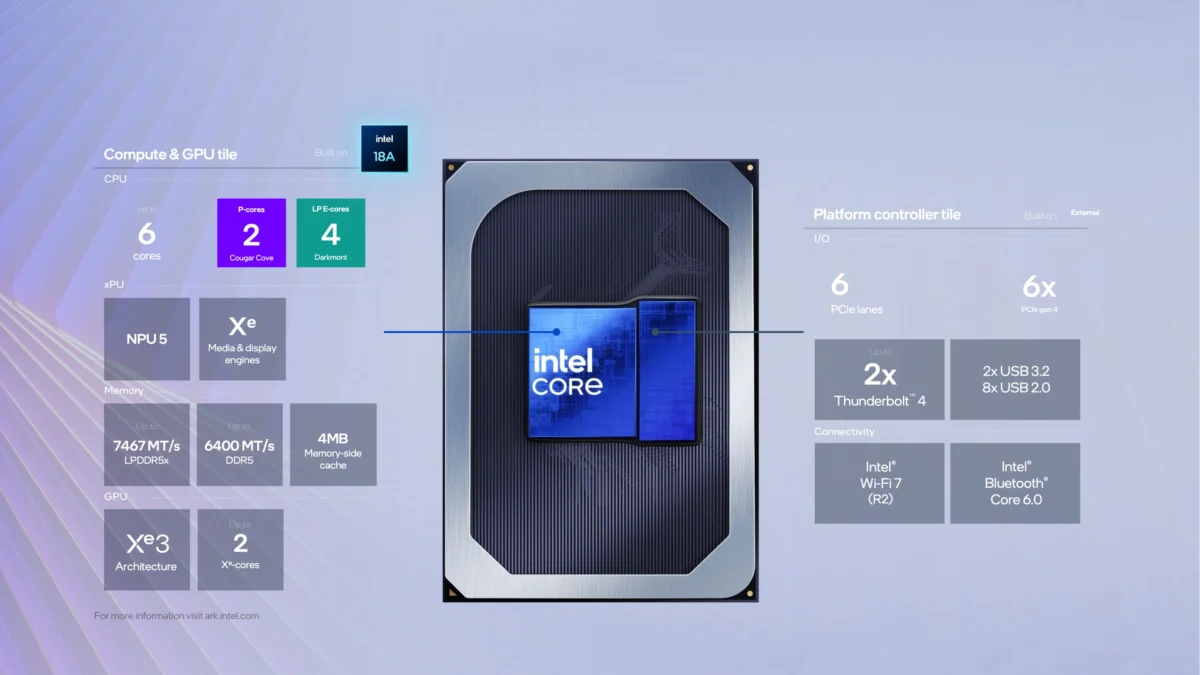
- CPU Cores: Wildcat Lake features a hybrid architecture, combining up to two "Cougar Cove" Performance-cores (P-cores) with four "Darkmont" Efficient-cores (E-cores). Cougar Cove P-cores represent an evolution of Intel’s high-performance core designs, optimized for single-threaded workloads and demanding applications. Darkmont E-cores, on the other hand, are designed for maximum power efficiency, handling background tasks, multi-threaded workloads, and maintaining system responsiveness with minimal power draw. This hybrid approach, first introduced with Alder Lake, ensures a balance of power and efficiency, dynamically allocating tasks to the most appropriate core type. While not as numerous or as high-performing as the cores in the flagship Panther Lake, these cores still offer a substantial upgrade over previous Raptor Lake-based mainstream chips.
- Integrated GPU: The compute tile also integrates one or two of Intel’s latest-generation Xe3 GPU cores. The Xe3 architecture, an evolution of the Xe-LPG (Low Power Gaming) graphics found in Meteor Lake, promises enhanced graphical performance and efficiency. This means improved capabilities for media playback, accelerated content creation tasks, and a more robust experience for casual gaming without the need for a discrete graphics card. The flexibility of having one or two Xe3 cores allows for different performance tiers within the Wildcat Lake family, catering to various price points and power envelopes.
- Neural Processing Unit (NPU): Crucially, Wildcat Lake typically includes a dedicated NPU capable of up to 17 Trillion Operations Per Second (TOPS). This NPU is a dedicated hardware accelerator designed specifically for AI and machine learning workloads, offloading these tasks from the CPU and GPU. The inclusion of a capable NPU in mainstream chips is a cornerstone of Intel’s "AI PC" vision, enabling features like real-time background blurring during video calls, advanced noise suppression, and local AI inferencing for productivity applications, all with greater power efficiency than CPU or GPU-based solutions. While 17 TOPS may be lower than the flagship NPUs in the Core Ultra series, it is more than sufficient to handle the initial wave of AI-powered applications emerging in the consumer space.
-
Platform Controller Tile: This separate silicon tile handles crucial connectivity and I/O functions. It is built on an unspecified non-Intel process, a detail that hints at Intel’s flexible manufacturing strategy, potentially leveraging external foundries for specific components where it makes economic or technological sense.
- Connectivity: The platform controller tile provides up to two Thunderbolt 4 ports, offering high-speed data transfer (up to 40 Gbps), video output, and power delivery over a single USB-C compatible connector. This is a premium feature increasingly expected in modern laptops. It also integrates Wi-Fi 7 and Bluetooth 6.0 connectivity. Wi-Fi 7 (802.11be) is the latest wireless standard, promising higher throughput, lower latency, and improved network efficiency, future-proofing devices for next-generation wireless networks. Bluetooth 6.0 ensures robust and efficient wireless peripheral connections.
- PCIe 4.0 Lanes: Six PCIe 4.0 lanes are provided for external connectivity, allowing for high-speed storage (NVMe SSDs) and other peripherals, contributing to overall system responsiveness.
-
Memory Support: Wildcat Lake chips support up to 48GB of LPDDR5X-7467 or up to 64GB of DDR5-6400 memory. LPDDR5X (Low-Power Double Data Rate 5X) is highly optimized for power efficiency and compact designs, making it ideal for thin and light laptops. DDR5, while potentially consuming slightly more power, often allows for higher capacities and is commonly used in more traditional laptop form factors. This dual memory support offers OEMs flexibility in designing various laptop models.
-
Power Profile: These processors operate within a base power level of 15W and can boost up to a maximum of 35W. This power envelope makes Wildcat Lake suitable for a wide range of laptop designs, from fanless ultrabooks (at the lower end of the power spectrum) to more robust mainstream laptops with active cooling, balancing performance with battery life considerations.
Strategic Positioning: Core Ultra vs. Core Series 3
The introduction of Wildcat Lake clarifies Intel’s tiered product strategy. While the Core Ultra Series 3 ("Panther Lake") will serve as Intel’s flagship, targeting premium devices with maximum performance, advanced AI capabilities, and cutting-edge features, the Core Series 3 ("Wildcat Lake") is designed for the high-volume mainstream market. The article states that Wildcat Lake "shares some things in common with Panther Lake, but it’s a slower and simpler design with much less computing power." This indicates that while both lines benefit from modern architectural principles and tile-based designs, Wildcat Lake will likely feature fewer P-cores and E-cores, potentially fewer Xe3 GPU cores, and a less powerful NPU than its Ultra counterpart.
This differentiation is logical. Core Ultra aims for users demanding the absolute best in performance and AI acceleration for intensive tasks like professional content creation, advanced gaming, and complex AI model execution. Core Series 3, on the other hand, is optimized for the vast majority of users who require reliable performance for everyday computing—web browsing, office productivity, multimedia consumption, and light creative work—now augmented with modern connectivity and local AI capabilities, all at a more accessible price point. This clear segmentation allows Intel to cater to diverse market needs effectively.
Industry Reactions and Implications
Intel’s launch of Wildcat Lake has been met with positive anticipation from industry analysts and original equipment manufacturers (OEMs). For Intel, this move is critical for maintaining its competitive edge against rivals like AMD, which has been making significant inroads into the laptop market with its Ryzen processors, and increasingly, Qualcomm, with its Snapdragon X series processors based on ARM architecture, particularly in the emerging AI PC segment.
An Intel spokesperson, in a statement accompanying the launch, underscored the company’s commitment to broad innovation: "With Wildcat Lake, we are democratizing the AI PC experience and delivering a truly modern computing foundation to the mainstream. This isn’t just a refresh; it’s new silicon engineered to redefine everyday computing, offering users enhanced performance, efficiency, and integrated AI capabilities across a wider range of devices. We believe this will be a game-changer for mainstream users seeking the latest technology without compromise." This highlights Intel’s strategic intent to ensure that the "AI PC" is not just a premium offering but a standard for all new systems.
Industry analysts concur that bringing new silicon to the mainstream is a prudent and necessary step. "Intel needed to move beyond Raptor Lake for its non-Ultra Core lineup to stay competitive," commented a senior analyst at Tech Insights. "Consumers are increasingly savvy, and they expect architectural innovation, not just clock speed bumps. Wildcat Lake, with its new cores, Xe3 graphics, and integrated NPU, positions Intel strongly in the crucial mainstream segment and significantly strengthens their AI PC narrative."
For OEMs, Wildcat Lake provides a compelling new platform for refreshing their laptop lineups. It enables them to offer products with genuinely new features—faster connectivity, better integrated graphics, and AI acceleration—at competitive price points, stimulating demand in the volume segment of the market. This renewed cadence of innovation from Intel provides greater design flexibility and allows manufacturers to differentiate their products more effectively.
The Broader Landscape: Competing in the AI PC Era
The introduction of Wildcat Lake is a pivotal moment in the ongoing "AI PC" revolution. With a dedicated NPU now integrated into mainstream Core processors, Intel is accelerating the adoption of AI-enabled features across the entire PC ecosystem. This ensures that a vast majority of new laptops, not just the high-end models, will be capable of running local AI applications, from enhanced video conferencing tools to more intelligent operating system features and creative applications. This broad availability of AI hardware is essential for fostering developer innovation and driving the growth of the AI PC market.
Furthermore, this move underscores Intel’s multi-pronged strategy to address the evolving competitive landscape. By offering both high-performance, feature-rich Core Ultra processors and modern, capable Core Series processors, Intel aims to provide a comprehensive portfolio that can compete effectively against AMD’s Ryzen 8000 series (which also features dedicated NPUs) and the emerging threat from ARM-based chips like Qualcomm’s Snapdragon X Elite and X Plus, which are making strong claims about AI performance and power efficiency. The choice to use a non-Intel process for the platform controller tile in Wildcat Lake also highlights Intel’s flexible manufacturing and supply chain strategy, leveraging the best available technology and capacity to deliver competitive products.
In conclusion, the launch of Intel’s "Wildcat Lake" Core Series 3 processors represents a strategic and timely recalibration for the company. By committing new silicon to its mainstream lineup, Intel is not only addressing past criticisms but also reinforcing its dedication to innovation across all market segments. This move is poised to deliver a more advanced, efficient, and AI-capable computing experience to a broader base of consumers, solidifying Intel’s position in the fiercely competitive and rapidly evolving personal computing market.