
Cern for ai eu last chance gain foreign competition – CERN for AI: EU’s Last Chance to Gain on Foreign Competition – the very phrase evokes a sense of urgency, a race against time for Europe to secure its place in the rapidly evolving landscape of artificial intelligence. As AI becomes increasingly crucial to economic growth and global power, the European Union faces a critical juncture.
While other nations like China and the United States are making significant strides in AI development, Europe needs to harness its own strengths and resources to remain competitive.
This blog delves into the critical role CERN, the European Organization for Nuclear Research, can play in propelling Europe to the forefront of AI innovation. With its cutting-edge research infrastructure, world-class scientists, and commitment to open collaboration, CERN possesses the potential to become a global leader in AI research and development.
By strategically leveraging its expertise and resources, CERN can not only contribute to Europe’s AI ambitions but also establish itself as a hub for attracting and retaining top AI talent from around the world.
CERN’s Role in AI Development: Cern For Ai Eu Last Chance Gain Foreign Competition
CERN, the European Organization for Nuclear Research, is renowned for its groundbreaking discoveries in particle physics. However, its influence extends far beyond the realm of fundamental physics, profoundly impacting the field of Artificial Intelligence (AI). CERN’s unique research environment, coupled with its massive data processing needs, has fostered the development of innovative AI techniques and applications.
CERN’s Contributions to AI Research and Development
CERN’s pursuit of unraveling the mysteries of the universe has led to the development of cutting-edge technologies, many of which have found applications in AI. The organization’s pioneering work in data analysis, high-performance computing, and distributed systems has played a pivotal role in advancing AI research.
AI-Powered Projects at CERN
CERN has leveraged AI in various projects, demonstrating its transformative potential in scientific research.
High-Energy Physics Data Analysis
CERN’s experiments generate enormous datasets, requiring sophisticated tools for analysis. AI algorithms, such as machine learning and deep learning, have proven invaluable in identifying patterns, classifying events, and extracting valuable insights from this data deluge.
Particle Tracking and Reconstruction
The Large Hadron Collider (LHC) produces billions of particle collisions per second. AI algorithms are used to reconstruct the trajectories of particles from these collisions, enabling physicists to study their properties and interactions.
Detector Optimization
AI algorithms are employed to optimize the design and performance of particle detectors, leading to increased sensitivity and precision in experiments.
Resource Management
CERN’s vast infrastructure requires efficient resource allocation and management. AI algorithms are used to optimize power consumption, network traffic, and computing resources, ensuring smooth operation of the organization’s facilities.
CERN’s Infrastructure and Resources for AI Advancements
CERN’s infrastructure and resources provide a fertile ground for AI research and development.
High-Performance Computing (HPC)
CERN operates one of the world’s most powerful supercomputers, providing immense computational power for AI training and simulations.
Massive Datasets
CERN’s experiments generate vast datasets, providing valuable training data for AI algorithms.
Open-Source Software
CERN promotes open-source software development, making its AI tools and libraries accessible to the broader research community.
Collaboration and Partnerships
CERN fosters collaborations with universities, research institutions, and industry partners, accelerating the development and deployment of AI technologies.
The European Union’s AI Strategy
The European Union (EU) recognizes the transformative potential of Artificial Intelligence (AI) and has developed a comprehensive strategy to guide its development and deployment. This strategy aims to position the EU as a global leader in trustworthy and ethical AI, ensuring its benefits are widely shared while mitigating potential risks.
Goals of the EU’s AI Strategy
The EU’s AI strategy Artikels a clear vision for the future of AI in Europe. It aims to:
- Promote responsible AI development:The EU emphasizes the importance of developing and deploying AI in a way that respects human rights, fundamental values, and ethical principles.
- Foster AI innovation and adoption:The strategy encourages investment in research and development, as well as the adoption of AI across various sectors, including healthcare, manufacturing, and transportation.
- Ensure competitiveness in the global AI market:The EU aims to strengthen its position in the global AI ecosystem by attracting talent, fostering collaboration, and supporting the development of AI-related industries.
- Prepare for the societal impact of AI:The EU recognizes the potential societal changes brought about by AI and aims to develop policies and strategies to address them, ensuring a fair and inclusive transition.
Competition in the AI Landscape
The global AI market is a dynamic and competitive landscape, with various players vying for dominance. This competition is driven by the immense potential of AI to revolutionize industries and improve our lives. Understanding the key players, their strengths, and the strategies of different countries and regions is crucial to navigating this complex landscape.
Key Players and Their Strengths
The global AI market is dominated by a few key players, each with its own strengths and strategies.
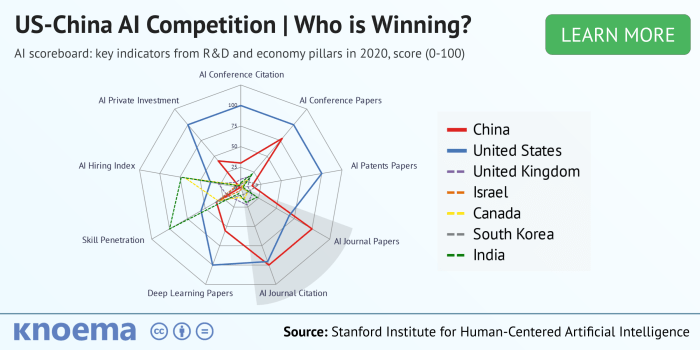
- The United States:The US leads in AI research and development, with prominent companies like Google, Microsoft, Amazon, and Facebook investing heavily in AI technologies. They possess a strong research ecosystem, access to large datasets, and a robust venture capital environment.
- China:China is rapidly catching up, with a focus on developing AI applications in various sectors, including e-commerce, healthcare, and manufacturing. Companies like Baidu, Alibaba, and Tencent are driving innovation in AI, leveraging their vast user base and government support.
- European Union:The EU aims to become a global leader in ethical and responsible AI development. Its strengths lie in its research expertise, focus on data privacy, and commitment to fostering a collaborative ecosystem.
AI Strategies of Different Countries and Regions
Countries and regions have adopted diverse strategies to foster AI development and compete in the global market.
Obtain direct knowledge about the efficiency of german vc early stage deep tech fund record breaking through case studies.
- The United States:The US focuses on promoting research and development, fostering innovation through venture capital, and encouraging the adoption of AI technologies across industries.
- China:China’s strategy emphasizes the development of AI applications in specific sectors, promoting the use of AI in manufacturing, healthcare, and education. The government provides significant financial support and encourages the use of AI in national initiatives.
- European Union:The EU’s AI strategy prioritizes ethical and responsible AI development, focusing on data privacy, transparency, and human oversight. The EU aims to create a regulatory framework that promotes innovation while safeguarding fundamental rights.
Challenges and Opportunities for European AI
The European Union faces both challenges and opportunities in the global AI market.
- Challenges:The EU faces challenges in attracting and retaining AI talent, competing with the large-scale investments of the US and China, and navigating the complexities of data privacy regulations.
- Opportunities:The EU’s focus on ethical AI development and data privacy could provide a competitive advantage. It can leverage its strengths in research, collaboration, and its commitment to responsible innovation to create a strong foundation for European AI.
CERN’s Potential for AI Leadership

CERN, the European Organization for Nuclear Research, is uniquely positioned to become a global leader in AI research and development. Its vast data sets, high-performance computing infrastructure, and international collaboration culture provide a fertile ground for AI innovation.
Leveraging CERN’s Expertise
CERN’s expertise in data analysis, simulation, and modeling, honed through decades of particle physics research, is directly transferable to AI applications. The organization has developed sophisticated algorithms and tools for data processing, pattern recognition, and anomaly detection, which can be readily adapted to address challenges in diverse fields like healthcare, finance, and climate science.
Attracting and Retaining AI Talent
CERN can attract and retain top AI talent by offering a unique research environment characterized by:
- Cutting-edge research opportunities:CERN provides access to massive datasets and advanced computing resources, enabling researchers to push the boundaries of AI.
- Collaborative and interdisciplinary environment:CERN fosters collaboration between physicists, computer scientists, and mathematicians, creating a dynamic and intellectually stimulating atmosphere.
- International and diverse community:CERN attracts researchers from around the world, offering opportunities for cultural exchange and global collaboration.
The Importance of Collaboration and Openness
In the rapidly evolving landscape of artificial intelligence (AI), collaboration and openness are not just desirable traits but essential drivers of progress. By fostering a spirit of shared knowledge and resources, the AI community can accelerate innovation, overcome technical challenges, and ultimately realize the full potential of this transformative technology.
The Benefits of Collaboration in AI Research and Development
Collaboration in AI research and development offers numerous benefits, including:
- Accelerated Innovation:By pooling expertise and resources, researchers can tackle complex problems more effectively, leading to faster breakthroughs and advancements in AI.
- Enhanced Diversity of Perspectives:Collaboration brings together individuals with diverse backgrounds and perspectives, fostering creativity and innovative solutions.
- Increased Efficiency:Shared resources, data, and infrastructure can significantly reduce duplication of effort and streamline research processes.
- Reduced Development Costs:Collaboration can help distribute the costs of AI development, making it more accessible to a wider range of researchers and institutions.
The Role of Open-Source Platforms and Data Sharing in AI Advancement, Cern for ai eu last chance gain foreign competition
Open-source platforms and data sharing play a crucial role in fostering collaboration and accelerating AI progress.
- Open-Source Platforms:Platforms like TensorFlow, PyTorch, and scikit-learn provide readily available tools and libraries that enable researchers to build and deploy AI models more efficiently. These platforms facilitate collaboration by allowing researchers to share code, algorithms, and best practices.
- Data Sharing:Access to large and diverse datasets is essential for training effective AI models. Initiatives like the ImageNet database have revolutionized computer vision research by providing a massive collection of labeled images. By sharing data, researchers can accelerate the development of AI models for various applications.
Opportunities for CERN to Foster International Collaborations in AI
CERN, with its long-standing tradition of international collaboration in fundamental research, is uniquely positioned to foster international collaborations in AI.
- Leveraging CERN’s Expertise:CERN possesses a wealth of expertise in data analysis, high-performance computing, and large-scale simulations, which are highly relevant to AI development. The organization can leverage this expertise to collaborate with AI researchers and institutions worldwide.
- Creating Open AI Platforms:CERN can develop and promote open-source AI platforms specifically designed for scientific applications. These platforms could provide researchers with tools and resources for data analysis, model training, and simulation.
- Facilitating Data Sharing:CERN can establish data sharing initiatives to make its vast datasets accessible to the global AI community. This could accelerate the development of AI models for scientific discovery and technological innovation.
The Future of AI at CERN
CERN, at the forefront of particle physics research, recognizes the transformative potential of artificial intelligence (AI). AI is poised to revolutionize how CERN conducts its research, analyzes data, and manages its operations. A strategic roadmap for AI development is crucial to harnessing this potential and solidifying CERN’s position as a global leader in AI-driven scientific discovery.
A Roadmap for CERN’s AI Development
A roadmap for CERN’s AI development should prioritize the following key areas:
- Data Management and Analysis:AI algorithms can be employed to efficiently manage and analyze the massive datasets generated by CERN’s experiments, such as the Large Hadron Collider (LHC). This includes tasks like data cleaning, anomaly detection, and pattern recognition.
- Simulation and Modeling:AI can be used to create more accurate and sophisticated simulations of particle interactions, enabling physicists to test theories and make predictions with greater precision. This could involve developing AI-powered models that can predict the behavior of particles in complex environments.
- Experiment Design and Optimization:AI can help optimize the design of future experiments, maximizing their scientific output while minimizing costs. This could involve using AI to identify the most promising experimental configurations based on simulations and past data.
- Resource Optimization:AI can be used to optimize the allocation and management of resources at CERN, including energy consumption, computing power, and personnel. This could involve using AI to predict resource demands and allocate resources accordingly.
- Accelerator Control and Monitoring:AI can be used to improve the control and monitoring of CERN’s accelerators, enhancing their performance and reliability. This could involve using AI to detect potential problems and adjust parameters in real time.
Potential Applications of AI in CERN’s Research and Operations
The applications of AI in CERN’s research and operations are vast and diverse. Here are some specific examples:
- Particle Identification:AI algorithms can be trained to identify different types of particles based on their properties, such as momentum, energy, and trajectory. This can help physicists analyze data from experiments and identify new particles. For example, AI could be used to analyze data from the LHC to identify new particles that could shed light on the nature of dark matter.
- Event Reconstruction:AI can be used to reconstruct the events that occur in particle collisions, allowing physicists to understand the interactions between particles in detail. This can help physicists test theoretical models and make new discoveries. For example, AI could be used to reconstruct the events that occur in collisions at the LHC, allowing physicists to study the properties of the Higgs boson.
- Detector Design:AI can be used to design and optimize the detectors used in particle physics experiments. This could involve using AI to identify the optimal materials and geometries for detectors, maximizing their sensitivity and efficiency.
- Scientific Communication:AI can be used to improve scientific communication by automatically generating reports, summaries, and visualizations of experimental data. This can help physicists communicate their findings to a wider audience and accelerate scientific progress.
Ethical and Societal Implications of AI Advancements at CERN
As CERN embraces AI, it is crucial to consider the ethical and societal implications of these advancements. This includes:
- Data Privacy and Security:CERN collects and analyzes vast amounts of data, and it is essential to ensure the privacy and security of this data. This involves implementing robust data protection measures and ensuring that AI algorithms are used responsibly.
- Bias and Fairness:AI algorithms can be susceptible to biases, which can lead to unfair or discriminatory outcomes. It is important to ensure that AI algorithms used at CERN are fair and unbiased, and that they do not perpetuate existing inequalities.
- Transparency and Explainability:It is essential to ensure that AI algorithms used at CERN are transparent and explainable. This means being able to understand how AI algorithms make decisions and ensuring that these decisions are justifiable.
- Job Displacement:AI advancements could lead to job displacement in some areas of CERN’s operations. It is important to consider the potential impact of AI on employment and to develop strategies for managing this transition.