








The home entertainment market has long faced a persistent challenge: balancing visual fidelity with immersive ambient lighting without requiring complex aftermarket installations. For over two decades, Philips has answered this consumer demand in international markets through its proprietary Ambilight technology, embedding addressable light-emitting diodes directly into the chassis of its television sets. Following its expanded introduction to North American storefronts via manufacturing partners, the release of the 2026 Philips 7985 QLED Series marks a significant milestone. Priced competitively at an MSRP of $389.00 for the 55-inch model (alongside $319.99 for the 50-inch iteration and $469.99 for the 65-inch option), this television introduces quantum dot color technology to an affordable tier. Manufactured and distributed under license by Skyworth in North America, the 7985 Series targets evening streamers and budget-conscious consumers seeking a theatrical atmosphere without the steep financial investment typically associated with high-end home theaters.
Background Context and Technological Evolution
To understand the positioning of the Philips 7985 Series, one must examine the historical trajectory of ambient television backlighting. For years, consumers wishing to extend their on-screen imagery onto surrounding walls had to rely on third-party aftermarket ecosystems. Companies like Govee and Philips’ own Hue division popularized external camera-based systems and HDMI sync boxes, which required meticulous calibration, complex cable routing, and adhesive strips that often degraded over time.
Ambilight eliminates these friction points by integrating the lighting control architecture directly into the television’s internal hardware. While European consumers have enjoyed this native integration for more than twenty years, its transition to the United States market has been gradual. The predecessor 7875 Series established a foothold for the brand in North America, but the 2026 7985 Series represents the first time a quantum dot (QLED) enhancement layer has been added to this specific price class. By merging QLED color enrichment with native three-sided Ambilight functionality and the streamlined Roku OS platform, Skyworth and Philips have positioned the 7985 as a value-driven alternative to standard entry-level panels from dominant market competitors like TCL and Hisense.

Detailed Specifications and Hardware Architecture
A comprehensive examination of the Philips 55-inch 7985 Series (model 55PUL7985/F7) reveals a hardware suite tailored precisely to its budget designation. At its core is a 4K Ultra HD (3,840 x 2,160 pixels) Vertical Alignment (VA) LCD panel enhanced by a quantum dot layer designed to expand color saturation, particularly across red and green spectrums. The panel utilizes a direct LED backlight architecture without local dimming zones, meaning the entire backlight array dims or brightens uniformly rather than adjusting independently across specific screen sectors.
The display operates at a native refresh rate of 60Hz, paired with a 120 PMR (Perfect Motion Rate) software-based motion processing index. It supports high dynamic range formats including Dolby Vision, HDR10, and Hybrid Log-Gamma (HLG), though it notably omits support for HDR10+. Rated contrast is reported by the manufacturer at a typical 4,000:1 ratio.
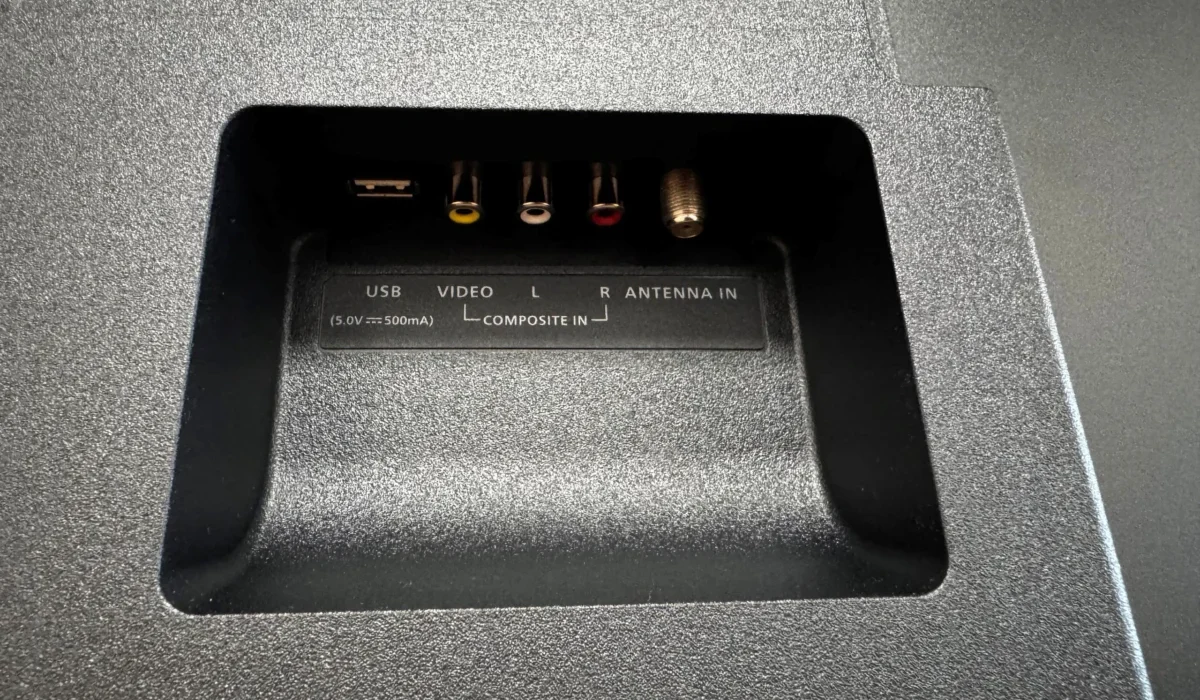
Connectivity options are surprisingly robust for a television priced under $400. The rear chassis houses four HDMI 2.0 ports, with HDMI 1 supporting eARC/ARC functionality, alongside All-MDT (Auto Low Latency Mode) and HDCP 2.3 compliance. Input signals are capped at a maximum of 4K at 60Hz. Additional physical ports include a single USB 2.0 port, an Ethernet jack for wired networking, an optical digital audio output, a headphone output, a composite video input, and an RF antenna coaxial jack for the built-in ATSC 1.0 digital tuner. Wireless communication is handled via Wi-Fi 5 (802.11ac), Bluetooth 5.0, and Apple AirPlay compatibility.
Acoustic performance is driven by a dual 10-watt speaker configuration featuring native Dolby Atmos decoding. Physically, the television measures 48.3 x 28.1 x 3.5 inches without its stand, expanding to a depth of 10.1 inches when mounted on the included dual-foot stands. The unit is exceptionally lightweight, tipping the scale at 22.2 pounds without the stand and 22.9 pounds with it, making unboxing and placement manageable for a single individual. For wall-mounting applications, the set utilizes a relatively compact 200 x 100 mm VESA hole pattern.

Design and Physical Integration
Out of the box, the industrial design of the 7985 Series aligns with contemporary entry-level television standards. It features slim black bezels framing the screen and relies on two wide-set feet secured to the bottom edge via standard screws. The absence of a central pedestal base means buyers with narrow media consoles must measure their furniture carefully before installation.
The defining physical characteristic of the chassis becomes apparent upon inspecting the rear panel. Three strips of addressable LEDs run along the left, right, and top edges of the television’s back casing. The intentional omission of a bottom LED strip reflects typical consumer placement scenarios where the television rests directly on top of furniture, though it also implies that wall-mounted installations will lack downward illumination.
Optimal utilization of the Ambilight system requires careful environmental consideration. Industry experts and manufacturer recommendations suggest placing the television against a neutral, light-colored or white wall rather than dark wood paneling or textured surfaces, allowing the LEDs to reflect and diffuse accurately. Because the VESA mounting pattern is compact relative to the 55-inch screen size, purchasers must verify that their chosen wall bracket aligns correctly with the mounting holes without obstructing internal wiring or ventilation.
Picture Quality Analysis: QLED Color Meets Budget Contrast

Evaluating the visual performance of the Philips 7985 requires acknowledging the engineering compromises inherent to its price point. The inclusion of a quantum dot layer yields noticeable improvements in color vibrancy compared to non-QLED budget predecessors. Reds and greens exhibit commendable richness, making animated films and nature documentaries visually engaging. Furthermore, upscaling performance for legacy 1080p content and standard-definition cable broadcasts remains clean, avoiding the aggressive over-sharpening artifacts that frequently plague economical displays.
However, the lack of local dimming introduces distinct limitations. Because the direct LED backlight cannot selectively darken behind shadowy areas of the image, dark cinematic scenes can occasionally appear in a muted charcoal gray rather than deep black. In brightly lit rooms, this limitation is virtually imperceptible. In a darkened viewing environment, however, the native contrast of the VA panel becomes more apparent. Ironically, the Ambilight system serves an optical function here: by casting ambient colored light onto the surrounding wall, it elevates the perceived room brightness, effectively mitigating the visual perception of washed-out blacks through a clever psychological contrast effect.
High Dynamic Range (HDR) performance similarly reflects cost-conscious engineering. While the inclusion of Dolby Vision at a $389 price point is an impressive software inclusion, the panel’s undisclosed peak brightness prevents specular highlights from achieving the striking luminance punch found on mid-range and premium television models. Additionally, the VA panel configuration prioritizes center-seat contrast over wide viewing angles. Observers seated at 30-degree or 45-degree angles will notice a distinct contrast shift, reinforcing the recommendation to position seating directly dead-center for optimal visual accuracy.
Motion handling is tied strictly to the panel’s native 60Hz refresh rate. While the 120 PMR motion processing index assists with smoothing certain sequences, cinephiles may detect minor judder during 24fps cinematic pans or motion blur during fast-paced 60fps sports broadcasts. Gamers utilizing current-generation consoles such as the PlayStation 5 or Xbox Series X will find themselves restricted to a 60Hz input ceiling, precluding 120Hz high-frame-rate gaming. Nevertheless, the inclusion of Auto Low Latency Mode (ALLM) ensures responsive input handling for standard gaming sessions.
Ambilight Functionality and Ambient Modes

The primary differentiator of the 7985 Series remains its integrated Ambilight system. Unlike aftermarket bias-lighting kits that necessitate external cameras, separate sync boxes, and third-party smartphone application calibration, Philips’ native system operates seamlessly out of the box. Setup is completed during the initial configuration wizard by selecting desired brightness parameters and identifying the background wall color to ensure accurate color matching.
By default, the television activates the "Follow Video" preset, which samples edge-pixel data in real time and projects corresponding hues onto the wall. Testing demonstrates that the light tracking operates with minimal latency, successfully synchronizing with dynamic on-screen action sequences, sports broadcasts, and narrative films without noticeable processing delays.
Alternative operating modes expand the television’s utility beyond standard video playback. "Follow Audio" pulses the LED array dynamically in response to musical input, providing an entertaining backdrop for music video viewing or house parties. "Lounge Light" permits the LEDs to maintain a static ambient color even when the display panel itself is powered off, effectively transforming the television into a large-scale mood lamp. When paired with Roku’s ambient backdrop features—which display curated artwork or personal photographs—the 7985 functions as an aesthetic focal point in living spaces or bedrooms. Minor instances of frame-edge lighting flicker can occasionally be observed during rapid visual transitions, though these occurrences are infrequent.
Software Ecosystem: Roku OS Integration
Software performance on budget televisions has historically been a frequent point of consumer friction, often marked by sluggish proprietary operating systems. Philips circumvents this issue by embedding Roku OS within the 7985 Series. While the user interface lacks avant-garde aesthetic styling, it delivers rapid response times, straightforward navigation, and comprehensive access to the entire library of mainstream streaming applications, alongside hundreds of free linear channels available via The Roku Channel.

Integration within the broader Roku ecosystem offers notable convenience. Users can pair Roku wireless speakers, soundbars, and subwoofers directly to the television without complex receiver setups. Furthermore, Apple AirPlay is built into the software architecture for seamless casting from iOS devices, while voice control compatibility spans Amazon Alexa, Google Assistant, and Apple Home via Siri.
As is standard with the Roku platform, users must navigate ad-supported interfaces, including promoted banner advertisements on the home screen and sponsored rows within content menus. HDMI-CEC functionality operates reliably, allowing seamless power and volume synchronization with external audio hardware and gaming consoles.
Acoustic Performance and Audio Options
Audio reproduction on ultra-slim television chassis inherently faces physical limitations, and the 7985 is no exception. Equipped with dual 10-watt stereo speakers and native Dolby Atmos decoding, the television provides clear vocal dialogue clarity suitable for casual daytime viewing and standard television broadcasts. However, the compact speaker drivers are physically incapable of generating true overhead height effects or deep, resonant bass response during explosive cinematic action sequences.
The inclusion of Dolby Atmos serves primarily as a compatibility feature rather than an acoustic promise. To achieve a genuinely immersive audio experience, buyers should budget for an external soundbar utilizing HDMI eARC. Alternatively, pairing the television with native Roku wireless audio peripherals provides an uncompressed wireless upgrade path.

Durability, Warranty, and Market Implications
In North America, Philips televisions are manufactured, distributed, and supported by Skyworth under a formal licensing agreement. The hardware is backed by a standard one-year limited warranty, aligning with industry norms for consumer electronics in this pricing tier. Long-term considerations include the integrated nature of the Ambilight LED strips; unlike modular external light strips, a hardware failure in the built-in LEDs outside of the warranty period cannot be easily replaced independently of the display chassis. Conversely, software longevity is bolstered by Roku’s continuous automated operating system updates.
Comparative Analysis and Market Positioning
When weighed against competing models in the sub-$400 category, the Philips Ambilight 7985 QLED TV occupies a distinct niche. While competitors such as Hisense and TCL offer Mini-LED alternatives equipped with local dimming zones and higher refresh rates (such as 144Hz panels tailored for competitive console gaming) for a modest price increase of $100 to $200, none of those manufacturers integrate native ambient backlighting.
For consumers who prioritize atmospheric immersion, evening cinematic streaming, and a hassle-free setup experience, the 7985 delivers exceptional aggregate value. Conversely, analytical viewers seeking reference-grade black levels, peak HDR specular highlights, or 120Hz competitive gaming performance will be better served by allocating funds toward a dedicated Mini-LED panel and purchasing an aftermarket lighting kit separately. For current owners of last year’s Philips 7875 Series, upgrading offers incremental gains—principally quantum dot color enhancement and Dolby Atmos decoding—though the core operational experience remains largely consistent. Ultimately, the Philips Ambilight 7985 succeeds by offering a unique visual flair that transforms standard television viewing into an engaging environmental event.