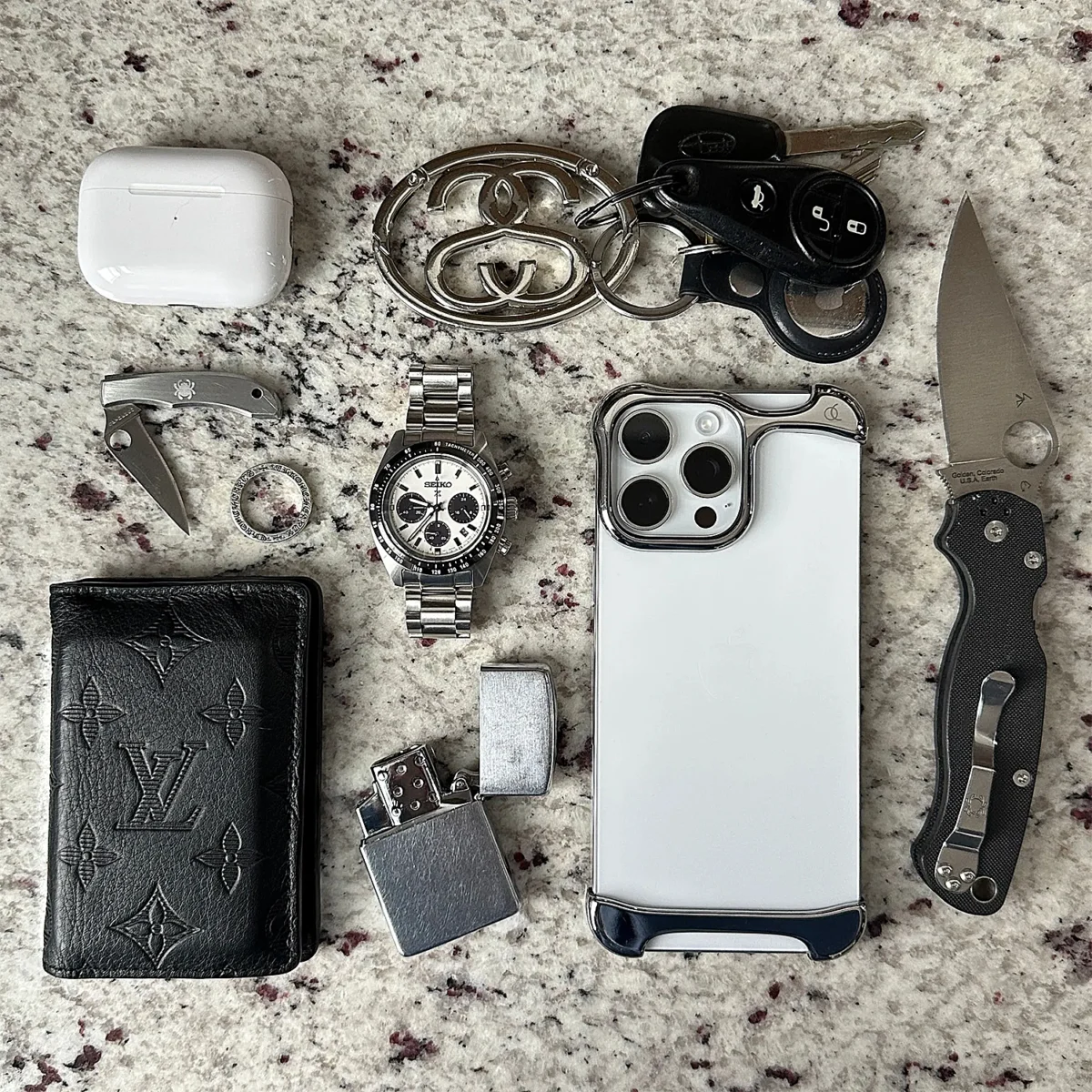
The contemporary landscape of Everyday Carry (EDC) has undergone a significant transformation, shifting from a focus on purely utilitarian survivalism toward a sophisticated intersection of high-fashion aesthetics and mechanical engineering. While early iterations of the EDC movement prioritized bulk and raw durability, modern practitioners are increasingly curating their daily toolsets to reflect a cohesive personal identity. This evolution is perhaps best illustrated by the integration of luxury fashion accessories, such as Chrome Hearts hardware, alongside precision-engineered tools like the Spyderco Paramilitary 2 and horological staples such as the Seiko “Panda” chronograph. This synthesis represents a broader trend in consumer behavior: the demand for gear that performs under pressure without sacrificing an elevated, curated appearance.
The Architectural Framework of Modern Carry
At the heart of the modern EDC movement is the principle of intentionality. The selection of items—ranging from mobile hardware to specialized cutting tools—is no longer incidental. Instead, enthusiasts are utilizing a design language that relies on material consistency and ergonomic optimization. The inclusion of chrome-accented mobile device protection, for instance, serves a dual purpose: it provides necessary physical shock absorption while creating a visual bridge between digital tools and metallic personal accessories.
Luxury card wallets represent another critical area of innovation. Traditionally, high-end leather goods were viewed as antithetical to the rugged ethos of EDC, often sacrificing accessibility for aesthetic minimalism. However, recent developments in luxury wallet design have introduced internal organization systems that cater to the logistical needs of the modern professional. These products utilize high-grade materials—often vegetable-tanned leathers or carbon-fiber composites—to minimize profile thickness while maximizing storage efficiency for payment methods, identification, and essential credentials.
Chronology of the Spyderco Paramilitary 2 Innovation
The Spyderco Paramilitary 2 (PM2) has remained a benchmark in the folding knife industry since its introduction in 2010. Designed by Eric Glesser, the PM2 refined the original Paramilitary platform by introducing a narrower profile, a more ergonomic handle, and the now-iconic Compression Lock.
The history of the PM2’s evolution is significant for its impact on user accessibility. Historically, the Compression Lock was perceived as a right-hand-dominant mechanism, creating a barrier for left-handed users who sought the security of the lock but were limited by the ergonomic constraints of standard production models.
- 2010: Spyderco releases the Paramilitary 2, setting a new standard for internal lock mechanisms.
- 2014: Increased demand for ergonomic equity leads to the development of the "Left-Handed" PM2 variant.
- 2016-Present: The model sees widespread adoption among niche communities, signaling a move toward inclusive design in tool manufacturing.
The transition to a left-handed version of the PM2 is not merely a cosmetic change; it involves a fundamental reconfiguration of the lock’s internal geometry. This allows users to maintain the same level of safety and rapid deployment as right-handed users, effectively closing the gap in specialized tool availability.
Horological Significance: The Seiko Panda Chronograph
The choice of a Seiko "Panda" chronograph as a staple of daily carry highlights the intersection of mid-century design and modern reliability. The "Panda" moniker refers to the dial configuration, characterized by a white background with black sub-dials, a design language that gained global popularity during the 1960s and 70s.
From a data-driven perspective, Seiko’s mechanical chronographs represent a high-value entry point into horology. With the introduction of the 6S37 and later solar-powered V192 movements, Seiko has maintained a standard of timekeeping accuracy that rivals Swiss counterparts at a significantly lower cost-to-performance ratio. For the EDC practitioner, the watch is not merely a timekeeper but a mechanical backup—a device that functions independently of the digital ecosystem.
Data Analysis: The Shift Toward Curated EDC
Market research into the EDC sector indicates that consumer spending has shifted toward "boutique" manufacturing. According to recent industry reports on outdoor and lifestyle gear, the demand for modular, high-end accessories grew by approximately 14% annually between 2019 and 2023. This growth is driven by three primary factors:
- Material Durability: Users are increasingly prioritizing materials like Grade 5 titanium, Damascus steel, and full-grain leathers that possess high longevity.
- Aesthetic Cohesion: There is a measurable increase in the purchase of "sets"—items that share common colorways or metal finishes (e.g., matching chrome, brass, or black PVD coatings).
- Inclusivity in Engineering: Manufacturers who address ergonomic imbalances, such as the aforementioned lefty-specific knife locks, report higher brand loyalty and repeat purchase rates.
The Role of Luxury in Daily Utility
The presence of brands like Chrome Hearts within the EDC sphere underscores a blurring of lines between "luxury" and "utility." While historically distinct, these categories are converging as consumers demand that every item in their possession serve as an extension of their personal brand.
Luxury items in this context are not viewed as purely ornamental. Instead, they are evaluated for their tactile feedback, weight distribution, and craftsmanship. When a user integrates a high-end ring or keychain into their daily rotation, they are making a statement regarding the value of permanence. In an era of disposable consumer goods, the commitment to maintaining and carrying high-quality, long-lasting items is a reactionary stance against planned obsolescence.
Implications for the Future of Personal Gear
The implications of this trend are substantial for both designers and manufacturers. As the EDC community continues to grow, the expectation for modularity and personalization will force mass-market brands to adopt more flexible design philosophies.
For the professional, the "optimal carry" is no longer just about having the right tool; it is about the fluidity of the system. The synergy created by matching materials and logical layout reduces the cognitive load associated with daily tasks. When every item—from the wallet that organizes capital to the knife that serves as a primary tool—is meticulously selected, the result is a streamlined workflow that minimizes friction in daily life.
Conclusion: Sustaining the Culture of Submission
The sharing of EDC configurations in public forums serves as an essential feedback loop for the industry. By observing how individuals synthesize disparate items into a functional whole, designers gain insights into real-world application, while newcomers find templates for their own gear development.
This culture of submission and analysis is what keeps the movement dynamic. As the industry moves forward, it is likely that we will see further collaborations between traditional tool manufacturers and high-fashion houses, leading to a new generation of products that define the "professional aesthetic." The standard has been set: functionality is the baseline, but personal style is the differentiator that defines the modern practitioner. The continued refinement of these kits reflects a broader societal shift toward valuing the items we interact with every day, proving that even the most mundane tools can be elevated through thoughtful curation and an appreciation for mechanical excellence.
As we look toward the future, the integration of smart-tech with classic analog tools will likely be the next frontier. We expect to see more innovation in the space where mobile hardware meets traditional craftsmanship, further solidifying the EDC community as a vanguard of design-conscious living. For now, the focus remains on the balance of the PM2, the reliability of the Seiko, and the personal touch of luxury accents—a trio that perfectly encapsulates the current state of personal gear.